CPaaS in India: Meaning, Full Form, Channels and How to Choose
No monthly fee · Pay as you go from ₹100 · Free setup help on a call
CPaaS stands for Communication Platform as a Service: a cloud platform that lets a business send SMS, WhatsApp, RCS and voice calls through APIs and a web panel, without building telecom connections of its own. Fast2SMS is a CPaaS for India that puts all four channels in one wallet and one journey builder, with no monthly fee. At the time of writing SMS starts at ₹0.25 and falls to ₹0.11 per SMS.
This guide covers what CPaaS means, how it works, the four channels every Indian business needs and their rules, the APIs and webhooks developers use, what a multi-channel journey costs, a neutral checklist for choosing a provider, and how to set it up in Fast2SMS.
What is CPaaS? Full form and meaning
CPaaS is short for Communication Platform as a Service. In simple words, it is a ready-made messaging and calling platform that you rent by usage. You call its API from your website, app or CRM, or use its web panel, and the platform delivers your SMS, WhatsApp message, RCS message or voice call to the customer's phone.
Before CPaaS, a business that wanted to send SMS or place automated calls had to sign contracts with telecom operators, set up its own connections, handle operator rules and build its own delivery reports. A CPaaS provider has already done that work. You get an account, an API key and a wallet, and you pay per message or per call.
Three ideas sit behind the word:
- Communication: the channels themselves. In India that means SMS, WhatsApp, RCS and voice calls.
- Platform: the shared layer on top: one account, one set of contacts, templates, reports, webhooks and, on better platforms, a journey builder that links channels together.
- As a Service: it runs in the cloud. Nothing to install, no hardware, no telecom licence on your side, and you pay for what you use.
In Hindi you could describe CPaaS as "ek cloud platform jo SMS, WhatsApp, RCS aur call ko API se bhejne deta hai". The meaning is the same: one service for all your customer messages.
How does a CPaaS platform work?
Your system sends a request, the CPaaS delivers the message on the right channel, and the result comes back to you as a status in the report and a webhook to your server.
- Something happens in your business. A customer signs up, an order ships, an EMI is due, a lead fills a form.
- Your software calls the CPaaS API, or your team uploads a list in the panel.
- The platform checks the rules for that channel: DLT sender and template for SMS, an approved Meta template for WhatsApp, an approved RCS agent for RCS, an approved audio file for voice, plus DND and opt-out lists.
- It delivers through operator routes, Meta's WhatsApp network or the RCS network, or it places the call.
- Results flow back: sent, delivered, read (WhatsApp and RCS), failed, not delivered, or answered and not answered for calls. You see them per number and receive them by webhook.
- The next step runs. On a journey-based CPaaS, a failed WhatsApp message can automatically become an SMS, and an SMS that does not land can become a voice call.
The last point is what separates a modern CPaaS from a basic sending tool. Sending is easy. Knowing what happened and acting on it without manual work is the real value. On Fast2SMS this is the Campaign journey builder.
Which channels does a CPaaS need in India?
For Indian customers a CPaaS needs four channels: SMS for reach, WhatsApp for rich two-way chat, RCS for branded cards in the default messages app, and voice calls for attention and for people who do not read. Each has its own approvals and prices.
| Channel | What you need first | Reaches | Best for | Price on Fast2SMS (at the time of writing) |
|---|---|---|---|---|
| SMS (DLT) | DLT entity, approved sender ID and approved DLT template linked to it | Every mobile, including feature phones | OTPs, alerts, reminders, a backup step when other channels fail | ₹0.25 per SMS from a ₹100 recharge, down to ₹0.11 on bigger slabs |
| WhatsApp Business API | Business number on the official API and Meta-approved templates | Customers who use WhatsApp | Offers with images and buttons, order updates, replies and chat | ₹0.95 marketing, ₹0.25 utility, ₹0.25 authentication, ₹0.13 service reply |
| RCS | An approved, active RCS agent (bot) | Android phones with RCS on | Branded rich cards, carousels and suggestion buttons in the SMS inbox | From ₹0.35 per message, same price for text, media or rich card |
| Voice call (OBD) | Voice enabled on the account and an approved recorded audio file | Every phone, including landlines | Payment and appointment reminders, urgent notices, non-readers | ₹0.25 per 15-second pulse, answered calls only |
Prices change, so always check the live pages: SMS pricing, WhatsApp pricing, RCS pricing and bulk voice call. A full side-by-side is in SMS vs WhatsApp vs RCS.
SMS and DLT
Business SMS in India runs on TRAI's DLT system. You register your business (the entity), your sender ID (header) and every message template on an operator's DLT portal. A CPaaS can only send a template that matches what you registered. On Fast2SMS, each SMS step uses an approved DLT sender and an approved DLT template linked to that sender, and a variable value longer than 30 characters is rejected for that number. Promotional SMS reach only Non-DND numbers and are held outside the promotional sending window when that rule applies. SMS is still the only channel that reaches every Indian mobile, so it is the natural last text step in most journeys.
WhatsApp Business API
WhatsApp for business at scale means the official WhatsApp Business API, not the phone app. Messages that start a conversation must use a template that Meta has approved, in one of four categories: marketing, utility, authentication or service. Templates can carry text, an image, video or document header and buttons. Meta also limits how many marketing messages one person receives, so some marketing messages are not delivered even to valid numbers. A CPaaS with fallback handles that by sending the next channel.
RCS business messaging
RCS is the upgraded SMS inbox on Android. A business sends from a verified RCS agent, also called a bot, that shows your name and logo. Messages can be plain text, a rich card, media, a carousel of two or more cards, and suggestion buttons. There is no separate per-template approval for RCS; what you need is an approved, active RCS agent. If RCS fails or the phone does not support RCS, the next step in your journey sends instead. Promotional RCS bots send between 7 AM and 10 PM. More in the RCS SMS guide.
Voice calls (OBD)
Outbound dialling plays a recorded message when the customer picks up. On Fast2SMS you upload an MP3 or WAV file up to 5 MB and pick a type: a simple message, DTMF (press a key), or call patch, which connects the customer to an agent group when they press a key. You can set retries and a retry interval. Voice does not read out names or amounts; the same audio plays to everyone, so keep personal details in the text channels. Voice must be enabled on your account before you can use it in a journey.
CPaaS vs UCaaS vs CCaaS vs SMS gateway: what is the difference?
CPaaS is about sending messages and calls from your software to customers. UCaaS and CCaaS are about how your own staff talk, and an SMS gateway is a single-channel pipe.
| Term | Full form | Who it is for | Typical job |
|---|---|---|---|
| CPaaS | Communication Platform as a Service | Developers, marketing and operations teams | Send SMS, WhatsApp, RCS and voice by API or panel, with reports and webhooks |
| UCaaS | Unified Communications as a Service | Employees inside a company | Office phones, video meetings and team chat |
| CCaaS | Contact Centre as a Service | Support and sales agents | Inbound and outbound agent calls, queues, IVR and call recording |
| SMS gateway | - | Developers | Send SMS only, usually with a basic delivery report |
| Omnichannel platform | - | Marketing and service teams | One customer journey that moves across channels based on results |
The lines are blurring. Fast2SMS is a CPaaS first, but it also offers cloud numbers and IVR for inbound calls, and the Campaign builder makes it an omnichannel platform. The difference between sending on several channels and running one connected journey is explained in omnichannel vs multichannel.
What APIs does a CPaaS give developers?
A good CPaaS gives you three kinds of API: send APIs for each channel, a journey API that starts a multi-step flow with one call, and webhooks that push every result back to your server.
1. Send APIs, one per channel
These send one message on one channel: an SMS, a WhatsApp template, an RCS message or a voice call. They are ideal for OTPs and single alerts. Fast2SMS documents them at docs.fast2sms.com; see also the SMS API and WhatsApp API integration pages.
2. The journey API: start a whole flow with one call
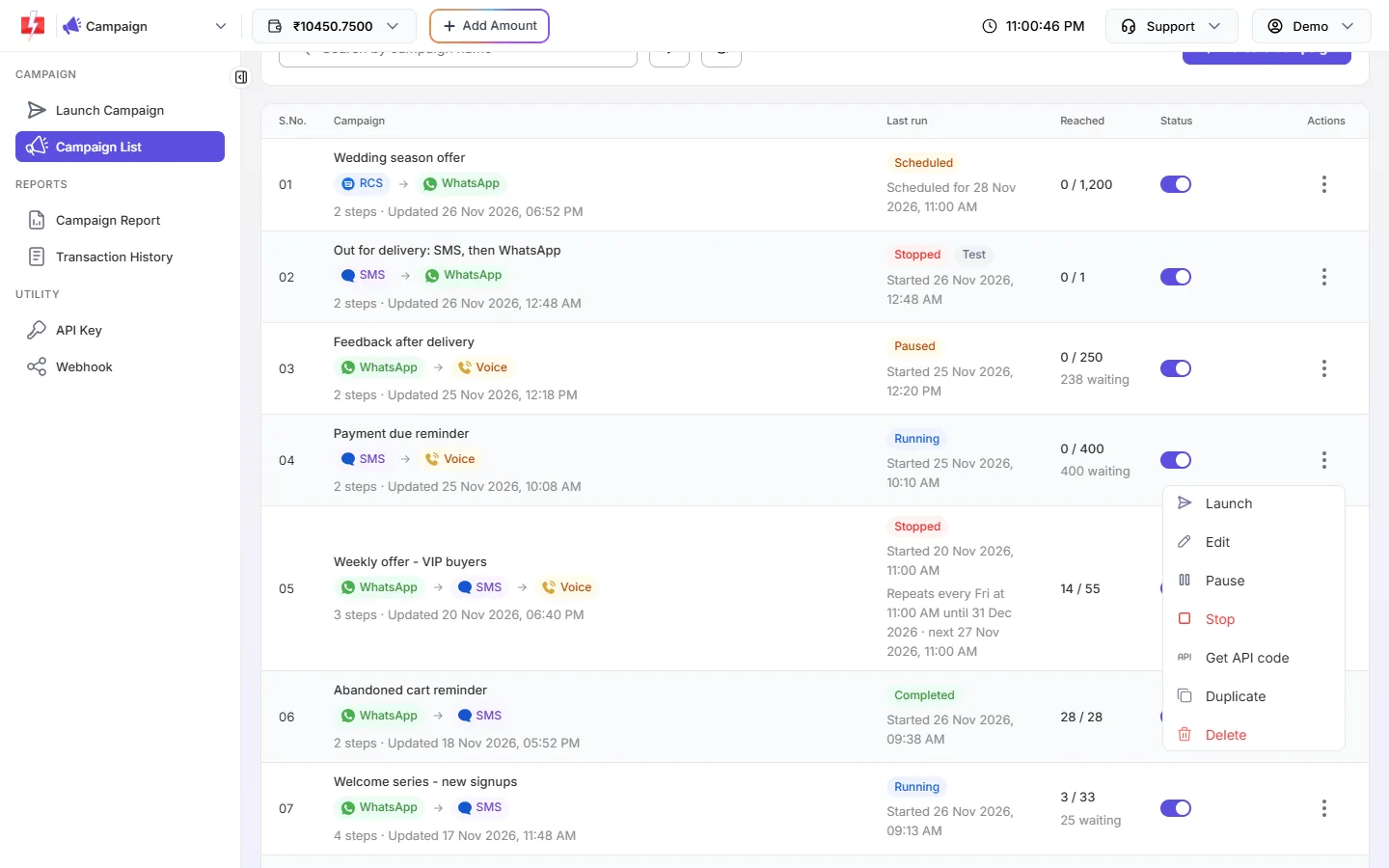
Instead of writing your own retry and fallback code, you build the journey once in the panel and start it for a customer from your software. On Fast2SMS the endpoint is POST https://www.fast2sms.com/dev/campaign/start. You pass the campaign ID (from Campaign List, the three-dot menu, "Get API code") and the customers. Each customer can carry variables such as a name, which fill the placeholders in your SMS and WhatsApp steps.
curl -X POST https://www.fast2sms.com/dev/campaign/start \
  -H "authorization: YOUR_API_KEY" \
  -H "Content-Type: application/json" \
  -d '{"campaign": "YOUR_CAMPAIGN_ID",
       "recipients": [{"mobile": "9000012345", "name": "Rahul"},
                      {"mobile": "9000067890", "name": "Priya"}]}'
The same call in Python:
import os, requests

resp = requests.post(
    "https://www.fast2sms.com/dev/campaign/start",
    headers={"authorization": os.environ["FAST2SMS_API_KEY"]},
    json={
        "campaign": "YOUR_CAMPAIGN_ID",
        "recipients": [{"mobile": "9000012345", "name": "Rahul"}],
    },
    timeout=15,
)
print(resp.status_code, resp.json())
Points worth knowing:
- Up to 1,000 numbers per call, and up to 50 variables per number.
- Numbers sent by API start the journey immediately. To schedule, use an Address Book group in the panel.
- Calls made on the same day for one campaign join one run named "<campaign> · API". A number already in today's run is skipped, so a double click on your side does not send twice.
- Rate limits per API key: 30 write calls a minute and 120 read calls a minute. Your IP whitelist and API on/off setting apply.
- "Get API code" shows ready code in cURL, PHP, Node.js and Python for that exact campaign.
You can also post an event for a contact, for example payment_received or clicked, to POST /dev/campaign/event with the number, event and value. A Condition step in the journey can branch on it: stop reminders once the customer has paid. Link clicks and custom events only exist when your software posts them; the platform does not track clicks by itself. Read, pause, resume and stop calls are available by API too. The developer walkthrough is in event-triggered messaging.
3. Webhooks: results pushed to your server
Every step result is sent to your URL as an event named campaign.step.<result>, with the step name, channel, status, reason, cost and the next step. Run status changes are sent too: scheduled, started, paused, paused_balance, resumed, stopped, finished and failed. Set this up under Webhook > Campaign in the panel or through the webhook API. With webhooks your CRM always knows whether a customer got the WhatsApp message, fell back to SMS, or answered the call.
How does one journey across four channels work?
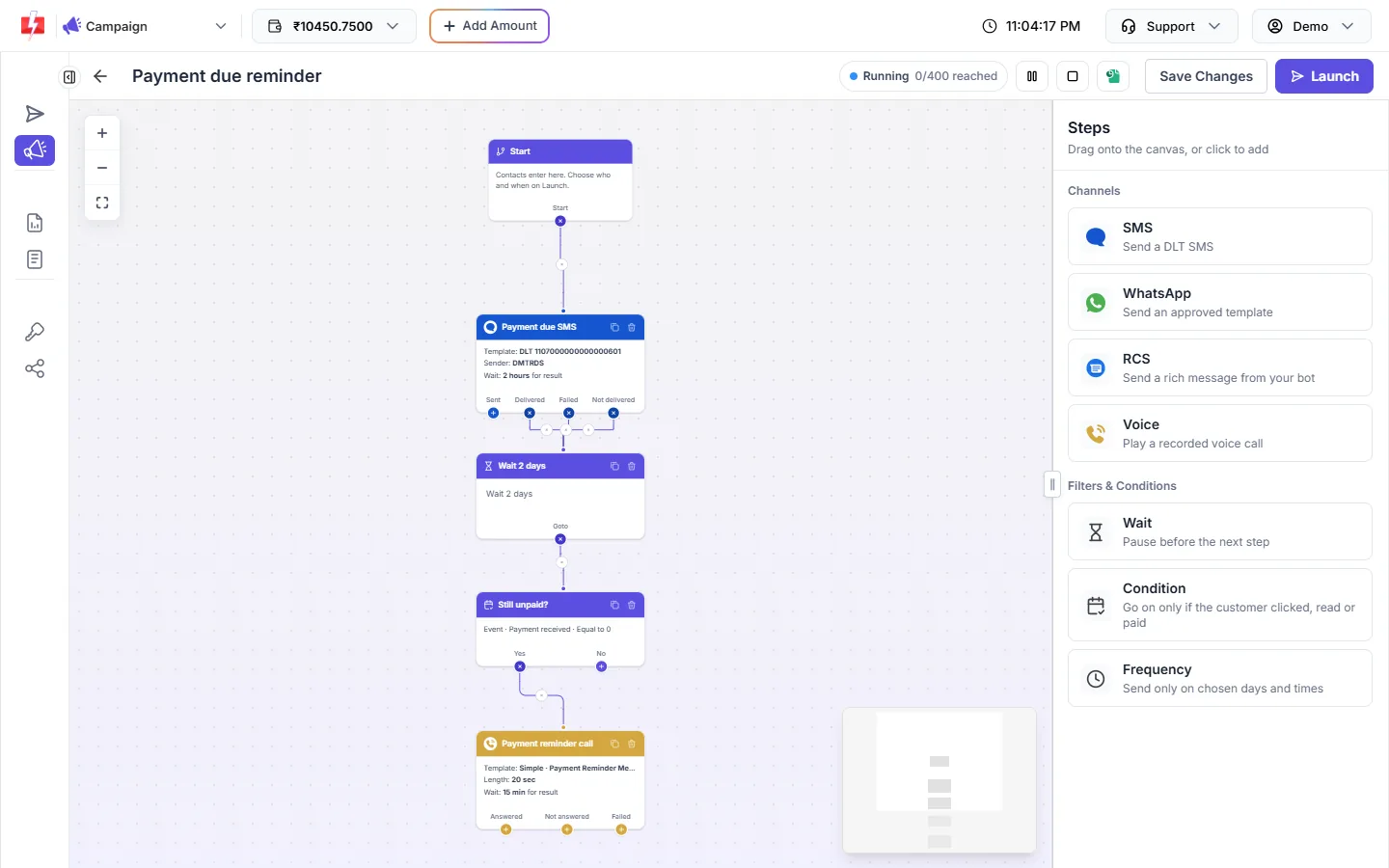
You draw the journey once: channel steps joined by their outputs, with Wait, Condition and Frequency steps in between. Each contact then moves through it on their own, based on what actually happened to their messages.
Here is a real-world service journey for a payment that is due today. Your billing software calls the start API in the morning for every customer with a due payment, and posts a payment_received event whenever someone pays.
| Step | When | Channel | Message | If it fails |
|---|---|---|---|---|
| 1 | As soon as your system calls the API | WhatsApp (utility template) | "Hi Rahul, ₹2,400 is due today for your Demo Traders account. Pay here: [button]" | Failed or not delivered after 30 minutes: go to step 2 |
| 2 | Right after step 1 fails | SMS (DLT template) | "Dear Rahul, Rs 2400 is due today. Pay at [link] - Demo Traders" | Not delivered after 120 minutes: go to step 4 |
| 3 | Wait 6 hours after a delivered message | Condition: event payment_received | No message. Yes: journey ends. No: go to step 4 | - |
| 4 | Frequency: weekdays, 10:00 to 19:00 | Voice call (simple message) | Recorded reminder: "This is Demo Traders. A payment on your account is due today. Please check your SMS or WhatsApp to pay." | Not answered: retries per your retry setting, then the journey ends |
The default wait for a final result is 120 minutes for SMS, 30 minutes for WhatsApp and RCS and 15 minutes for voice, and you can set it anywhere from 1 minute to 24 hours. A Wait step can pause from 1 minute up to 30 days. A journey can have up to 200 steps and 400 connections, lasts at most 30 days per contact, and each step runs once per contact. For more patterns see the WhatsApp to SMS fallback guide.
How much does CPaaS cost in India?
A pay-per-use CPaaS costs only the messages and calls you send. On Fast2SMS there is no platform fee, no journey builder fee and no monthly fee: each step is charged at that channel's normal rate from one wallet.
Worked example: 10,000 payment reminders
Take the journey above for 10,000 customers, with a ₹100 to ₹3,999 recharge slab for SMS. The delivery figures below are assumptions to show the maths, not promises. Prices are at the time of writing.
| Step | Contacts | Rate | Cost |
|---|---|---|---|
| WhatsApp utility reminder | 10,000 | ₹0.25 per message | ₹2,500 |
| SMS for the 1,500 not delivered on WhatsApp | 1,500 | ₹0.25 per SMS | ₹375 |
| Voice call to 2,000 unpaid or unreached customers, 1,200 answer, 30-second audio (2 pulses) | 2,000 dialled | ₹0.25 per pulse, answered only | ₹600 |
| Total | ₹3,475 |
That is about ₹0.35 per customer for three chances to reach each person. If the reminder were promotional, the WhatsApp step would use the marketing rate of ₹0.95, and an RCS rich card as the first step would cost from ₹0.35. On a larger recharge the SMS rate falls, down to ₹0.11 per SMS. 18% GST is added on recharges.
Other things to know about billing:
- The panel shows a cost estimate before launch, and refuses to launch if the wallet cannot cover the first step.
- If the balance runs low mid-run, the run pauses and resumes on its own after you recharge. It is stopped after 3 days on low balance.
- Refunds follow each channel's own rules: failed WhatsApp and RCS messages per that channel's policy, SMS only on accounts with "On Delivery" billing, and voice charges answered pulses only.
- Contacts still waiting when you stop a run are not charged.
- Test sends are charged like normal sends.
- SMS also needs DLT registration on an operator portal; the operator charges ₹5,900 a year including GST at the time of writing.
How to choose a CPaaS provider in India
Choose on Indian channel coverage, honest pricing, the quality of reports and webhooks, and how easily channels work together. Here is a neutral checklist you can use with any provider.
| Question to ask | Why it matters | Good answer |
|---|---|---|
| Do you support all four Indian channels: SMS, WhatsApp, RCS and voice? | Customers differ; one channel never reaches everyone | Yes, from one account and one wallet |
| Do you help with DLT entity, sender and template registration? | SMS will not deliver without matching DLT records | Yes, with clear steps and support |
| Is WhatsApp on the official Business API with Meta-approved templates? | Unofficial tools get numbers banned | Official API only |
| Is the price per message published, with no setup or monthly fee? | Hidden fees make cost per customer hard to plan | Public price list, pay as you go |
| Can one message fall back to another channel automatically? | Saves building your own retry code | Visual journey builder plus an API to start it |
| What statuses do reports and webhooks give? | You need to know delivered, read, failed and why | Per-number status, reason and cost, pushed by webhook |
| How are failed messages refunded? | Refund rules differ by channel | Written rules for each channel |
| Do you handle DND, opt-outs and blocked numbers? | Keeps you inside TRAI and Meta rules | Yes, numbers that opt out leave the journey |
| Can I test with free credit before paying? | Lets you check delivery on your own phone | Free signup credit |
| What are the API rate limits and security controls? | Affects how you design your integration | Published limits, IP whitelist, API on/off |
Also check support hours in Indian time, how fast DLT and WhatsApp onboarding questions are answered, and whether you can talk to a person before you commit. Large teams with special needs can read about the enterprise plan, and the reasons businesses pick Fast2SMS are on why Fast2SMS.
How to set it up in Fast2SMS
Set up each channel once, build a journey in Campaign, test it on up to 10 numbers, then send it from the panel or start it from your software.
- Create a free account at fast2sms.com. ₹50 credit is added for testing. Recharge from ₹100 when you are ready.
- Set up the channels you plan to use. SMS: an approved DLT sender and DLT templates. WhatsApp: your number on the Business API and approved templates. RCS: an approved, active RCS agent. Voice: voice enabled on your account and an approved MP3 or WAV file up to 5 MB.
- Open Campaign > Launch Campaign (or Campaign List > Create Campaign).
- Pick "Start from a ready journey" or start blank. There are 16 ready journeys across 7 goals, such as payment reminders, lead follow-up and feedback.
- Add channel steps (SMS, WhatsApp, RCS, Voice) and choose the sender and template in each.
- Wire the outputs. Each step has sent, delivered, failed and not delivered outputs; WhatsApp and RCS also have read; voice has answered, not answered and failed. Connect failed and not delivered to the next channel for fallback.
- Add Wait, Condition and Frequency steps. Wait pauses for minutes, hours or days. Condition checks a step result, a reply received on WhatsApp or RCS, or an event your system posted. Frequency keeps sending to chosen weekdays and hours (default 09:00 to 21:00).
- Choose the audience. Upload a CSV, TXT, XLSX or XLS file up to 20 MB and 10 lakh rows, pick an Address Book group or paste numbers. Map sheet columns to your SMS and WhatsApp placeholders; RCS uses the column name in braces in its text.
- Send test to up to 10 numbers and check every step on a real phone.
- Send now, Schedule (up to 90 days ahead) or Repeat (daily or chosen weekdays). You can also set limits per minute, hour or day.
- For API use, open Campaign List, the three-dot menu and "Get API code", and add webhook URLs under Webhook > Campaign.
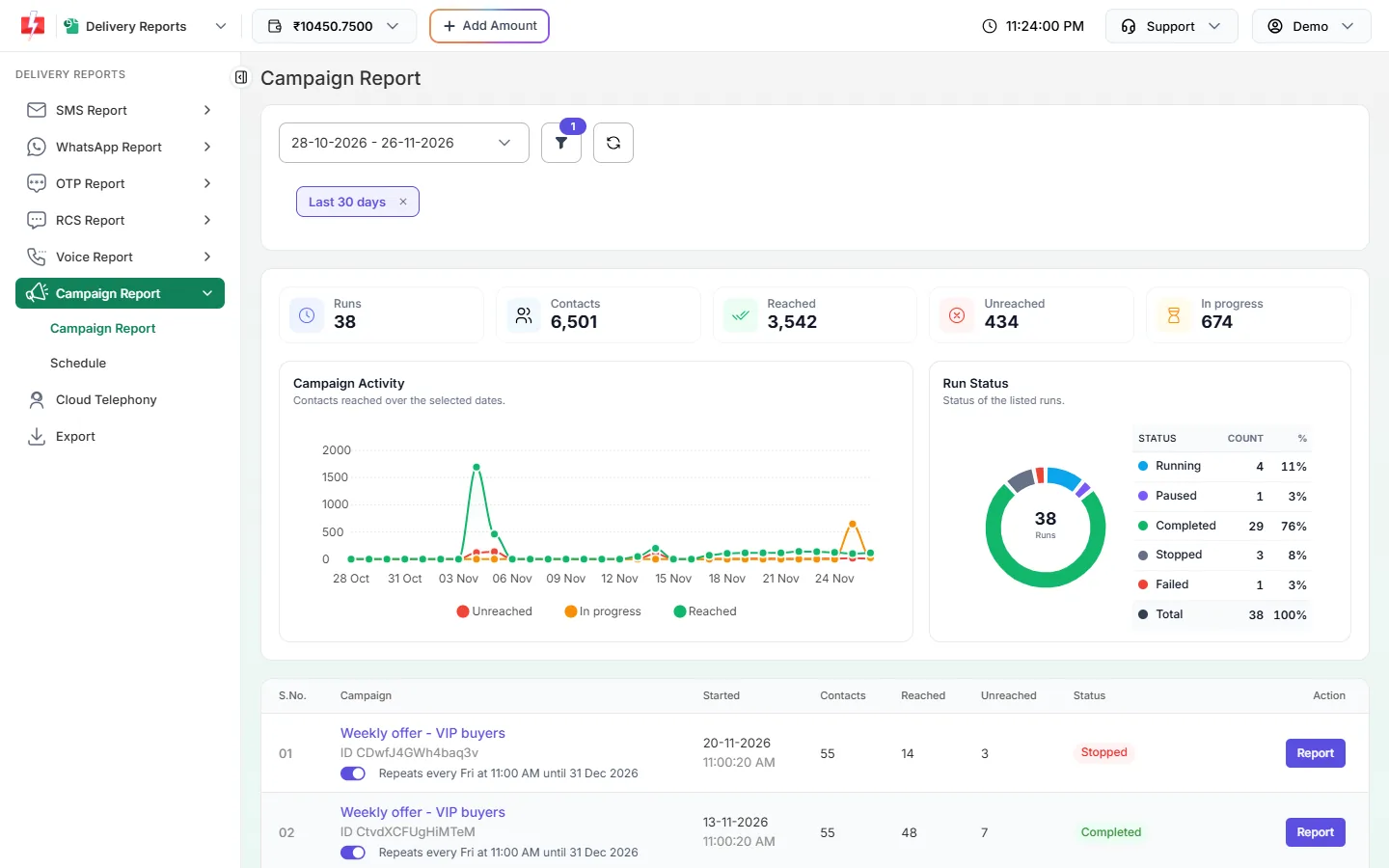
- Track results in Reports > Campaign Report: reached, unreached, cost, refund and each contact's full journey.
Runs can be paused, resumed, stopped or duplicated, and an account can hold up to 200 campaigns, with one open run per campaign at a time. A run sends up to 5,000 contacts per minute, so 1 lakh contacts start in about 20 minutes. Indian mobile numbers only; duplicates and invalid numbers are dropped and counted. See the multi-channel campaign builder for the full feature list.
CPaaS use cases by industry in India
Any business that needs to reach customers reliably on their phones can use a CPaaS. These are the most common journeys.
- E-commerce and D2C: order confirmation on WhatsApp with SMS fallback, shipping updates, and a feedback request after delivery. Your store backend calls the API; there is no ready plug-in trigger, so one API call from your order system starts it.
- Lending and NBFCs: EMI reminders on WhatsApp with a pay link, then SMS, then a voice call, with a payment_received event to stop the sequence.
- Education and coaching: instant reply to an admission enquiry, then a call patch to a counsellor when the student presses a key.
- Healthcare: appointment reminders the day before, a short call on the day for patients who do not read messages.
- Real estate: site visit invites on WhatsApp and RCS cards, reminders, and follow-ups over the next weeks.
- Events and webinars: WhatsApp invite, SMS if it is not delivered, and a reminder call on the day.
- SaaS and apps: a welcome message on signup, an offer a few hours later, and a reminder the next day, all started by one API call.
For the marketing side of these flows, read marketing automation in India, and for the full picture of one platform across every channel, the omnichannel marketing platform guide.
Mistakes to avoid when using a CPaaS
- Relying on one channel. WhatsApp marketing messages can be capped by Meta, RCS needs a supported phone, and SMS can land in a filtered inbox. Add a fallback step.
- Building your own retry logic. It is easy to get wrong and send twice. Use a journey with failed and not delivered outputs instead.
- Mismatched DLT templates. If your SMS text does not match the registered template, or a variable is longer than 30 characters, the SMS is rejected.
- Putting personal details in voice. The audio is the same for everyone. Keep names and amounts in SMS and WhatsApp.
- Ignoring webhooks. Without them your CRM does not know who was reached. Store step results against each customer.
- Expecting click tracking for free. Clicks and custom events only reach a Condition step if your software posts them to the event API.
- Marketing on the utility category. Offers belong in marketing templates; Meta can reject or recategorise templates that mix the two.
- Calling at bad hours. Use a Frequency step so calls and messages go out only on the days and times you choose.
- Skipping the test send. Test on up to 10 numbers first. Test sends are charged, but a broken template sent to 1 lakh people costs far more.
- Forgetting the wallet. A run pauses on low balance. Keep enough credit for every step, not just the first.
Frequently asked questions
What is the full form of CPaaS?
CPaaS stands for Communication Platform as a Service. It is a cloud platform that lets businesses send SMS, WhatsApp, RCS messages and voice calls through APIs and a web panel.
What is the meaning of CPaaS?
CPaaS means renting a ready-made messaging and calling platform by usage instead of building telecom connections yourself. You get an account, an API key and a wallet, and pay per message or per call.
What is CPaaS in simple words?
It is one online service that sends your business messages and calls to customers. Your website, app or team tells it what to send, and it delivers the message and reports back what happened.
What is CPaaS in Hindi?
CPaaS ka matlab hai Communication Platform as a Service: ek cloud platform jo SMS, WhatsApp, RCS aur voice call ko API ya panel se bhejne deta hai, aur aap har message ke hisaab se pay karte hain.
What does a CPaaS platform do?
It delivers messages and calls on several channels, checks each channel's rules, gives per-number delivery reports, pushes results to your server by webhook and, on journey-based platforms, moves a customer to the next channel when a message fails.
Is CPaaS the same as an SMS gateway?
No. An SMS gateway sends SMS only. A CPaaS covers several channels, such as SMS, WhatsApp, RCS and voice, with shared reports, webhooks and contacts.
What is the difference between CPaaS and UCaaS?
CPaaS sends messages and calls from your software to customers. UCaaS, Unified Communications as a Service, is for your own staff: office phones, video meetings and team chat.
What is the difference between CPaaS and CCaaS?
CCaaS, Contact Centre as a Service, runs agent calls, queues and IVR for support and sales teams. CPaaS is the messaging and automated calling layer. Fast2SMS offers both bulk channels and cloud numbers with IVR.
Is CPaaS the same as an omnichannel platform?
They overlap. A CPaaS gives you the channels; an omnichannel platform connects them into one customer journey. Fast2SMS does both through its Campaign journey builder. See the omnichannel marketing platform guide.
Who uses CPaaS in India?
E-commerce stores, lenders and NBFCs, schools and coaching institutes, clinics, real estate firms, event organisers, SaaS products and any business that sends OTPs, alerts, reminders or offers to customers' phones.
Which channels does a CPaaS in India support?
The four that matter in India are SMS, WhatsApp Business API, RCS and voice calls (OBD). Fast2SMS supports all four from one account and wallet.
Is email part of the Fast2SMS CPaaS?
No. Fast2SMS covers SMS, WhatsApp, RCS and voice calls. Email is not one of its channels.
Do I need DLT registration to send SMS through a CPaaS?
Yes. Business SMS in India needs a DLT entity, an approved sender ID and approved templates. On Fast2SMS each SMS step uses an approved DLT sender with a DLT template linked to it.
What is the DLT registration fee?
DLT registration is done on a telecom operator portal. At the time of writing the operator charges ₹5,900 a year including GST for entity registration.
Why is my SMS variable rejected?
On Fast2SMS a DLT variable value longer than 30 characters is rejected for that number, and the text must match your registered template. Shorten the value or change the template.
Do I need the official WhatsApp Business API?
Yes, for bulk and automated messages. Business-started messages must use Meta-approved templates in the marketing, utility, authentication or service category. Unofficial tools risk getting your number banned.
Why are some WhatsApp marketing messages not delivered?
Meta limits how many marketing messages one person receives, so some messages are not delivered even to valid numbers. Add an SMS or RCS step on the failed or not delivered output. See the SMS fallback guide.
What do I need to send RCS messages?
An approved, active RCS agent (bot) that shows your brand name and logo. You can then send plain text, rich cards, media, carousels and suggestion buttons.
Do RCS messages need template approval?
There is no separate per-template approval on Fast2SMS. What you need is an approved, active RCS agent. Message content still goes through the scam-content check.
What happens if the customer phone does not support RCS?
If RCS fails or the phone does not support RCS, the next step in your journey sends, for example WhatsApp or SMS.
What types of voice calls can a CPaaS send?
On Fast2SMS: a simple recorded message, a DTMF call where the customer presses a key, and a call patch that connects the customer to an agent group on a key press. You can set retries and a retry interval.
Can a voice call read out the customer name or amount?
No. Voice steps play the same recorded audio to everyone. Put names, amounts and links in the SMS or WhatsApp steps.
Which audio files can I use for voice calls?
An approved MP3 or WAV file up to 5 MB. Voice must also be enabled on your account.
Which channel reaches the most people in India?
SMS and voice reach every mobile, including feature phones. WhatsApp reaches people who use WhatsApp and RCS reaches Android phones with RCS on. A journey that combines them reaches the most. Compare them in SMS vs WhatsApp vs RCS.
What is a CPaaS API?
It is the set of web requests your software uses to send messages, start journeys and read results. Fast2SMS documents its APIs at docs.fast2sms.com.
How do I start a multi-channel journey from my software?
Send POST https://www.fast2sms.com/dev/campaign/start with the header authorization set to your API key, and a JSON body with the campaign ID and recipients, for example {"campaign": "YOUR_CAMPAIGN_ID", "recipients": [{"mobile": "9000012345", "name": "Rahul"}]}.
Where do I find the campaign ID for the API?
In Campaign List, open the three-dot menu on your campaign and choose "Get API code". It shows the ID and ready code in cURL, PHP, Node.js and Python.
How many numbers can I send in one API call?
Up to 1,000 numbers per call, with up to 50 variables per number.
Can I schedule a journey started by API?
Numbers sent by API start immediately. To schedule, use an Address Book group in the panel and pick Schedule or Repeat.
What if my system calls the start API twice for the same number?
Same-day calls for one campaign join one run named "campaign · API", and a number already in that day's run is skipped, so it is not sent twice.
What are the API rate limits?
Per API key: 30 write calls a minute and 120 read calls a minute. Your IP whitelist and API on/off setting also apply.
Can my CRM tell the journey that a customer has paid?
Yes. Post an event such as payment_received to POST /dev/campaign/event with the number, event and value. A Condition step can then end the journey for that customer.
Does the CPaaS track link clicks automatically?
No. Link clicks and custom events reach a Condition step only when your software posts them to the event API.
Can the journey branch on an SMS reply or a specific button?
No. A Condition step can check "Reply received" on WhatsApp or RCS, step results, link clicks you post, or your own events. SMS replies and specific button choices are not branch options.
Which webhooks does Fast2SMS send for campaigns?
Every step result as campaign.step.<result>, with step name, channel, status, reason, cost and next step, plus run status changes: scheduled, started, paused, paused_balance, resumed, stopped, finished and failed.
Where do I set up campaign webhooks?
In the panel under Webhook > Campaign, or through the webhook API.
Can I pause or stop a journey by API?
Yes. You can read runs, reports, numbers and a contact's journey, and pause, resume or stop a run by API.
Can I trigger a journey from Shopify or WooCommerce directly?
There is no native store trigger. Trigger it from your website, app, CRM or store backend with one API call. The developer guide is event-triggered messaging.
What steps can a journey have?
Channel steps for SMS, WhatsApp, RCS and Voice, plus Wait, Condition and Frequency steps.
How does fallback work in a CPaaS journey?
You connect a step's failed or not delivered output to another channel, for example WhatsApp to SMS, or SMS to a voice call. Each step waits for a final result before taking the not delivered path.
How long does a step wait before it counts as not delivered?
By default 120 minutes for SMS, 30 minutes for WhatsApp and RCS and 15 minutes for voice. You can set any time from 1 minute to 24 hours.
How long can a Wait step be?
From 1 minute up to 30 days, in minutes, hours or days. Presets include 10 minutes, 30 minutes, 1 hour, 1 day and 3 days.
What does the Frequency step do?
It lets the journey continue only on chosen weekdays between set times, by default 09:00 to 21:00, with presets for every day, weekdays or weekends.
Are there ready-made journeys?
Yes. "Start from a ready journey" offers 16 journeys across 7 goals: promotional, transactional, lead follow-up, payment reminder, event, re-engagement and feedback.
What are the journey limits?
Up to 200 steps and 400 connections per journey. A journey lasts at most 30 days per contact, and each step runs once per contact.
How fast does a campaign send?
Up to 5,000 contacts per minute per run, so 1 lakh contacts start in about 20 minutes. You can also set your own limits per minute, hour or day.
Can I send to international numbers?
No. Campaign journeys are for Indian mobile numbers only: 10 digits starting with 6 to 9. Duplicates and invalid numbers are dropped and counted.
How much does CPaaS cost in India?
On a pay-per-use CPaaS you pay only for messages and calls. At the time of writing Fast2SMS charges ₹0.25 to ₹0.11 per SMS, ₹0.95 per WhatsApp marketing message, ₹0.25 utility, ₹0.25 authentication, ₹0.13 service, from ₹0.35 per RCS message and ₹0.25 per 15-second answered voice pulse.
Is there a monthly fee or platform fee?
No. There is no campaign fee, no builder fee and no monthly fee. Each step is charged at that channel's normal rate from the same wallet.
Do I pay for unanswered voice calls?
No. Voice is charged per 15-second pulse for answered calls only.
What happens if my wallet runs out during a campaign?
The run pauses and resumes on its own after you recharge. It checks every 10 minutes and is stopped after 3 days on low balance. A launch is refused if the wallet cannot cover the first step.
Are failed messages refunded?
Refunds follow each channel's rules: failed WhatsApp and RCS messages per that channel's policy, SMS only on "On Delivery" billing accounts, and voice charges answered pulses only. Contacts still waiting when you stop a run are not charged.
Are test sends free?
No. Test sends to up to 10 numbers are charged like normal sends. New accounts get ₹50 free credit, which covers testing.
Is GST added?
Yes, 18% GST is added on recharges, and a GST invoice is available in Transaction History.
What is the minimum recharge?
You can recharge from ₹100. See SMS pricing, WhatsApp pricing and RCS pricing for current rates.
How do I choose a CPaaS provider in India?
Check that it supports SMS with DLT, the official WhatsApp Business API, RCS and voice; publishes per-message prices with no hidden fees; offers fallback journeys, per-number reports and webhooks; states its refund rules per channel; and lets you test with free credit.
What questions should I ask a CPaaS provider?
Ask about DLT help, WhatsApp onboarding, RCS agent setup, prices per channel, refund rules, API rate limits, IP whitelisting, webhook statuses, DND and opt-out handling, and support hours in Indian time.
How do I build my first journey on Fast2SMS?
Go to Campaign > Launch Campaign, pick "Start from a ready journey" or start blank, add channel steps, wire failed and not delivered outputs, add Wait, Condition or Frequency steps, choose the audience, send a test, then Send now, Schedule or Repeat.
Which files can I upload as an audience?
CSV, TXT, XLSX or XLS files up to 20 MB and up to 10 lakh rows. You can also pick an Address Book group or paste numbers. Sheet columns become variables.
How far ahead can I schedule a campaign?
Up to 90 days ahead. You can also repeat a campaign daily or on chosen weekdays at a set time.
Where do I see campaign results?
In Reports > Campaign Report: total, reached, unreached, opted out, cost, refund and net cost, each step's counts and failure reasons, and each contact's full journey. It refreshes every 15 seconds while running and exports to CSV.
Does the CPaaS handle opt-outs and DND?
DND is handled for SMS and voice. Numbers blocked on WhatsApp, unsubscribed on RCS or on the voice opt-out list leave the journey. There is no automatic STOP keyword handling, so manage SMS opt-outs in your own list.
Is there an enterprise option?
Yes. Large teams can read about the enterprise plan or book a free meeting at fast2sms.com/meet.