Omnichannel vs Multichannel Marketing: The Difference, With an Indian Example
No monthly fee · Pay as you go from ₹100 · Free setup help on a call
Multichannel marketing means you use several channels, such as SMS, WhatsApp, RCS and voice calls, but each one runs on its own. Omnichannel marketing links those channels into one journey, so the next message depends on what happened to the last one. On Fast2SMS you build that journey in Campaign with no campaign fee: every step costs that channel's normal rate, for example ₹0.25 per SMS and ₹0.95 per WhatsApp marketing message at the time of writing.
This guide explains the difference between multichannel, cross-channel and omnichannel marketing with one Indian example (a Diwali offer sent on WhatsApp and SMS), shows the timing and the cost of both approaches, and tells you how to set up the omnichannel version in the Fast2SMS panel.
What is the difference between omnichannel and multichannel marketing?
The difference is whether your channels know about each other. In multichannel marketing each channel sends its own message to its own list. In omnichannel marketing the channels share one customer journey, and each step reacts to the result of the step before it.
Think of a shop with three salespeople. In a multichannel shop, all three walk up to the same customer and say the same thing. In an omnichannel shop, the first salesperson talks to the customer, and the second one only steps in if the first could not reach them. The customer hears the message once, on the channel that worked.
A third term, cross-channel marketing, sits in between. The table puts all three side by side.
| Multichannel | Cross-channel | Omnichannel | |
|---|---|---|---|
| Simple meaning | Many channels, each used separately | Channels connected for one campaign | One journey per customer across all channels |
| Who decides the next message | You, by hand, channel by channel | A fixed plan made for that campaign | The result of the last step (delivered, read, failed, answered, replied) |
| Lists | One list per channel, often uploaded again | Usually one list, sent in a set order | One list; each contact moves on their own path |
| Duplicate messages | Common: the same offer on SMS and WhatsApp | Fewer | Rare: the next channel goes only where needed |
| Reports | Separate report for each channel | Partly joined | One report per run, per step and per contact |
| Cost control | You pay for every channel for every contact | Better | You pay for the backup channel only for contacts who need it |
| Indian example | WhatsApp blast at 11 am, SMS blast at 11 am, same list | SMS with a link that opens a WhatsApp chat | WhatsApp first, SMS only if WhatsApp is not delivered, RCS reminder next day only if not read |
In everyday use, many people say "cross-channel" and "omnichannel" for the same thing. What matters is the idea underneath: one connected journey instead of separate blasts. The full picture of what an omnichannel set-up needs, channel by channel, is in our pillar guide to the omnichannel marketing platform in India. This page stays on the comparison.
What does multichannel marketing mean?
Multichannel marketing means reaching customers on more than one channel, with each channel planned and sent separately. It is how most Indian businesses start, and there is nothing wrong with it.
A typical multichannel week for a retail store looks like this. On Monday the owner sends a bulk SMS about a sale from the SMS panel. On Tuesday someone in the team sends the same offer as a WhatsApp broadcast from a different screen, to a list exported from the billing software. On Thursday a voice call goes to older customers who do not read messages. Each channel has its own report, its own list and its own wallet entry.
The good parts:
- Easy to start. You only need one channel working to begin, and you add the next one when you are ready.
- More reach than one channel. Some customers read SMS, some live on WhatsApp, some only pick up calls.
- Simple to explain to the team. One person handles SMS, another handles WhatsApp.
The problems show up as you grow:
- The same customer gets the same message two or three times. It looks careless and can push people to block you.
- You pay twice. A customer who already read the offer on WhatsApp still gets an SMS you paid for.
- Gaps go unnoticed. A customer whose WhatsApp message failed does not get a backup unless someone checks the report and sends it by hand.
- No single view. To know what one customer received, you open three reports.
What is cross-channel marketing?
Cross-channel marketing means channels hand over to each other inside one campaign. The customer may start on one channel and finish on another, but the plan is usually fixed in advance for everyone.
Common Indian examples are an SMS with a link that opens a WhatsApp chat, a missed-call number printed on a newspaper ad that triggers an SMS, or a voice call that says "check your WhatsApp for the payment link". These connect channels, which is a big step up from separate blasts. But the order is the same for every customer, whether or not the first message reached them.
Omnichannel goes one step further: each contact takes a different path depending on what happened to them. That is the part that saves money and avoids duplicates.
What does omnichannel marketing mean?
Omnichannel marketing means every channel works as part of one journey for each customer, and the journey adapts to what the customer did. In a wider sense it covers your shop, website, app and call centre too. For messaging, it means SMS, WhatsApp, RCS and voice calls joined in one flow.
In practice an omnichannel messaging journey answers four questions for every contact:
- Which channel first? Usually the richest or cheapest one the customer is likely to see.
- What if it fails? Wire the failed or not-delivered result to the next channel. This is called fallback, explained fully in our WhatsApp to SMS fallback guide.
- When should the next message go? Add a wait (10 minutes, 6 hours, 3 days) and allowed hours.
- Should it go at all? Check a result first: was the message read, did the customer reply, did your system report a payment?
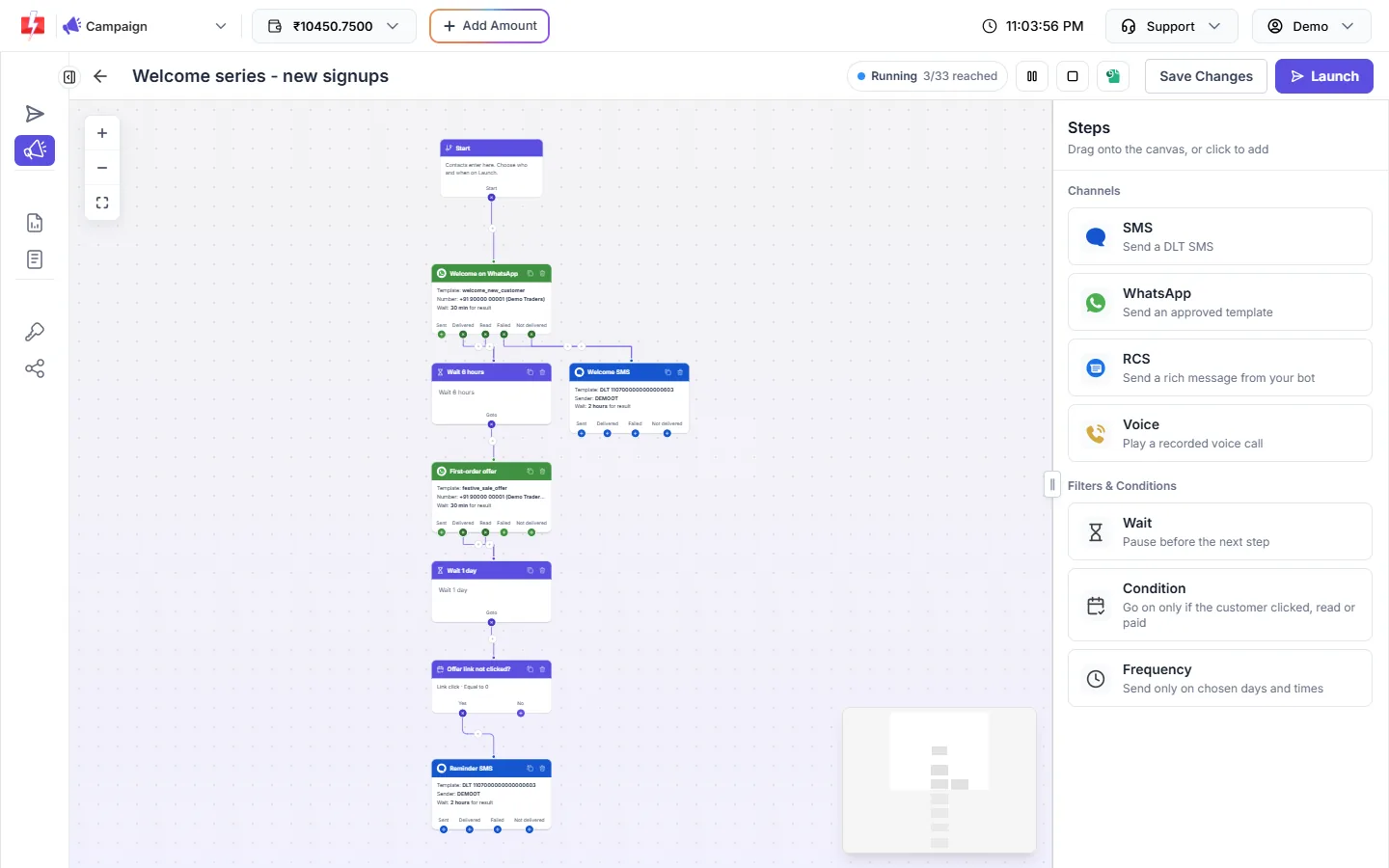
Fast2SMS Campaign, the multi-channel journey builder, does exactly this on one canvas with four channel steps (SMS, WhatsApp, RCS, Voice) and three control steps (Wait, Condition, Frequency).
An Indian example: one Diwali offer, two ways
Here is the same offer sent both ways, so you can see the difference in practice. Demo Traders, a store in Pune, has 10,000 customers who agreed to receive offers. It wants to announce a Diwali sale with 20% off till Sunday.
The multichannel way
- 11:00 am: a WhatsApp marketing template with a banner and a Shop now button goes to all 10,000 numbers.
- 11:00 am: a promotional SMS with the same offer goes to the same 10,000 numbers from the SMS panel.
- Next day: an RCS rich card reminder goes to all 10,000 again.
Result: a customer with WhatsApp who read the offer at 11:05 also gets an SMS at 11:00 and an RCS card the next day. Demo Traders pays three times for that one customer. A customer whose WhatsApp failed still gets the SMS, but only by luck, because the SMS went to everyone.
The omnichannel way
- 11:00 am: the WhatsApp offer goes to all 10,000.
- If WhatsApp fails or is not delivered within 30 minutes: that contact gets the SMS offer instead. Everyone else gets nothing extra.
- Next day: the journey checks whether the WhatsApp offer was read. Only those who did not read it get an RCS reminder card.
- If RCS fails or the phone does not support RCS: a short SMS reminder goes instead.
Result: each customer hears about the sale on one channel, plus one reminder only if they missed it. Demo Traders pays for the backup channel only where it was needed. Both versions use the same four channels. The difference is the wiring between them.
What does the omnichannel journey look like, step by step?
The omnichannel version is five steps with one wait and one check. Here is the timing as Demo Traders would set it up in Campaign.
| Step | When | Channel | Message | If it fails |
|---|---|---|---|---|
| 1 | Day 0, 11:00 am (scheduled) | WhatsApp, marketing template | Diwali banner, "20% off till Sunday", Shop now button | Failed, or not delivered within 30 minutes: go to step 2 |
| 2 | Day 0, around 11:30 am | SMS, DLT promotional template | Short offer text with your store link | Failed: the contact leaves the journey |
| 3 | Day 1 (Wait 1 day after step 1 is delivered) | Condition | Was the WhatsApp offer read? | Yes: stop, no reminder. No: go to step 4 |
| 4 | Day 1, inside 10 am to 8 pm (Frequency step) | RCS rich card | "Sale ends Sunday" card with a Shop now button | Fails or phone has no RCS: go to step 5 |
| 5 | Day 1, right after step 4 fails | SMS | One-line last reminder with the link | Failed: the contact leaves the journey |
Each channel step waits for a final result before it takes the "not delivered" path. The defaults are 30 minutes for WhatsApp and RCS, 120 minutes for SMS and 15 minutes for a voice call, and you can set any time from 1 minute to 24 hours. The Wait step can be anything from 1 minute up to 30 days. The Frequency step lets the journey continue only on chosen weekdays and between set times (09:00 to 21:00 by default).
If your store software can tell Fast2SMS when someone buys, it can post a "purchased" event for that number through the event API, and step 3 can check "Your event" instead of "read". Then buyers never get a reminder. Without that event, Fast2SMS does not track link clicks or purchases on its own.
Which costs more in India: multichannel or omnichannel?
Omnichannel usually costs less for the same reach, because the backup channel is paid only for contacts who need it. Fast2SMS charges no campaign fee, builder fee or monthly fee. Every step costs that channel's normal per-message rate from the same wallet.
The prices below are the ones listed on the Fast2SMS pricing pages at the time of writing:
| Channel | Price at the time of writing | Pricing page |
|---|---|---|
| SMS (DLT) | ₹0.25 per SMS from a ₹100 recharge, down to ₹0.11 per SMS on bigger slabs | Bulk SMS pricing |
| ₹0.95 marketing, ₹0.25 utility, ₹0.25 authentication, ₹0.13 service reply | WhatsApp pricing | |
| RCS | From ₹0.35 per message, same price for text, media and rich card | RCS pricing |
| Voice call | ₹0.25 per 15-second pulse, answered calls only | Bulk voice call |
Worked example: 10,000 customers
Take the Demo Traders offer. To keep the maths simple, assume 8,000 WhatsApp messages are delivered and 2,000 fail or are not delivered, 5,000 of the delivered offers are not read by the next day, and 3,000 of those 5,000 receive the RCS card while 2,000 fail on RCS. SMS is priced at the ₹0.25 starting rate; a bigger recharge lowers it.
| Item | Multichannel (everyone, every channel) | Omnichannel (one journey) |
|---|---|---|
| WhatsApp offer at ₹0.95 | 10,000 × ₹0.95 = ₹9,500 | 10,000 × ₹0.95 = ₹9,500 |
| SMS offer at ₹0.25 | 10,000 × ₹0.25 = ₹2,500 | 2,000 × ₹0.25 = ₹500 (only not delivered) |
| RCS reminder at ₹0.35 | 10,000 × ₹0.35 = ₹3,500 | 5,000 × ₹0.35 = ₹1,750 (only unread) |
| SMS reminder at ₹0.25 | Not sent | 2,000 × ₹0.25 = ₹500 (only where RCS failed) |
| Total before refunds | ₹15,500 | ₹12,250 |
| Messages per customer | 3 for everyone | 1 to 3, based on need |
The omnichannel journey saves ₹3,250 here, about 21%, and nobody who read the offer gets two more copies of it. Refunds follow each channel's own rules: failed WhatsApp and RCS messages are refunded under that channel's policy, SMS refunds apply only on accounts billed "On Delivery", and voice charges only answered pulses. The example leaves refunds out, so your real bill can be lower.
Before you launch, Campaign shows a cost estimate. If the wallet cannot cover the first step, the launch is refused. If the balance runs low mid-run, the run pauses and resumes on its own after you recharge (it checks every 10 minutes); after 3 days on low balance it stops. Contacts still waiting when you stop a run are not charged.
Plan your own numbers with the SMS vs WhatsApp vs RCS comparison, which compares price, reach and rich media for all four channels.
Copy-ready messages for the Diwali example
Use these as a starting point. The WhatsApp text must be approved by Meta as a marketing template, and the SMS text must be registered as a DLT promotional template linked to your sender before you can send it.
| Step | Channel | Message |
|---|---|---|
| 1 | WhatsApp (marketing, image header, button) | Hi {{1}}, Diwali is here! Get 20% off on everything at Demo Traders till Sunday. Tap Shop now to see the offers. |
| 2 | SMS (DLT promotional) | Diwali Sale at Demo Traders: 20% off till Sunday. Shop now: {#var#} - Demo Traders |
| 4 | RCS rich card | Title: "Sale ends Sunday". Text: "{{name}}, your 20% Diwali discount is waiting." Button: Shop now |
| 5 | SMS (DLT promotional) | Last 2 days: 20% off at Demo Traders ends Sunday. Visit {#var#} - Demo Traders |
Map the WhatsApp placeholder to the name column of your sheet (or to fixed text such as "there"). In RCS, the column name goes straight into the text. Keep any DLT variable within 30 characters, because longer values are rejected for that number. Numbers that have blocked you on WhatsApp, unsubscribed on RCS or are on the voice opt-out list leave the journey on their own. For more ready festive sequences, see the festival marketing campaigns guide.
Which one should your business choose?
If you send one message a month on one channel, multichannel is fine. If you send on two or more channels to the same customers, omnichannel almost always wins on cost and on how your brand looks to the customer.
| Your situation | Good fit | Why |
|---|---|---|
| Only SMS, a few campaigns a month | Multichannel or single channel | Nothing to connect yet; send from the bulk SMS panel |
| Different lists for different channels (for example, WhatsApp only for opted-in buyers) | Multichannel | The audiences do not overlap, so duplicates are not a problem |
| Same customers on SMS and WhatsApp | Omnichannel | WhatsApp first and SMS only if not delivered avoids paying twice |
| Payments, EMIs, fees or appointments where every contact must be reached | Omnichannel | SMS, WhatsApp and a voice call in order until something lands |
| Leads from ads or your website | Omnichannel | WhatsApp first, call if no reply, SMS last, with no manual follow-up |
| Big sales and launches | Omnichannel | Rich RCS or WhatsApp first, SMS for the rest, reminders only for those who missed it |
Moving from multichannel to omnichannel does not mean throwing away what you have. The same DLT templates, WhatsApp templates, RCS bot and voice files you already use become steps in a journey. If you are new to automation in general, start with our marketing automation guide for small businesses.
More omnichannel marketing examples in India
Omnichannel is not only for festive offers. Fast2SMS Campaign comes with 16 ready-made journeys across 7 goals, and each one is a real omnichannel pattern you can start from. A few that Indian businesses use most:
- Payment reminder: SMS first, then WhatsApp, then a voice call. A school, a gym or a distributor reaches every customer without three separate blasts. If your billing software posts a "payment_received" event, the Condition step stops the reminders for people who have paid.
- EMI due: WhatsApp with a pay link, then SMS, then a call. Lenders use this for borrowers who miss the first message.
- Service updates: WhatsApp update, SMS in 5 minutes if it fails. Good for order, delivery and appointment updates where speed matters.
- Lead follow-up: WhatsApp first; if there is no reply, a call, then an SMS. The Condition step can check "Reply received" on WhatsApp.
- Event or webinar: WhatsApp invite, SMS if not delivered, and a reminder call on the day.
- Re-engagement: win back old customers with an RCS card first, then WhatsApp, then SMS.
- Feedback: a feedback call with "press a key" options, and WhatsApp if the call is not answered.
For timed sequences over several days, such as a welcome series or a course reminder, see our WhatsApp drip campaign guide. For every journey type with its own guide, go to the "Guides for every journey" list in the omnichannel marketing platform guide.
What do you need before you go omnichannel?
You need each channel you plan to use to be ready on its own first. A journey cannot send on a channel that is not set up.
| Channel | What must be ready | Personalisation |
|---|---|---|
| SMS | An approved DLT sender and an approved DLT template linked to it | Template variables mapped to a column or fixed text (30 characters max per variable) |
| A connected WhatsApp Business API number and approved Meta templates (text, image, video or document header, buttons) | Placeholders mapped to a column or fixed text | |
| RCS | An approved, active RCS bot (agent). Message types: plain text, rich card, media, carousel and suggestion buttons | Column names written into the text |
| Voice call | Voice enabled on your account and an approved voice file (MP3 or WAV up to 5 MB) | None: the same recording plays for everyone |
You also need a list. Campaign takes a CSV, TXT, XLSX or XLS file up to 20 MB and up to 10 lakh rows, an Address Book group, or a pasted list of numbers. Only Indian mobile numbers are accepted (10 digits starting with 6 to 9; a 91 or 0 prefix is removed). Duplicates and invalid numbers are dropped and counted, so you see how many were removed.
Rules still apply inside a journey. SMS needs DLT, WhatsApp needs approved templates, text on SMS, WhatsApp and RCS goes through a scam-content check, and DND rules apply to SMS and voice. Promotional SMS is held outside the promotional window where that rule applies, and promotional RCS bots send between 7 am and 10 pm. There is no single sending window for every channel, which is why the Frequency step is useful.
How to set it up in Fast2SMS
Once your channels are ready, the Diwali journey above takes a few steps to build. This is how it works in the panel.
- Sign up or log in. New accounts get ₹50 free credit. Recharge from ₹100 when you are ready; there is no setup or monthly fee.
- Get your channels ready. A DLT sender and template for SMS, a WhatsApp number with an approved marketing template, an active RCS bot, and voice enabled if you plan to call.
- Open Campaign. In the panel header open the "Campaign" app (Automated Journeys), then go to Campaign > Launch Campaign. You can also start from Campaign List > Create Campaign.
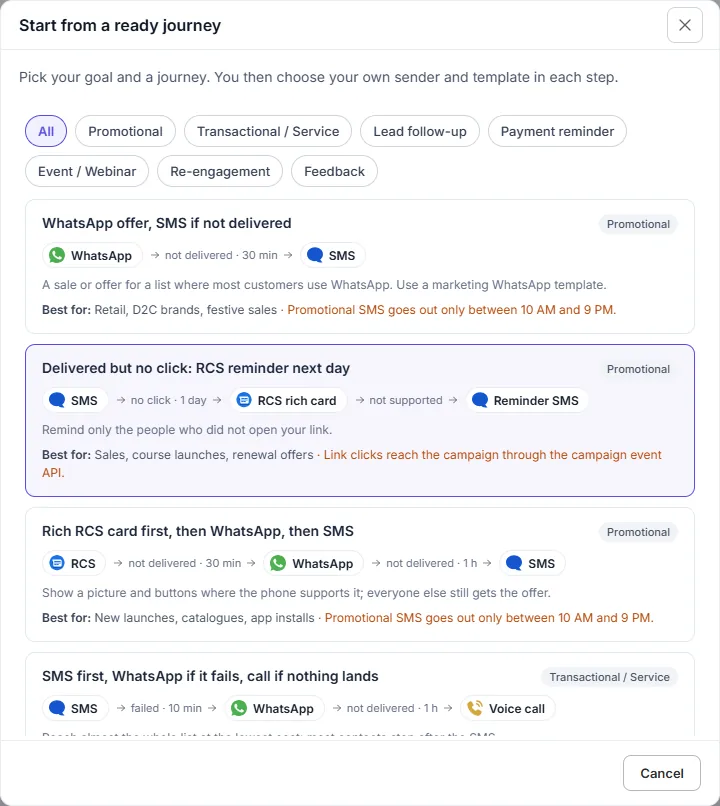
- Pick a starting point. Choose "Start from a ready journey", pick the Promotional goal and select "WhatsApp offer, SMS if not delivered". Or start with an empty canvas.
- Add your audience. Upload your sheet, choose an Address Book group or paste numbers. Your sheet columns (name, city, coupon) become variables.
- Fill each channel step. Choose the sender and template in the WhatsApp and SMS steps and map each placeholder to a column or to fixed text.
- Wire the results. Each step has outputs: sent, delivered, failed and not delivered, plus read for WhatsApp and RCS, and answered or not answered for voice. Connect WhatsApp's failed and not-delivered outputs to the SMS step.
- Add the reminder branch. From WhatsApp's delivered output add a Wait step of 1 day, then a Condition step that checks the WhatsApp step result for "read". Connect "No" to a Frequency step (10:00 to 20:00), then an RCS step, and connect RCS failed to a final SMS step.
- Send a test. Use Send test to try the journey on up to 10 numbers, such as your own and your team's. Test sends are charged like normal sends.
- Check the estimate and launch. Review the cost estimate, then choose Send now, Schedule (up to 90 days ahead) or Repeat (daily or chosen weekdays at a set time). Times follow your account time zone (IST).
- Watch the report. Open Reports > Campaign Report. While the run is live, the counts refresh every 15 seconds.
A journey can have up to 200 steps and 400 connections, each contact stays in a journey for at most 30 days, and each step runs once per contact. You can limit contacts per minute, hour or day; a run starts up to 5,000 contacts per minute, so 1 lakh contacts start in about 20 minutes. One run per campaign is open at a time, and you can pause, resume, stop, duplicate or rename a campaign.
If your website, app or CRM should start the journey for one customer at a time (a signup, an order, a lead), your server can start it with one API call instead of a list upload. Campaign List > ⋮ > "Get API code" shows ready code in cURL, PHP, Node.js and Python, and the event-triggered messaging guide explains the API and events.
How do you know the omnichannel journey is working?
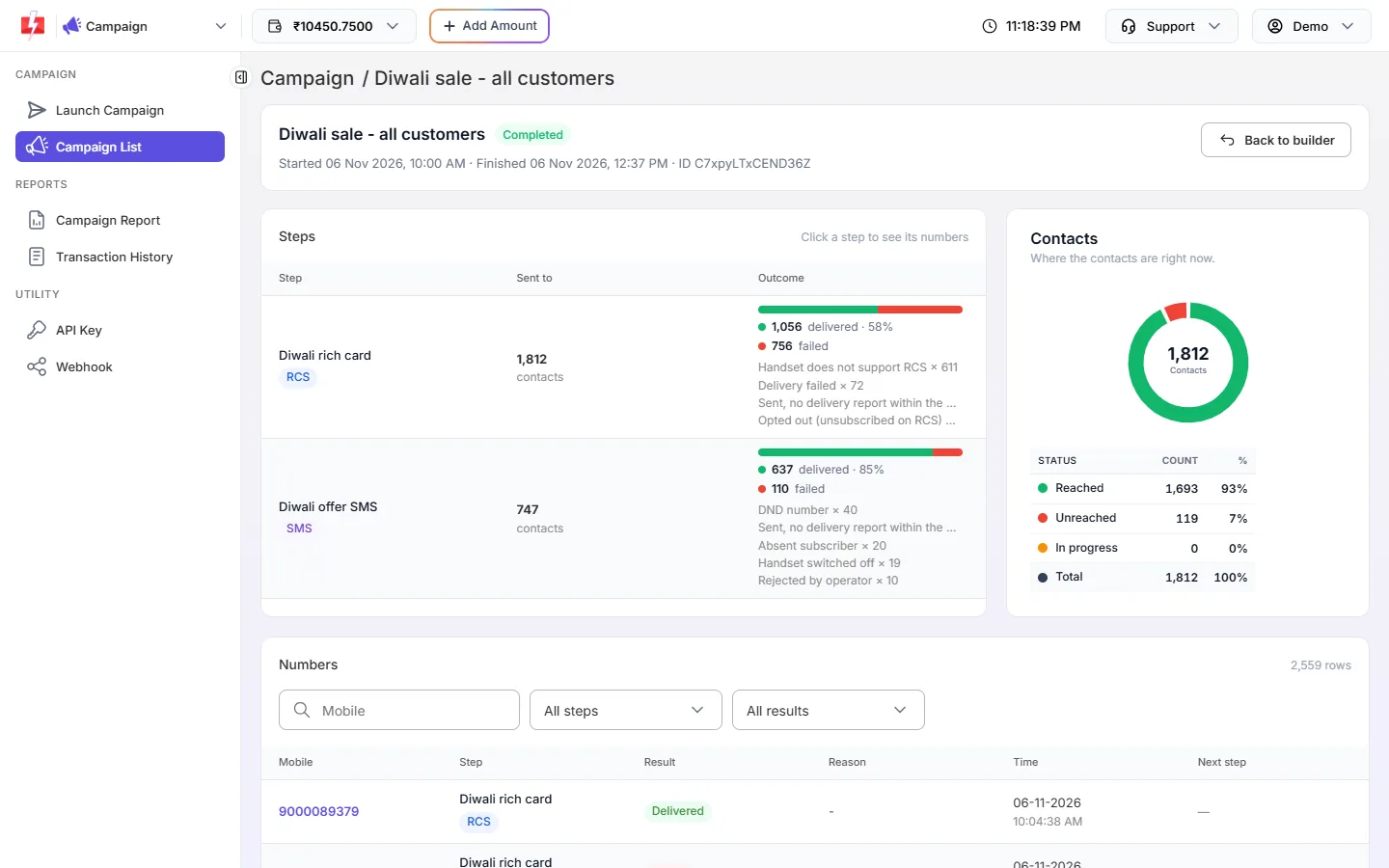
You compare reach and cost per reached contact with what you got from separate blasts. Campaign gives you one report for the whole journey, so you do not have to add up three channel reports.
- Run summary: total contacts, reached, unreached, opted out, stopped, in progress, cost, refund and net cost.
- Per step: entered, sent, delivered, read, answered, not answered, failed and not delivered, with cost and refund, average time and the top failure reasons.
- Per number: each contact's full path, so you can answer "what did Rahul receive?" in one click.
- Export: CSV from Delivery Reports > Export > Campaign.
- Webhooks: every step result and run status can be pushed to your server from Webhook > Campaign.
Three numbers to watch: reach (reached divided by total), cost per reached contact (net cost divided by reached), and fallback share (how many contacts needed the second channel). A high fallback share on WhatsApp often means old numbers or people not on WhatsApp; cleaning the list helps both approaches.
Mistakes to avoid when moving from multichannel to omnichannel
- Copying the multichannel habit into the journey. Sending SMS from the "delivered" output as well as the "failed" output brings the duplicates back. Send the backup only from failed or not delivered.
- Setting the wait too short. If WhatsApp takes the "not delivered" path after 1 minute, many customers get an SMS for a message that would have arrived a minute later. The 30-minute default is a good start.
- Forgetting allowed hours. A 1-day wait after a 9 pm send lands at 9 pm the next day. Add a Frequency step before reminders.
- Expecting click tracking for free. "Link clicked" and custom events work only when your own software posts them through the event API. Without that, branch on read or reply instead.
- Using a marketing template where a utility one fits, or the other way round. A reminder for an existing order belongs in a utility template (₹0.25 on WhatsApp at the time of writing); an offer belongs in a marketing template.
- Different offers on different channels. If WhatsApp says 20% and SMS says 15%, customers who see both lose trust. Keep the core message the same.
- Skipping the test. Send the journey to up to 10 of your own numbers first and check each branch.
- Promising personalised voice. Voice steps play one recording; they cannot read out a name or an amount. Put personal details in the WhatsApp or SMS step.
- Leaving the wallet near zero. A low balance pauses the run, and reminders arrive late. Recharge before a big launch.
Ready to try it? Open Fast2SMS Campaign, pick a ready journey and test it on your own number with the free credit. If you are comparing platforms, the CPaaS in India guide has a neutral checklist for choosing one.
Frequently asked questions
What is the difference between omnichannel and multichannel marketing?
Multichannel marketing uses several channels, but each one runs on its own with its own list and report. Omnichannel marketing links the channels into one journey per customer, so the next message depends on what happened to the last one, for example SMS only if WhatsApp was not delivered.
What is multichannel marketing in simple words?
It means reaching customers on more than one channel, such as SMS, WhatsApp and voice calls, with each channel planned and sent separately.
What is omnichannel marketing in simple words?
It means all your channels work as one. Each customer moves through a single journey, and every step reacts to the result of the step before it: delivered, read, failed, answered or replied.
What is cross-channel marketing?
Cross-channel marketing connects channels inside one campaign, such as an SMS with a link that opens a WhatsApp chat. The order is usually fixed for everyone, while omnichannel changes the path for each contact based on results.
Is cross-channel the same as omnichannel?
Many people use the two words for the same thing. Strictly, cross-channel means channels hand over to each other in a set order, and omnichannel means each customer takes their own path based on what happened to them.
Multichannel vs omnichannel: which is better?
If you message the same customers on two or more channels, omnichannel is usually better: fewer duplicate messages and a lower bill for the same reach. If each channel has a different audience, multichannel is fine.
Is omnichannel just multichannel with more channels?
No. You can be omnichannel with only two channels, such as WhatsApp and SMS. What makes it omnichannel is the link between them, not the number of channels.
What does omnichannel mean in messaging?
In messaging, omnichannel means SMS, WhatsApp, RCS and voice calls are steps in one journey. The journey picks the next channel based on the last result, so each customer gets the message once on the channel that works for them.
What is the multichannel marketing meaning in India?
For most Indian businesses it means sending bulk SMS from one panel, WhatsApp broadcasts from another and maybe voice calls from a third, each to its own list.
What is an omnichannel customer journey?
It is the path one customer takes through your messages: for example a WhatsApp offer, an SMS if WhatsApp is not delivered, a wait of one day, and a reminder only if the offer was not read.
Why do businesses move from multichannel to omnichannel?
To stop sending the same message two or three times to the same person, to stop paying for those copies, and to make sure contacts whose first message failed still get reached without manual work.
Is omnichannel only for large companies?
No. On Fast2SMS there is no campaign fee and no monthly fee, so a small shop can run the same WhatsApp-then-SMS journey as a large brand and pay only per message.
What is an example of omnichannel marketing in India?
A store sends a Diwali offer on WhatsApp. Contacts whose WhatsApp is not delivered get an SMS instead. The next day, only those who did not read the offer get an RCS card reminder, and an SMS if RCS fails.
What is an example of multichannel marketing?
The same store sends the Diwali offer as a WhatsApp broadcast and a bulk SMS to the same list at 11 am, then an RCS reminder to everyone the next day. Each customer gets three messages.
What are some omnichannel marketing examples for Indian businesses?
Payment reminders (SMS, then WhatsApp, then a call), EMI reminders (WhatsApp pay link, SMS, then a call), lead follow-up (WhatsApp, no reply: call, then SMS), event invites (WhatsApp, SMS if not delivered, call on the day) and feedback (call, WhatsApp if not answered). All are ready journeys in Fast2SMS Campaign.
What is fallback in omnichannel messaging?
Fallback means wiring a step’s failed or not-delivered result to another channel, such as WhatsApp to SMS. See the WhatsApp to SMS fallback guide.
How long does Fast2SMS wait before sending the backup channel?
Each channel step waits for a final result before taking the not-delivered path: 30 minutes by default for WhatsApp and RCS, 120 minutes for SMS and 15 minutes for voice. You can set any time from 1 minute to 24 hours.
Can the journey check if a WhatsApp message was read?
Yes. A Condition step can check the result of a WhatsApp or RCS step, including read, and send a reminder only to contacts who did not read it.
Can the journey check if a customer replied?
Yes, for WhatsApp and RCS. The Condition step has a "Reply received (WhatsApp / RCS)" check. SMS replies and specific button taps are not used for branching.
Does Fast2SMS track link clicks automatically?
No. "Link clicked" and custom events work only when your own website or software posts them to the Campaign event API. Without that, branch on delivered, read or replied.
Can I stop reminders when a customer pays or buys?
Yes, if your system posts an event such as payment_received for that number through the event API. A Condition step then checks "Your event" and skips the reminder.
Can I limit the journey to business hours?
Yes. Add a Frequency step to continue only on chosen weekdays between set times, 09:00 to 21:00 by default, with presets for every day, weekdays or weekends.
How long can a wait between messages be?
A Wait step can be from 1 minute up to 30 days, in minutes, hours or days. Presets include 10 minutes, 30 minutes, 1 hour, 1 day and 3 days.
Is omnichannel marketing more expensive than multichannel?
Usually it is cheaper for the same reach, because the backup channel is paid only for contacts who need it. In our 10,000-contact Diwali example the omnichannel journey cost ₹12,250 before refunds against ₹15,500 for separate blasts, at the prices listed at the time of writing.
Is there a fee for using the Fast2SMS journey builder?
No. There is no campaign fee, builder fee or monthly fee. Every step is charged at that channel’s normal per-message rate from the same wallet.
What does each channel cost on Fast2SMS?
Can I see the cost before launching a journey?
Yes. Campaign shows a cost estimate before launch, and refuses the launch if your wallet cannot cover the first step.
What happens if my balance runs out during a journey?
The run pauses and resumes on its own after you recharge; it checks every 10 minutes. If the balance stays low for 3 days, the run is stopped.
Are failed messages refunded in a journey?
Refunds follow each channel’s own rules: failed WhatsApp and RCS messages under that channel’s policy, SMS only on accounts billed On Delivery, and voice charges only answered pulses.
Am I charged for contacts still waiting when I stop a run?
No. Contacts that have not reached their next step when you stop the run are not charged for it.
Is there free credit to try an omnichannel journey?
Yes. Every new Fast2SMS account gets ₹50 free credit, and you can recharge from ₹100 with no setup or monthly fee.
Are test sends free?
No. Send test reaches up to 10 numbers before launch, and those messages are charged like normal sends.
Which channels can I combine in Fast2SMS Campaign?
Four: SMS, WhatsApp, RCS and voice calls. Email, push notifications, A/B split, webhook steps and code steps are not part of the builder.
Do I need DLT registration for SMS steps?
Yes. SMS steps use an approved DLT sender and an approved DLT template linked to it. Each DLT variable must stay within 30 characters.
Do WhatsApp steps need approved templates?
Yes. WhatsApp steps use Meta-approved templates with text, an image, video or document header, and buttons. Free text through Direct Send (Utility) works only on numbers with a 100K or unlimited tier.
What do I need for an RCS step?
An approved, active RCS bot (agent). You can send plain text, a rich card, media, a carousel of two or more cards and suggestion buttons.
What happens if a phone does not support RCS?
The RCS step takes the failed path, so if RCS fails or the phone does not support RCS, the next step you wired, such as WhatsApp or SMS, sends instead.
Can a voice call read out the customer’s name?
No. Voice steps play one approved recording (MP3 or WAV up to 5 MB) for everyone. Types are a simple message, press-a-key (DTMF) and call patch to an agent group.
Is there one sending time window for all channels?
No. Promotional SMS is held outside the promotional window where that rule applies, and promotional RCS bots send between 7 am and 10 pm. Use a Frequency step to set your own hours.
What happens to customers who opt out?
Numbers that have blocked you on WhatsApp, unsubscribed on RCS or are on the voice opt-out list leave the journey. Fast2SMS does not process STOP keywords automatically.
Can I send to international numbers in a journey?
No. Campaign accepts Indian mobile numbers only: 10 digits starting with 6 to 9, with a 91 or 0 prefix removed.
Is message content checked?
Yes. Text on SMS, WhatsApp and RCS goes through a scam-content check, and DND rules apply to SMS and voice.
How do I build an omnichannel journey in Fast2SMS?
Open Campaign > Launch Campaign (or Campaign List > Create Campaign), choose "Start from a ready journey" or an empty canvas, add your audience, fill each channel step, wire the outputs, send a test to up to 10 numbers, then choose Send now, Schedule or Repeat.
Are there ready-made omnichannel journeys?
Yes. There are 16 ready journeys in 7 goals: promotional, transactional and service, lead follow-up, payment reminder, event and webinar, re-engagement, and feedback.
How do I upload my customer list?
Upload a CSV, TXT, XLSX or XLS file up to 20 MB and up to 10 lakh rows, choose an Address Book group, or paste numbers. Duplicates and invalid numbers are dropped and counted.
Can I personalise messages in a journey?
Yes. Sheet columns become variables. Map SMS and WhatsApp placeholders to a column or fixed text, and write column names into RCS text. Voice has no variables.
Can I schedule an omnichannel journey?
Yes. Send now, schedule up to 90 days ahead, or repeat daily or on chosen weekdays at a set time, with optional from and until dates. Times follow your account time zone (IST).
How fast does a journey start for a big list?
A run starts up to 5,000 contacts per minute, so 1 lakh contacts start in about 20 minutes. You can also set your own limits per minute, hour or day.
How many steps can one journey have?
Up to 200 steps and 400 connections. Each step runs once per contact, and one contact stays in a journey for at most 30 days.
Can my website or CRM start the journey for one customer?
Yes. Your server calls POST https://www.fast2sms.com/dev/campaign/start with your API key and the campaign ID, and the journey starts for those numbers. See the event-triggered messaging guide.
Does Fast2SMS connect to Shopify or WooCommerce triggers directly?
There are no built-in store or cart triggers in Campaign. Trigger the journey from your website, app, CRM or store backend with one API call.
Can I pause or stop a running journey?
Yes. You can pause, resume or stop a run, and duplicate, rename or switch a campaign on and off. One run per campaign is open at a time.
How do I measure an omnichannel journey?
The Campaign Report shows a run summary (total, reached, unreached, opted out, cost, refund, net cost), per-step counts with failure reasons, and each contact’s full path. Export it as CSV from Delivery Reports > Export > Campaign.
Can I get journey results on my server?
Yes. Webhooks send every step result and run status, with step name, channel, status, reason, cost and next step. Set them up under Webhook > Campaign.
Which metrics matter when comparing multichannel and omnichannel?
Reach (reached divided by total), cost per reached contact (net cost divided by reached) and fallback share (how many contacts needed the second channel).
When is multichannel marketing enough?
When each channel has a different audience, or you send rarely on a single channel. If the same customers get messages on two channels, a journey saves money and avoids duplicates.
Do I have to change my templates to go omnichannel?
No. Your existing DLT templates, WhatsApp templates, RCS bot and voice files become steps in the journey.
Where can I learn more about omnichannel platforms?
Read the pillar guide to the omnichannel marketing platform in India, the SMS vs WhatsApp vs RCS comparison and the CPaaS in India guide.