Omnichannel Marketing Platform in India: One Journey Across SMS, WhatsApp, RCS and Voice
No monthly fee · Pay as you go from ₹100 · Free setup help on a call
An omnichannel marketing platform sends one customer journey across several channels, where each next message depends on what happened to the last one. On Fast2SMS, the Campaign journey builder links SMS, WhatsApp, RCS and voice calls in one flow: WhatsApp first, SMS if it is not delivered, a call if nothing lands. There is no platform fee. You pay each channel's normal rate, from ₹0.11 per SMS at the time of writing.
This guide covers what omnichannel marketing means, how one journey across four Indian channels works, what it costs, real examples for 7 business goals, a buyer's checklist, setup steps in the Fast2SMS panel, and links to 19 detailed guides for every journey.
What is an omnichannel marketing platform?
An omnichannel marketing platform is software that sends messages to a customer on more than one channel as one connected journey. The channels share the same contact list, the same wallet and the same report, and each step knows the result of the step before it.
In India, the channels that reach customers on their phones are SMS, WhatsApp, RCS (rich messages in the Android messages app) and voice calls. A good omnichannel platform lets you send on all four from one place. More importantly, it lets you decide what happens next: if the WhatsApp message is delivered, wait; if it fails, send an SMS; if the SMS is also not delivered, place a short call.
You will see other names for the same idea: omnichannel marketing software, omnichannel communication platform, omnichannel messaging platform, cross channel marketing platform and customer journey builder. The words differ, but the test is simple. Can one campaign move a customer from one channel to another based on what actually happened? If yes, it is omnichannel. If you have to send separate blasts on each channel and compare spreadsheets afterwards, it is not.
On Fast2SMS this is the Campaign journey builder. You find it in the panel under Campaign, marked "Automated Journeys". It went live for all Fast2SMS customers in November 2026.
What does omnichannel marketing mean in simple words?
Omnichannel marketing means the customer gets one conversation from your business, not four separate ones. "Omni" means all. The channels work together, so the customer is not hit with the same offer on every app at the same time.
Think of a shop owner who wants to tell 5,000 customers about a Diwali sale. Without an omnichannel tool, the owner sends a WhatsApp blast, then an SMS blast to the same 5,000 people, then maybe calls. Many customers get the same offer three times. Some never get it at all, because their WhatsApp was not active and the SMS went to a full inbox.
With an omnichannel journey, the owner sends WhatsApp first. Only the people who did not get it receive an SMS. Only the people who still have not received anything get a call. Each customer hears about the sale once, on the channel that works for them, and the owner pays for fewer messages.
That is the whole idea: right channel, right order, no repeats, one report.
How is omnichannel different from multichannel?
Multichannel means you use several channels, but each runs on its own. Omnichannel means the channels are linked, so one step's result decides the next step. Cross-channel sits in between: channels are linked by hand, not by rules.
| Multichannel | Cross-channel | Omnichannel | |
|---|---|---|---|
| How channels run | Separate campaigns per channel | Separate campaigns, planned together | One journey with steps on each channel |
| Who decides the next message | Nobody; every list gets every blast | You, by exporting and re-uploading lists | The journey, based on sent, delivered, read or failed |
| Repeat messages | Common | Fewer, with manual work | Each step runs once per contact |
| Report | One per channel | Several, merged in a spreadsheet | One run report with every step and every contact |
| Cost | Highest: you pay for duplicates | Lower | Lowest: later steps go only to the people who need them |
For a longer comparison with a worked Diwali example and costs on both sides, read omnichannel vs multichannel marketing.
Which channels does an omnichannel platform need in India?
In India you need four: SMS for reach, WhatsApp for rich messages and replies, RCS for branded cards in the Android messages app, and voice calls for attention and for people who do not read. Each has its own approval rule, so set these up first.
| Channel | What you need first | Step results in a journey | Best job |
|---|---|---|---|
| SMS | DLT registration: an approved sender ID and an approved DLT template linked to it | Sent, delivered, failed, not delivered | Reaching every mobile, including phones without internet |
| A WhatsApp Business API number and approved Meta templates (text, image, video or document header, buttons) | Sent, delivered, read, failed, not delivered | Offers with images, pay links, replies | |
| RCS | An approved, active RCS agent (bot) | Sent, delivered, read, failed, not delivered | Rich cards, carousels and suggestion buttons in the Android messages app |
| Voice call | Voice enabled on your account and an approved recorded audio file (mp3 or wav, up to 5 MB) | Answered, not answered, failed | Reminders people hear, feature phones, local languages |
A few points that matter when you plan a journey:
- RCS does not work on every phone. If RCS fails or the phone does not support RCS, the step reports failed and the next step sends. That is why RCS is usually followed by WhatsApp or SMS.
- WhatsApp marketing messages can be held back. Meta limits how many marketing messages one person receives, so some offers are not delivered even to valid numbers. A fallback step catches them. The WhatsApp to SMS fallback guide explains this in detail.
- Voice calls play recorded audio. The call cannot read out a name or an amount, so keep the audio general ("your payment is due") and put the details in the text step.
- Email, push notifications and A/B split steps are not part of the builder. The journey runs on the four phone channels.
To compare the four channels on cost, reach and rules side by side, read SMS vs WhatsApp vs RCS vs voice call. If you are new to the term CPaaS, the CPaaS in India guide explains how these channels and their APIs fit together.
What does one journey across four channels look like?
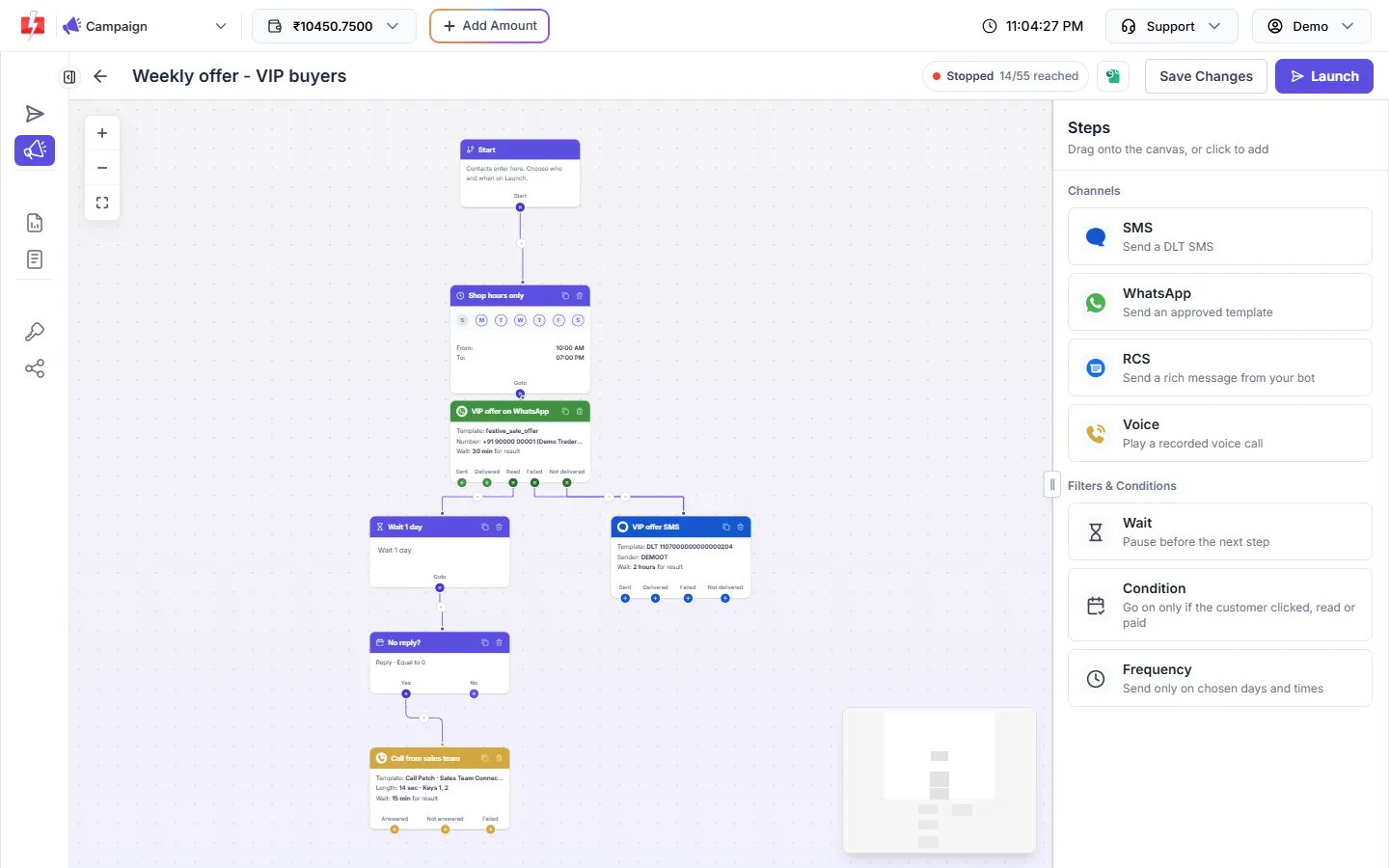
A typical omnichannel journey tries the richest channel first and falls back to the one with the widest reach. Here is a festival offer that uses all four channels, with a wait and a time window before the call.
Here is the same journey as a timing table. Each row is one step on the builder canvas.
| Step | When | Channel | Message | If it fails |
|---|---|---|---|---|
| 1 | Day 0, 11:00 (scheduled) | WhatsApp (marketing template) | Festival offer with a banner image and a "Shop now" button | Not delivered within the wait window (default 30 minutes): go to step 2 |
| 2 | Day 0, about 11:30 | RCS rich card | Same offer as a card with "Shop now" and "Call us" buttons | Failed or phone has no RCS: go to step 3 |
| 3 | Day 0, right after step 2 fails | SMS (DLT template) | Short offer text with the code and your website | Failed or not delivered: the journey ends for that contact |
| 4 | Day 1 (Wait 1 day) | Frequency step | Holds the contact until your chosen hours, for example 10:00 to 19:00 | Not a sending step |
| 5 | Day 1, inside the window | Voice call (simple message) | 15-second recorded reminder: "The Demo Traders sale ends tomorrow" | Not answered: the journey ends; you pay nothing for that call |
Customers who read the WhatsApp offer in step 1 never get the RCS card or the SMS. That is where the savings come from. You can also wire step 1's "read" output to its own Wait and a different reminder, so engaged customers get a softer follow-up.
How does the Fast2SMS customer journey builder work?
You drag steps onto a canvas and join them with lines. Channel steps send messages. Wait, Condition and Frequency steps control timing and logic. Every channel step has outputs for each result, and you wire each output to the next step.
The seven step types
| Step | What it does | Settings |
|---|---|---|
| SMS | Sends an approved DLT template from your approved sender | Sender, template, variables mapped to sheet columns or fixed text |
| Sends an approved Meta template from your WhatsApp number | Number, template, header media, buttons, variables | |
| RCS | Sends plain text, a rich card, media, a carousel (2 or more cards) or suggestion buttons from your RCS agent | Agent, message type, text with column names as variables |
| Voice | Calls and plays your recorded audio: a simple message, a press-a-key (DTMF) call, or a call patch that connects to an agent group on a key press | Audio file, call type, retries and retry interval |
| Wait | Pauses the contact | 1 minute to 30 days; presets 10 min, 30 min, 1 hour, 1 day, 3 days |
| Condition | Splits contacts into Yes and No | A step result, "Reply received (WhatsApp / RCS)", "Link clicked" or "Your event"; AND/OR rules; time windows |
| Frequency | Lets contacts continue only on chosen days and hours | Weekdays plus From and To times (default 09:00 to 21:00); presets every day, weekdays, weekends |
Outputs: how fallback works
Each channel step waits for a final result before it takes a "not delivered" line. The default waits are 120 minutes for SMS, 30 minutes for WhatsApp and RCS, and 15 minutes for voice. You can set any wait from 1 minute to 24 hours.
- SMS outputs: sent, delivered, failed, not delivered.
- WhatsApp and RCS outputs: sent, delivered, read, failed, not delivered.
- Voice outputs: answered, not answered, failed.
Fallback simply means you wire a failed or not-delivered output to another channel. Common chains are WhatsApp to SMS, RCS to WhatsApp to SMS, and SMS to a voice call.
What the Condition step can and cannot check
A Condition can check the result of any earlier SMS, WhatsApp, RCS or voice step, whether the customer replied on WhatsApp or RCS, and two signals that come from your own software: "Link clicked" and "Your event". Both of these are posted by your system to the event API, for example when your website sees a click or your payment gateway confirms a payment. The builder does not track link clicks by itself, and it does not branch on SMS replies or on which button was tapped.
Limits worth knowing
- Up to 200 steps and 400 connections in one journey.
- A journey lasts at most 30 days for each contact, and each step runs once per contact.
- Up to 200 campaigns per account, and one open run per campaign at a time.
- Runs can be paused, resumed, stopped, duplicated, renamed and switched on or off.
The full list of step options, with screenshots, is on the multi-channel campaign builder product page.
How do you start a journey: list, schedule or API?
You can start a journey for a list of customers (now, later or on repeat), or for one customer at a time from your own software with a single API call.
From a list
- Upload a file: CSV, TXT, XLSX or XLS, up to 20 MB and up to 10 lakh (1,000,000) rows.
- Pick Address Book groups you already keep in Fast2SMS, or paste numbers.
- Only Indian mobile numbers are accepted: 10 digits starting with 6 to 9. A 91 or 0 prefix is removed. Duplicates and invalid numbers are dropped and counted.
- Sheet columns become variables. You map each SMS or WhatsApp placeholder to a column or to fixed text. RCS text uses the column name in double braces, such as {{name}}. Voice steps have no variables.
When it sends
- Send now.
- Schedule: up to 90 days ahead, in your account time zone (IST).
- Repeat: daily or on chosen weekdays at a set time, with optional from and until dates.
Up to 5,000 contacts start per minute in a run, so a list of 1 lakh contacts starts in about 20 minutes. You can also set your own limits per minute, hour or day, which helps when your call centre can only handle so many callbacks.
From your website, app, CRM or store backend
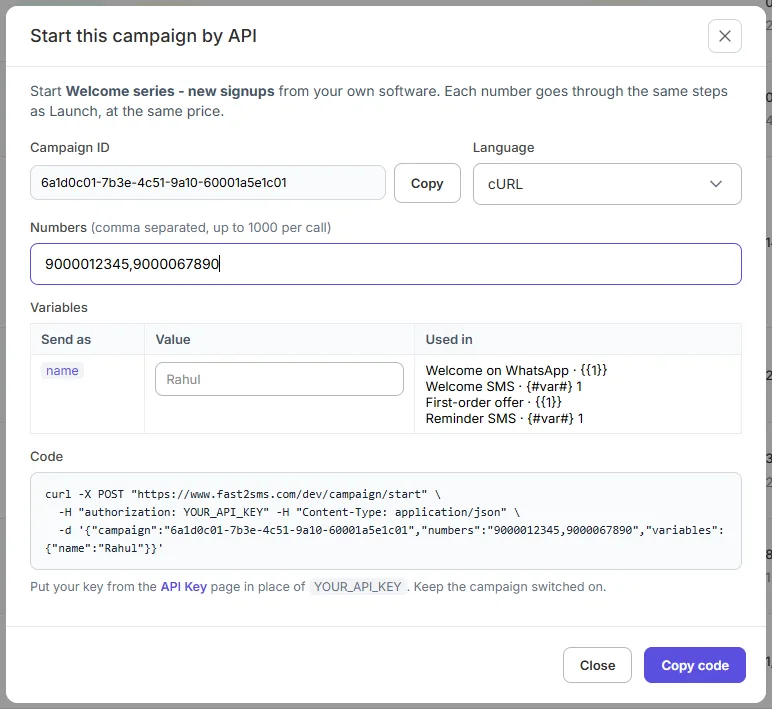
When something happens in your system (a signup, an order, a due date), your server calls one API and the journey starts for that customer straight away. There is no ready-made Shopify or WooCommerce trigger inside the builder; you trigger it from your own backend with one call. Here is a request with the fields the API accepts:
curl -X POST https://www.fast2sms.com/dev/campaign/start \
  -H "authorization: YOUR_API_KEY" \
  -H "Content-Type: application/json" \
  -d '{"campaign": "YOUR_CAMPAIGN_ID",
       "recipients": [{"mobile": "9000012345", "name": "Rahul"}]}'
You get the campaign ID and ready code in cURL, PHP, Node.js and Python from Campaign List, the three-dot menu, "Get API code". One call can carry up to 1,000 numbers, each with up to 50 variables. Calls made on the same day for one campaign join one run, and a number already in today's run is skipped. Your system can also post events (for example payment_received) so a Condition step can stop reminders once the customer has paid. The developer details are in the event-triggered messaging API guide, and the most common use is covered in welcome message automation.
Omnichannel marketing examples for Indian businesses
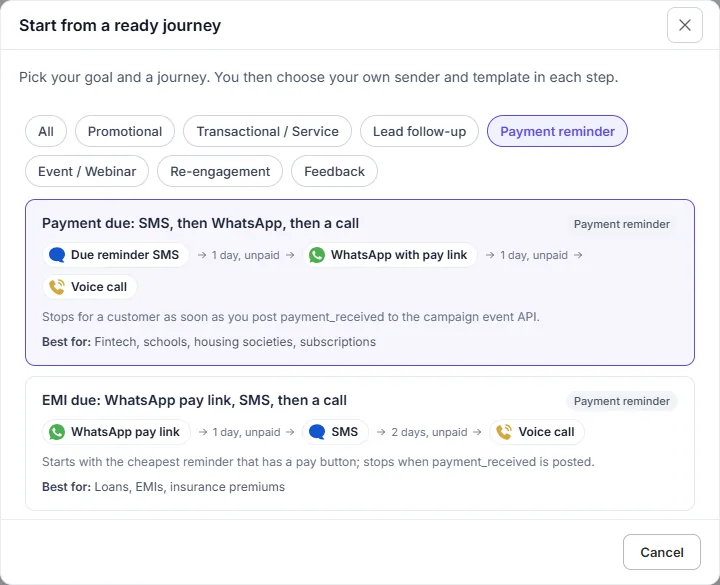
The quickest way to start is a ready journey. Fast2SMS ships 16 of them, grouped under 7 goals, in the "Start from a ready journey" picker. You pick one, and the steps and lines appear on the canvas. You then choose your own sender, templates and audio in each step.
| Goal | Ready journeys | Who uses it |
|---|---|---|
| Promotional | WhatsApp offer, SMS if not delivered · Delivered but no click: RCS reminder next day (needs click events from your system) · Rich RCS card first, then WhatsApp, then SMS | Retail, D2C brands, restaurants, festival sales |
| Transactional / service | SMS first, WhatsApp if it fails, call if nothing lands · WhatsApp update, SMS in 5 minutes if it fails · SMS, then a voice call if not delivered | Order and delivery updates, service alerts |
| Lead follow-up | WhatsApp, no reply: call, then an SMS · Call first, WhatsApp if not answered | Real estate, education, insurance, B2B sales |
| Payment reminder | Payment due: SMS, then WhatsApp, then a call · EMI due: WhatsApp pay link, SMS, then a call | Lenders, NBFCs, schools, subscriptions, utilities |
| Event / webinar | WhatsApp invite, SMS if not delivered, call on the day · RCS invite card, WhatsApp if not supported | Webinars, launches, open days, seminars |
| Re-engagement | Win back with an RCS card, then WhatsApp · WhatsApp offer, RCS card if no click in 3 days | Inactive customers, lapsed subscribers |
| Feedback | Feedback on WhatsApp, SMS link if no reply · Feedback call, WhatsApp if not answered | Clinics, service centres, hotels, stores |
Example 1: a clinic cuts no-shows
A clinic sends a WhatsApp appointment reminder (utility template) the evening before each appointment. If it is not delivered, an SMS goes out. On the day, a short voice call plays a 15-second reminder. The clinic's booking software calls the API once per appointment, on the day before. Full timing and templates are in the appointment reminder guide.
Example 2: a lender collects on time
Three days before the due date, the lender's system starts a journey: a WhatsApp message with a pay link. If it fails, an SMS with the same link. If the customer has not paid by the next day, a voice call. When the payment gateway confirms payment, the lender posts a payment_received event and a Condition step ends the journey for that customer. The EMI reminder guide has the day-by-day plan.
Example 3: an online store recovers carts
When a cart is left, the store backend calls the API. A WhatsApp reminder goes after 30 minutes (a Wait step), an RCS or SMS with a coupon after 6 hours, and a last message after 24 hours. The abandoned cart recovery guide has the templates and code.
Example 4: a coaching institute follows up every enquiry
A new enquiry gets a WhatsApp reply in seconds. If there is no reply, a call-patch voice call lets the student press 1 to talk to a counsellor. An SMS follows for anyone who did not answer. See admission enquiry follow-up.
How much does an omnichannel marketing platform cost in India?
On Fast2SMS the journey builder itself is free: no campaign fee, no builder fee and no monthly fee. Every step is charged at that channel's normal per-message rate from the same wallet you already use.
| Item | Price at the time of writing | Pricing page |
|---|---|---|
| Campaign journey builder | ₹0 (no setup, no monthly fee) | Campaign |
| SMS | ₹0.25 per SMS from a ₹100 recharge, down to ₹0.11 per SMS on bigger recharge slabs | Bulk SMS pricing |
| ₹0.95 per marketing message, ₹0.25 per utility, ₹0.25 per authentication, ₹0.13 per service reply | WhatsApp pricing | |
| RCS | ₹0.35 per message, the same for text, media and rich cards | RCS pricing |
| Voice call | ₹0.25 per 15-second pulse, answered calls only | Bulk voice call |
New accounts get ₹50 free credit. Recharges start at ₹100, and 18% GST is added to recharges.
Cost example: a service reminder to 10,000 customers
Take the ready journey "SMS first, WhatsApp if it fails, call if nothing lands". The numbers below are an example, not a promise of delivery rates.
| Step | Contacts | Rate | Cost |
|---|---|---|---|
| SMS to everyone | 10,000 | ₹0.25 | ₹2,500 |
| WhatsApp utility to the 600 whose SMS failed or was not delivered | 600 | ₹0.25 | ₹150 |
| Voice call to the 200 still not reached; 120 answer a 15-second message | 120 answered | ₹0.25 per pulse | ₹30 |
| Total | ₹2,680 |
If you had sent all three channels to all 10,000 people as separate blasts, the SMS and WhatsApp alone would have cost ₹5,000, plus calls. The journey sends the second and third channel only to the people who need them. On a bigger recharge the SMS rate falls (down to ₹0.11 at the time of writing), which lowers the first line further.
How billing works during a run
- Estimate first. The panel shows a cost estimate before you launch. A launch is refused if the wallet cannot cover the first step.
- Low balance pauses, it does not fail. If the wallet runs low mid-run, the run pauses and resumes on its own after you recharge (it checks every 10 minutes). After 3 days on low balance, the run is stopped.
- Refunds follow each channel's own rules. Failed WhatsApp and RCS messages are refunded under each channel's policy, SMS refunds apply on "On Delivery" billing accounts, and voice charges answered pulses only.
- Stopping saves money. Contacts still waiting in a journey when you stop the run are not charged for steps they never reached.
Copy-ready messages for a four-channel journey
Use the same offer in every step, but shape it for the channel. Keep SMS short and plain, WhatsApp visual, RCS with buttons, and the call to one clear sentence.
| Step | Template (edit and submit for approval where needed) |
|---|---|
| WhatsApp (marketing) | Hi {{1}}, the Demo Traders Diwali sale is live. Get 20% off on everything till Sunday with code {{2}}. Tap Shop now to see the offers. |
| RCS rich card | Title: Diwali sale, 20% off. Text: Hi {{name}}, use code SAVE20 till Sunday. Buttons: Shop now, Call us. |
| SMS (DLT) | Dear {#var#}, Demo Traders Diwali sale: 20% off till Sunday. Use code {#var#}. Shop at {#var#} - Demo Traders |
| Voice (15 s) | "Namaste, this is Demo Traders. Our Diwali sale with 20 percent off ends this Sunday. Check your SMS or WhatsApp for the code. Thank you." |
| SMS in Hindi (DLT) | प्रिय {#var#}, Demo Traders दिवाली सेल: रविवार तक 20% छूट। कोड {#var#} इस्तेमाल करें। - Demo Traders |
Each WhatsApp template needs Meta approval and each SMS template must be registered on DLT with the same wording before it can be used in a step. For more templates by goal, see the WhatsApp drip campaign examples, payment reminder templates in English and Hindi and festival campaign messages.
How to set it up in Fast2SMS
Setup takes about 15 minutes once your channels are approved. Get the approvals first: they take the longest.
- Create a free account at fast2sms.com. ₹50 credit is added for tests.
- Get each channel ready. SMS: a DLT sender ID and template linked to it. WhatsApp: connect your number and get templates approved by Meta. RCS: an approved, active RCS agent. Voice: ask for voice to be enabled and upload an approved audio file.
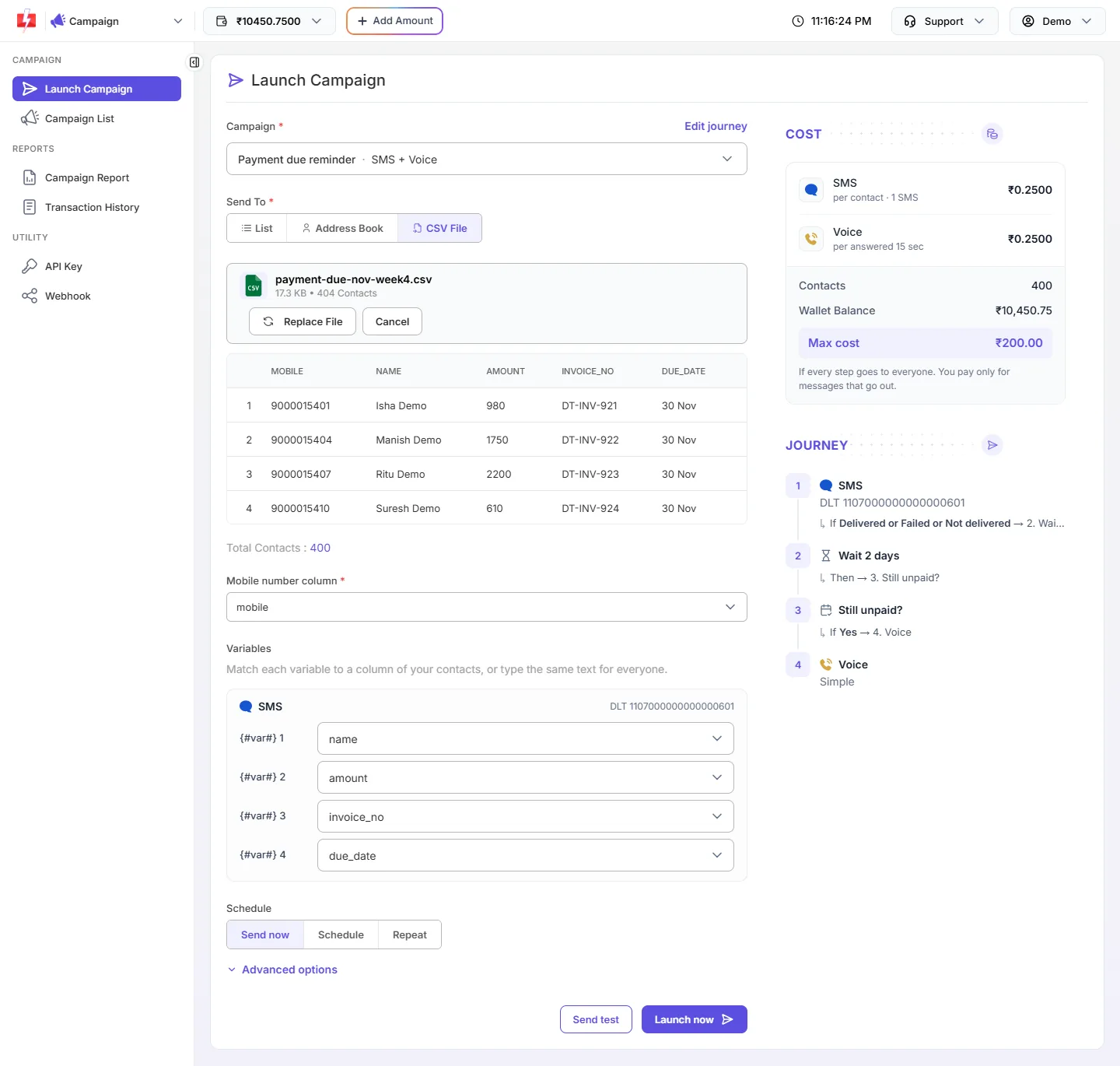
- Open Campaign. In the panel header, open the Campaign app ("Automated Journeys"). Click Launch Campaign, or go to Campaign List and click Create Campaign.
- Start from a ready journey, or start from a blank canvas. Pick a goal, then a journey.
- Fill each channel step. Choose your sender, number, agent or audio file and the approved template. Map variables to sheet columns or fixed text.
- Add logic. Drop in Wait steps for gaps, a Condition for Yes/No splits and a Frequency step to keep calls and messages inside your hours.
- Wire the outputs. Join each step's sent, delivered, read, failed or not-delivered output (answered or not answered for voice) to the next step. Leave an output empty to end the journey there.
- Add the audience. Upload a file, pick Address Book groups or paste numbers. Check the counts of valid, duplicate and invalid numbers.
- Send a test to up to 10 numbers. Test sends are charged like normal sends, so the ₹50 credit is enough for a few rounds.
- Check the cost estimate, then choose Send now, Schedule or Repeat.
- Watch the run report. It refreshes every 15 seconds while the run is active.
- Optional: connect your software. Copy the API code for the campaign and set up campaign webhooks under Webhook, then Campaign.
How do you measure an omnichannel campaign?
Look at three levels: the run, each step, and each contact. Fast2SMS shows all three in the Campaign Report, under Reports.
- Run summary: total contacts, reached, unreached, opted out, stopped, in progress, cost, refund and net cost.
- Per step: entered, sent, delivered, read, answered, not answered, failed, not delivered, cost and refund, average time, and the top failure reasons.
- Per number: one contact's full journey, step by step, with times and results.
- Export: download a CSV from Delivery Reports, Export, Campaign.
- Webhooks: every step result (campaign.step.<result>) and every run status (scheduled, started, paused, paused_balance, resumed, stopped, finished, failed) is posted to your server with the step name, channel, status, reason, cost and next step.
The number that matters most is reached: how many contacts got your message on at least one channel. Compare it with what a single channel would have reached. Then look at cost per reached contact. A good journey raises reach and lowers cost per reached contact at the same time.
Campaign spends also appear in Transaction History under Campaign, so finance can match the wallet with each run.
What rules apply to omnichannel marketing in India?
Each channel keeps its own rules inside a journey. The platform applies them per step, so plan your timing around the strictest one in your flow.
| Channel | Main rule | What it means for your journey |
|---|---|---|
| SMS | DLT: registered sender, template and content; DND handling for promotional SMS | Promotional SMS is held outside the permitted promotional hours, so a fallback SMS at night waits for the morning |
| Approved Meta templates; Meta limits marketing messages per person | Expect some marketing messages to be not delivered; always add a fallback | |
| RCS | Approved RCS agent; promotional bots send from 7 AM to 10 PM | Use RCS for daytime offers, not night alerts |
| Voice | Approved audio; DND handling for promotional calls; calling hours for promotions | Put a Frequency step before calls to keep them in daytime hours |
- Content checks. SMS, WhatsApp and RCS text is checked for scam content before sending.
- Opt-outs leave the journey. Numbers that blocked you on WhatsApp, unsubscribed on RCS or are on the voice opt-out list leave the journey. Keep your own unsubscribe list too, and remove those numbers before you upload.
- Consent. Message people who have given you their number and expect to hear from you. Good consent keeps WhatsApp quality high and complaints low.
More on DND rules is on the DND page.
How to choose an omnichannel marketing platform in India: a buyer's checklist
Ask every provider the same questions. The right platform answers yes to most of them in writing, with prices on its website.
| Question | Why it matters | Fast2SMS today |
|---|---|---|
| Does it cover SMS, WhatsApp, RCS and voice in one journey? | India needs all four to reach everyone | Yes, all four as steps in one builder |
| Can a step branch on delivered, read and failed? | That is what makes fallback automatic | Yes, per-step outputs; voice has answered / not answered / failed |
| Is there a platform or monthly fee? | Fixed fees hurt small senders | No; you pay per message per channel |
| Are channel prices public? | You can estimate cost before you sign | Yes, on each pricing page |
| Can your own software start a journey for one customer? | Signups, orders and due dates happen one at a time | Yes, one API call; events and webhooks too |
| Are there ready journeys? | Starting from a blank canvas is slow | 16 ready journeys in 7 goals |
| Does it handle DLT, Meta templates and DND for you? | Compliance mistakes block sending | Yes, per channel, with help for DLT |
| Is there a per-contact report? | You need to answer "did Rahul get it?" | Yes, every contact's full journey |
| What happens when the wallet runs low? | A campaign should not die silently | The run pauses and resumes after recharge |
| Does it support email or A/B tests? | Know the limits before you plan | No; the builder is for the four phone channels |
Also ask for a demo on your own data and a test on your own phone. If you send at very large volumes or need help planning, read the enterprise page or book a call at fast2sms.com/meet.
Mistakes to avoid with omnichannel journeys
- Sending every channel to everyone. That is multichannel spam, and you pay for it. Wire later channels to the failed and not-delivered outputs only.
- No fallback after WhatsApp marketing. Some marketing messages are held back by Meta. Without an SMS or RCS step, those customers never hear from you.
- Very short wait windows. A 1-minute wait before "not delivered" sends the SMS before WhatsApp had a fair chance. Start with the defaults.
- Calls at the wrong hour. Put a Frequency step before every voice step, so a Wait that ends at night does not ring someone at 11 pm.
- Expecting the call to read the name. Voice plays one recording for everyone. Put names, amounts and links in the text steps.
- Waiting for click data that never comes. "Link clicked" and "Your event" only work if your website or app posts them to the event API. Set that up before you use those conditions.
- Templates not approved in time. Get DLT templates, Meta templates, RCS agent and voice audio approved before launch day.
- Skipping the test send. Send to up to 10 of your own numbers and read every step on a real phone first.
- Uploading a dirty list. Remove opt-outs and old numbers. Duplicates and invalid numbers are dropped, but numbers that do not want your messages hurt WhatsApp quality.
- Trying to schedule by each customer's due date inside the builder. Waits are fixed. For "3 days before the due date", have your system call the API on that day.
Guides for every journey
Each guide below goes deep on one journey, with timing tables, templates, costs and setup steps. They all use the same Fast2SMS Campaign builder.
Understand the basics
- Omnichannel vs multichannel marketing: the difference, with an Indian SMS and WhatsApp example.
- CPaaS in India: full form, meaning and how to choose a provider.
- SMS vs WhatsApp vs RCS vs voice call: cost, reach and rules of all four channels.
- Marketing automation for small businesses: six starter automations with no monthly fee.
Automate a channel
- WhatsApp automation for business: timed and triggered WhatsApp sequences with SMS backup.
- Automated SMS service: DLT-template automation and reminders that reach every phone.
- WhatsApp drip campaigns: six copy-ready drips with hour-by-hour timing.
- WhatsApp to SMS fallback: why messages fail in India and how to catch them.
- Event-triggered messaging API: start a journey from your code, with examples.
Automate the customer lifecycle
- Welcome message on signup: welcome now, offer at 6 hours, reminder the next day.
- Abandoned cart WhatsApp messages: 30-minute, 6-hour and 24-hour recovery steps.
- Payment reminder messages: before-due, due-day and overdue templates in English and Hindi.
- EMI reminder messages: WhatsApp, SMS and a call for loan repayments.
- Appointment reminder SMS: fewer no-shows for clinics, labs and salons.
- Win-back campaigns: "we miss you" journeys for inactive customers.
- Diwali and festival marketing campaigns: teaser, sale-day and last-hour messages.
Automate by industry
- Ecommerce marketing automation: order, COD, shipping and review journeys.
- WhatsApp marketing for real estate: enquiry reply, site visit reminders and follow-ups.
- Admission enquiry follow-up: speed-to-lead, counsellor calls and fee reminders.
Where to start
Pick the one journey that would make the biggest difference this month. For most businesses that is a reminder (payments, appointments, EMIs) or a fallback on an existing WhatsApp campaign. Set up the channels it needs, start from the matching ready journey, test it on your own phone, and launch it for a small list first. Once the report shows the reach you expected, add the next journey.
Create your free account at fast2sms.com, or read more about the omnichannel campaign builder first.
Frequently asked questions
What is an omnichannel marketing platform?
It is software that sends one customer journey across several channels, such as SMS, WhatsApp, RCS and voice calls, where each next message depends on the result of the last one. Fast2SMS does this with its Campaign journey builder.
What is the meaning of omnichannel marketing?
Omnichannel marketing means all your channels work as one conversation with the customer. Instead of separate blasts on each app, the customer gets the message once, on the channel that reaches them, and the next step follows from what they did.
What does omni mean in omnichannel?
Omni means all. Omnichannel means all channels connected, so the customer experiences one journey rather than several unrelated messages.
What is omnichannel marketing in simple words?
Send on the best channel first, and only move to the next channel if the first one did not reach the customer. One journey, no repeats, one report.
What is the difference between omnichannel and multichannel marketing?
Multichannel uses several channels separately, so every list often gets every blast. Omnichannel links the channels into one journey that reacts to sent, delivered, read and failed results. See omnichannel vs multichannel for a worked example.
What is cross-channel marketing?
Cross-channel marketing plans several channels together but usually links them by hand, for example by exporting the people who did not open a WhatsApp and uploading them for an SMS. An omnichannel journey does that step automatically.
What is a customer journey builder?
A customer journey builder is a visual canvas where you drag message steps, waits and conditions and join them with lines. On Fast2SMS it is the Campaign builder, with SMS, WhatsApp, RCS, Voice, Wait, Condition and Frequency steps.
Is an omnichannel messaging platform the same as an omnichannel marketing platform?
Mostly yes. "Messaging" stresses the channels (SMS, WhatsApp, RCS, voice) and "marketing" stresses the use. On Fast2SMS the same journey builder runs offers, reminders, updates and follow-ups.
What is an omnichannel communication platform?
It is another name for a platform that reaches customers on several channels from one account and connects those messages into journeys. Fast2SMS covers SMS, WhatsApp, RCS and voice from one panel and one wallet.
What is a multichannel campaign?
A multichannel campaign uses more than one channel for the same goal. On Fast2SMS you can build it as one connected journey, so later channels go only to customers the earlier ones did not reach.
Which channels does Fast2SMS support in a journey?
Four: SMS (DLT), WhatsApp (approved Meta templates), RCS (approved RCS agent) and voice calls (approved recorded audio). Email, push notifications and A/B split steps are not part of the builder.
Is the Fast2SMS Campaign builder live for all customers?
Yes. Campaign has been live for all Fast2SMS customers since 26 November 2026. You find it in the panel under Campaign ("Automated Journeys").
Why does a business in India need omnichannel marketing?
Because no single channel reaches everyone. Some customers do not have WhatsApp active, many phones do not support RCS, SMS inboxes get crowded and some people only respond to a call. A journey uses each channel where it works best.
Is omnichannel marketing only for large companies?
No. On Fast2SMS there is no platform fee or monthly fee, so a small shop or clinic can run a journey for a few hundred customers and pay only for the messages sent. See marketing automation for small businesses.
How does fallback work in a Fast2SMS journey?
Each channel step has outputs for each result. You wire the failed or not-delivered output to another channel step, for example WhatsApp to SMS, or RCS to WhatsApp to SMS. Read the SMS fallback guide for common chains.
What outputs does each step have?
SMS: sent, delivered, failed, not delivered. WhatsApp and RCS: sent, delivered, read, failed, not delivered. Voice: answered, not answered, failed.
How long does a step wait before taking the not delivered line?
By default 120 minutes for SMS, 30 minutes for WhatsApp and RCS, and 15 minutes for voice. You can set any value from 1 minute to 24 hours on each step.
What happens if a phone does not support RCS?
The RCS step reports failed, and if you wired that output to another step, the next step sends. That is why RCS is usually followed by WhatsApp or SMS in a journey.
How long can a Wait step be?
From 1 minute up to 30 days, in minutes, hours or days. Presets are 10 minutes, 30 minutes, 1 hour, 1 day and 3 days.
What does the Frequency step do?
It lets contacts continue only on the weekdays and between the From and To times you choose (default 09:00 to 21:00). Put it before a call so a Wait that ends at night does not ring customers late.
What can a Condition step check?
The result of an earlier SMS, WhatsApp, RCS or voice step, "Reply received (WhatsApp / RCS)", "Link clicked" and "Your event". You can combine rules with AND/OR and use time windows such as the last N hours or days.
Does Fast2SMS track link clicks automatically?
No. The "Link clicked" condition works when your own website or app posts the click to the event API. Without those events, a click condition has nothing to check.
Can a journey branch on an SMS reply or on which button was tapped?
No. Conditions can check whether a reply was received on WhatsApp or RCS, but not SMS replies or the specific button. For other actions, post your own event to the event API.
Can a voice call in a journey say the customer's name or amount?
No. Voice steps play one recorded audio file for everyone. Put names, amounts and links in the SMS, WhatsApp or RCS steps.
What types of voice call can a journey use?
A simple recorded message, a DTMF call that asks the listener to press a key, and a call patch that connects the customer to an agent group when they press a key. You can set retries and a retry interval.
What RCS message types can a journey send?
Plain text, a rich card, media, a carousel of two or more cards, and suggestion buttons, all from your approved RCS agent.
How many steps can one journey have?
Up to 200 steps and 400 connections. A journey lasts at most 30 days for each contact, and each step runs once per contact.
Are there ready-made journeys?
Yes. Fast2SMS has 16 ready journeys under 7 goals: promotional, transactional or service, lead follow-up, payment reminder, event or webinar, re-engagement and feedback. Choose "Start from a ready journey" when you create a campaign.
How do I add contacts to a journey?
Upload a CSV, TXT, XLSX or XLS file (up to 20 MB and 10 lakh rows), pick Address Book groups, or paste numbers. Duplicates and invalid numbers are dropped and counted.
Can I send journeys to international numbers?
No. Journeys accept Indian mobile numbers only: 10 digits starting with 6 to 9. A 91 or 0 prefix is removed automatically.
Can I personalise messages with names and other details?
Yes. Sheet columns become variables. Map SMS and WhatsApp placeholders to a column or fixed text, and use column names in double braces in RCS text. Voice steps have no variables.
Can I schedule a journey?
Yes. Send now, schedule up to 90 days ahead, or repeat daily or on chosen weekdays at a set time, with optional from and until dates. Times follow your account time zone (IST).
How fast does a journey start for a big list?
Up to 5,000 contacts start per minute in a run, so 1 lakh contacts start in about 20 minutes. You can also set your own per-minute, per-hour or per-day limits.
Can my website or CRM start a journey for one customer?
Yes. Your server calls POST https://www.fast2sms.com/dev/campaign/start with your API key and the campaign ID, and the journey starts for those numbers straight away. The event-triggered messaging guide has code in cURL, PHP, Node.js and Python.
How many numbers can one API call start?
Up to 1,000 numbers per call, each with up to 50 variables. Calls on the same day for one campaign join one run, and a number already in today's run is skipped.
Is there a Shopify or WooCommerce trigger in the journey builder?
Not a native one. You trigger the journey from your store backend, website, app or CRM with one API call. For store plugins, see the Shopify and WooCommerce pages.
How do I stop reminders once a customer has paid?
Have your system post an event such as payment_received to the event API, and add a Condition step on that event before each reminder. Customers who paid take the Yes line and the journey ends for them.
Can I schedule a message for each customer's own due date?
Waits in a journey are fixed, not per-customer dates. For "3 days before the due date", have your system call the start API on that day for the customers who are due.
Does the journey send webhooks?
Yes. Every step result and every run status (scheduled, started, paused, paused_balance, resumed, stopped, finished, failed) can be posted to your server, with the step name, channel, status, reason, cost and next step. Set it up under Webhook, then Campaign.
What are the API rate limits for Campaign?
Per API key: 30 write calls per minute and 120 read calls per minute. Your IP whitelist and API on/off setting also apply.
How much does an omnichannel marketing platform cost in India?
On Fast2SMS the journey builder costs nothing: no campaign fee, no builder fee and no monthly fee. You pay each channel's normal per-message rate from one wallet.
What are the channel prices on Fast2SMS?
At the time of writing: SMS ₹0.25 per SMS from a ₹100 recharge, down to ₹0.11 on bigger slabs; WhatsApp ₹0.95 marketing, ₹0.25 utility, ₹0.25 authentication and ₹0.13 service; RCS ₹0.35 per message; voice ₹0.25 per 15-second pulse, answered calls only.
Is there a monthly fee for the journey builder?
No. There is no setup fee and no monthly fee. You recharge from ₹100 and pay per message sent in each step.
How much does a four-channel journey cost for 10,000 customers?
It depends on how many customers each step reaches. In one example, an SMS to 10,000 (₹2,500), a WhatsApp utility message to 600 who were not reached (₹150) and calls answered by 120 (₹30) come to ₹2,680 at the time of writing.
Do I pay for steps a customer never reaches?
No. A customer who was reached on WhatsApp never enters the SMS fallback step, so you do not pay for that SMS. Contacts still waiting when you stop a run are not charged either.
Can I see the cost before I launch?
Yes. The panel shows a cost estimate before launch. A launch is refused if your wallet cannot cover the first step.
What happens if my balance runs out during a journey?
The run pauses and resumes on its own after you recharge (it checks every 10 minutes). If the balance stays low for 3 days, the run is stopped.
Are failed messages refunded in a journey?
Refunds follow each channel's own rules: failed WhatsApp and RCS messages under each channel's policy, SMS on "On Delivery" billing accounts, and voice charges only answered pulses.
Are test sends free?
No, test sends to up to 10 numbers are charged like normal sends. New accounts get ₹50 free credit, which covers several test rounds.
Is GST added to Fast2SMS recharges?
Yes, 18% GST is added to recharges, and the invoice appears in your Transaction History. Campaign spends are listed there under Campaign.
Which channel is cheapest in a journey?
At the time of writing, SMS on bigger recharge slabs (from ₹0.11) and WhatsApp service replies (₹0.13) are the lowest per message. Voice is ₹0.25 per answered 15-second pulse. Compare all four in SMS vs WhatsApp vs RCS.
Do I need DLT registration for SMS steps?
Yes. SMS steps use an approved DLT sender ID and an approved DLT template linked to that sender. A DLT variable longer than 30 characters is rejected for that number.
Do WhatsApp steps need approved templates?
Yes. WhatsApp steps send approved Meta templates with text, image, video or document headers and buttons. Free-text "Direct Send (Utility)" works only on numbers with a 100K or unlimited messaging tier.
Do RCS steps need template approval?
RCS steps need an approved, active RCS agent (bot). You then send text, rich cards, media or carousels from that agent.
What do voice steps need?
Voice must be enabled on your account, and you need an approved recorded audio file in mp3 or wav format, up to 5 MB.
At what times do journey messages go out?
Each channel follows its own rules. Promotional SMS is held outside the permitted promotional hours, promotional RCS bots send from 7 AM to 10 PM, and you can add a Frequency step to keep any step inside your own hours.
Does the journey handle opt-outs?
Numbers that blocked you on WhatsApp, unsubscribed on RCS or are on the voice opt-out list leave the journey. There is no automatic STOP keyword handling, so keep your own unsubscribe list and remove those numbers before upload.
Is message content checked?
Yes. SMS, WhatsApp and RCS text is checked for scam content, and DND handling applies to SMS and voice.
Why are some WhatsApp marketing messages not delivered?
Meta limits how many marketing messages one person receives, so some offers are held back even to valid numbers. Wire the not-delivered output to an SMS or RCS step so those customers still get the offer.
What does the Campaign Report show?
A run summary (total, reached, unreached, opted out, stopped, in progress, cost, refund, net cost), per-step counts (entered, sent, delivered, read, answered, failed, not delivered, average time, top failure reasons) and each contact's full journey.
Can I see what happened to one customer?
Yes. The per-number view shows every step that contact went through, with times and results.
Can I export journey results?
Yes. Download a CSV from Delivery Reports, Export, Campaign.
Does the report update live?
Yes. The run report refreshes every 15 seconds while the run is active.
How do I create my first journey on Fast2SMS?
Open Campaign, click Launch Campaign (or Campaign List, then Create Campaign), choose "Start from a ready journey", fill each step, add the audience, send a test to up to 10 numbers and then Send now, Schedule or Repeat.
How long does it take to set up an omnichannel journey?
About 15 minutes once your channels are ready. DLT templates, Meta templates, the RCS agent and voice audio approvals take the longest, so start those first.
Can I pause or stop a running journey?
Yes. You can pause, resume or stop a run, and duplicate, rename or switch a campaign on or off. One run per campaign can be open at a time, with up to 200 campaigns per account.
What should I look for when choosing an omnichannel platform in India?
All four phone channels in one journey, branching on delivered, read and failed, no fixed monthly fee, public prices, an API to start journeys from your software, ready journeys, per-contact reports and help with DLT and templates.
Is Fast2SMS an omnichannel marketing platform or a CPaaS?
Both terms fit. Fast2SMS gives APIs for SMS, WhatsApp, RCS and voice (the CPaaS part) and a journey builder that links them (the omnichannel part). Read CPaaS in India for the difference.
What are good omnichannel marketing examples for India?
A WhatsApp offer with SMS fallback, an EMI reminder that moves from WhatsApp to SMS to a call, an abandoned cart reminder at 30 minutes, 6 hours and 24 hours, and an appointment reminder with a call on the day. See the drip campaign examples.
Can I get help planning a journey?
Yes. Book a free meeting at fast2sms.com/meet, or see the enterprise page for large volumes.