WhatsApp Fallback: What to Do When a WhatsApp Message Is Not Delivered
No monthly fee · Pay as you go from ₹100 · Free setup help on a call
WhatsApp fallback means a backup message goes out on its own when a WhatsApp message fails or is not delivered. On Fast2SMS there are two kinds: Smart OTP sends a WhatsApp OTP and resends the same code by SMS if WhatsApp fails, and Campaign sends an SMS, RCS message or voice call when a WhatsApp campaign message fails. There is no fallback fee; you pay only for the backup messages that go out.
This guide covers why WhatsApp messages fail in India, what to do when one shows "not delivered", the difference between OTP fallback and campaign fallback, WhatsApp to SMS and WhatsApp to RCS orders, a timing table, costs, setup steps, copy-ready backup templates and the mistakes that cause double messages. For the SMS side in depth (DLT rules, result waits, voice as the last step), read the SMS fallback guide.
What is WhatsApp fallback?
WhatsApp fallback is a rule that says: if this WhatsApp message cannot reach the customer, send the information another way. It is also called WhatsApp failover. The backup is usually an SMS, because SMS reaches every phone that is switched on, but it can also be an RCS message or a voice call.
WhatsApp is the first choice for many Indian businesses. Messages show your verified business name, can carry images, documents and buttons, and come with delivery and read receipts. But WhatsApp only works when the number has WhatsApp, the phone is online, your template is active and Meta agrees to deliver. When any of those is missing, a fallback keeps the customer informed.
A fallback fires only for the customers who need it. If 9,500 of 10,000 WhatsApp messages are delivered, only the other 500 customers get the backup, and you pay only for those 500 backup messages.
Why do WhatsApp messages fail in India?
Most WhatsApp failures come from the customer's side or from Meta's rules, not from a mistake in your list. The table shows the common reasons, how they appear on Fast2SMS and whether a fallback helps.
| Reason | What you see | Fallback that helps |
|---|---|---|
| The number is not on WhatsApp, or WhatsApp cannot deliver to it | Failed; the report shows an error such as 131026 | SMS or RCS at once |
| Meta's per-person limit on marketing messages | Failed, error 131049 | SMS now, or WhatsApp again the next day, then SMS |
| Your template was paused or disabled by Meta after quality problems | Sends with that template fail | SMS keeps the journey working while you fix the template |
| Phone switched off, no data, or WhatsApp not opened for a long time | Sent but no delivery receipt; in Campaign, "not delivered" after the result wait | SMS after a wait you choose |
| Phone without RCS (when RCS was the first step) | RCS step: failed | WhatsApp next, then SMS |
| Customer blocked your WhatsApp number | In Campaign, the number leaves the journey | None in Campaign: respect the block |
Error 131049 in one paragraph
Error 131049 means Meta held back a marketing message because the person has recently received many marketing messages from businesses. It is about the customer, not your number, and the limits are not published. Utility and authentication messages are not the target of this limit; offers and promotions are. Resending at once does not help. The failed message is refunded under the WhatsApp policy, and the SMS fallback guide explains the three ways to handle it.
Template paused or disabled
Meta watches how customers react to each template. If many people block or report a template, Meta can pause it and later disable it, and messages using it cannot be sent. Check the template status in the panel before a large run, keep a second approved template ready for important flows, and let the fallback carry the message in the meantime. Never move an offer into a utility template to get around limits; Meta recategorises such templates as marketing.
Phone off or offline
WhatsApp holds the message and delivers it when the phone comes back online. That might be in five minutes or in two days. This is the case where "how long to wait" matters, because the message may still arrive after your backup has gone.
WhatsApp message not delivered: what next?
First find out whether it failed or is only waiting. A failed message will never arrive, so send a backup now. A message that is sent but not delivered may still arrive, so decide how long the information stays useful.
- Check the status. In WhatsApp terms, one grey tick means sent, two grey ticks mean delivered and two blue ticks mean read. In Fast2SMS reports these are sent, delivered and read.
- Read the reason. A failed message shows the reason, such as 131049 or a number that cannot receive WhatsApp. That tells you which fix to use.
- Check the template. If every message with one template fails, the template may be paused, rejected or deleted.
- Check the number. Ten digits, starting with 6 to 9. A wrong number fails on every channel.
- For an OTP: attach an SMS fallback in Smart OTP so the next request falls back on its own.
- For campaigns and notifications: connect the WhatsApp step's failed and not delivered outputs to an SMS, RCS or voice step so you never have to do this by hand again.
Doing this manually for one customer is easy. Doing it for hundreds of customers every day is what fallback automates.
What are the two kinds of WhatsApp fallback?
OTP fallback and campaign fallback. They solve different problems and live in different parts of Fast2SMS.
- OTP fallback (Smart OTP). One code, one customer, waiting on a login or checkout screen. Speed is everything. The fallback is built into the OTP API: WhatsApp first, SMS if WhatsApp fails, or the other way round.
- Campaign fallback (Campaign journeys). Reminders, order updates, offers and notices to one customer or a whole list. You draw the order of channels and how long each step waits, and the backup can be SMS, RCS or a voice call.
How does WhatsApp OTP fallback work?
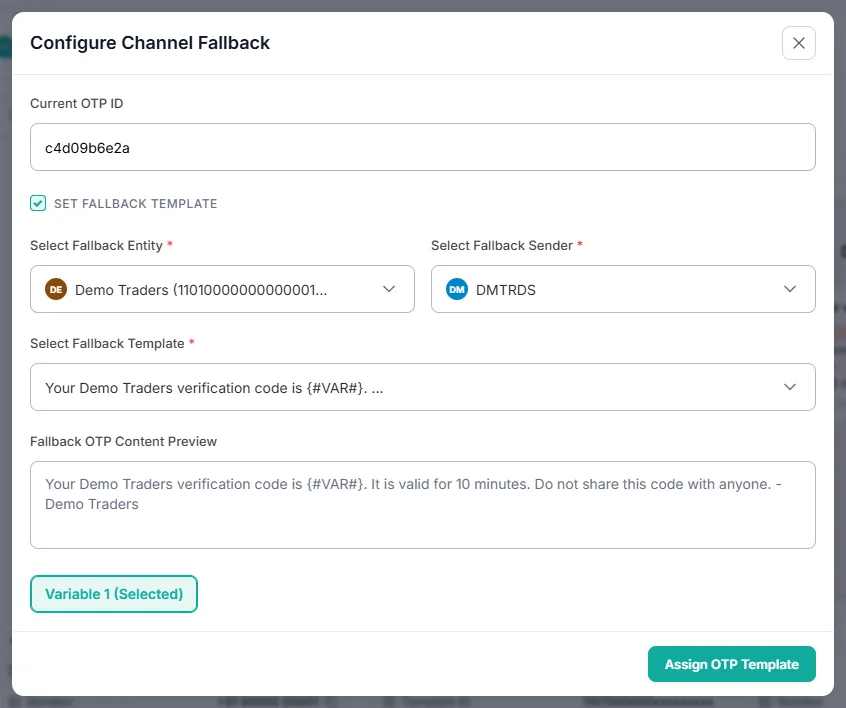
With Smart OTP, one API request sends the code on WhatsApp, and if WhatsApp reports the attempt as failed, Fast2SMS sends the same code by SMS automatically. Your app makes no second request. This section is a short summary; the full guide with code samples is the WhatsApp OTP API guide.
- One OTP ID. You create an OTP template in Smart OTP, choose WhatsApp (or SMS) as the primary channel and attach the other channel as fallback, each with its own approved template.
- Same code on both channels. The customer verifies the same OTP whichever channel delivered it.
- Fast. The WhatsApp OTP guide says the fallback goes out within about a minute, and only for attempts less than two minutes old, so a late backup never confuses a customer who has already left.
- Both directions. WhatsApp first with SMS fallback suits signups and delivery codes; SMS first with WhatsApp fallback suits login, payments and banking flows.
- Change without code. Switch the channel or the fallback in the panel; every app using that OTP ID follows at once.
- Pay for the channel used. A WhatsApp OTP costs ₹0.25 per delivered authentication message at the time of writing, failed WhatsApp attempts are refunded, and the SMS fallback is charged at your SMS rate.
One point to know: the OTP fallback fires when an attempt is reported as failed. A phone with no data may simply hold the WhatsApp message, so for audiences with weak mobile data the OTP guide suggests SMS first. Do not build OTPs in Campaign; Smart OTP is made for one-time codes and has the verify endpoint. The SMS side is on the OTP SMS page.
How does campaign fallback work?
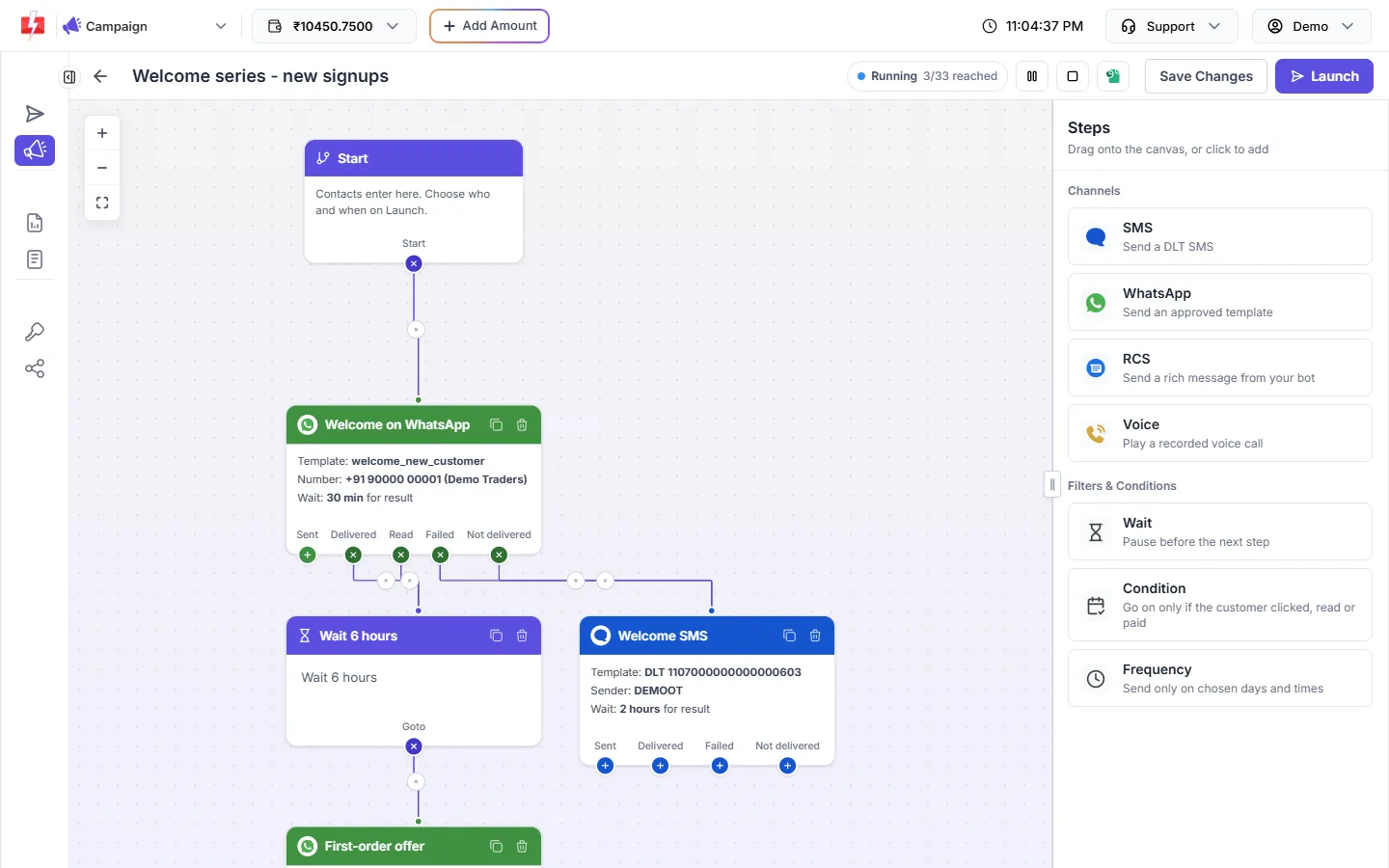
In Campaign, every WhatsApp step gives a result, and you draw a line from the results you care about to the backup step. Fallback is simply the failed and not delivered outputs wired to another channel.
| WhatsApp step output | What it means | Usual next step |
|---|---|---|
| Sent | Meta accepted the message | Nothing; wait for the final result |
| Delivered | It reached the phone | End, or a later follow-up |
| Read | The customer opened it | End, or check for a reply |
| Failed | WhatsApp said it cannot deliver (131049, not on WhatsApp, template problem) | Backup step at once |
| Not delivered | No final result within the result wait (default 30 minutes, settable 1 minute to 24 hours) | Backup step |
Things that make campaign fallback work well:
- Connect both failed and not delivered. Offline phones never give "failed"; they give "not delivered" when the wait ends.
- Pick the wait by urgency. Ten minutes for a delivery arriving soon, 30 minutes for a payment due today, a few hours for an offer that runs all week.
- Each step runs once per customer, and one customer's journey lasts at most 30 days, so the path always ends.
- Start it your way: upload a list, pick an Address Book group, or let your website, app, CRM or store backend start the journey with one API call to
POST https://www.fast2sms.com/dev/campaign/start. - Blocked numbers leave the journey. Numbers blocked on WhatsApp, unsubscribed on RCS or on the voice opt-out list are not pushed to another channel.
Beyond failures, a Condition step can look at the WhatsApp result or at "Reply received (WhatsApp / RCS)". That is how the ready journey "WhatsApp, no reply: call, then SMS" works for leads. Remember that some customers switch off read receipts, so "not read" does not always mean "not seen".
OTP fallback vs campaign fallback: comparison
Use Smart OTP for one-time codes and Campaign for everything else. The table shows how the two differ.
| Smart OTP fallback | Campaign fallback | |
|---|---|---|
| Made for | Login, signup, checkout and delivery OTPs | Reminders, order updates, offers, notices, follow-ups |
| How it starts | Your app calls the OTP send API with an OTP ID | A list, an Address Book group, or one API call to /dev/campaign/start |
| Channels | WhatsApp and SMS, either one first | WhatsApp, RCS, SMS and voice, in any order you draw |
| When the backup fires | When the first attempt is reported failed, within about a minute | At once on failed, or after the result wait on not delivered |
| Phone with no data | WhatsApp may wait for the phone; choose SMS first for such users | Becomes "not delivered" after your wait, then the backup sends |
| Content of the backup | The same code | Your own SMS, RCS or voice version of the message |
| What you prepare | WhatsApp authentication template + DLT SMS template | WhatsApp template + DLT SMS template, plus an RCS bot or voice file if used |
| Verification | Built-in verify endpoint | Not needed |
| Reports | OTP report, each attempt on its own line | Campaign Report per step and per number, plus webhooks |
| Cost | Rate of the channel that carried the code | Each step at its channel rate; no campaign or fallback fee |
| Full guide | WhatsApp OTP API | SMS fallback and this page |
How does WhatsApp to RCS fallback work?
Connect the WhatsApp step's failed and not delivered outputs to an RCS step, and the RCS step's failed and not delivered outputs to an SMS step. Customers WhatsApp missed get a rich RCS message on Android, and anyone RCS cannot reach still gets the SMS.
Why add RCS in the middle instead of going straight to SMS:
- The image and buttons survive. An RCS step can send plain text, a rich card, media, a carousel of 2 or more cards, or suggestion buttons, from your approved, active RCS bot. A product image or a "Track order" button reaches more customers than plain SMS can carry.
- No DLT template for the RCS step. RCS uses your approved RCS bot. The SMS step at the end still needs your DLT template.
- Price at the time of writing: RCS from ₹0.35 per message, the same for text, media and rich cards. See RCS pricing.
- Phones without RCS move on. If RCS fails or the phone does not support RCS, the next step sends. You do not need to know in advance which phones have RCS.
- Sending hours differ. Promotional RCS bots send between 7 AM and 10 PM. There is no single sending window for every channel, so a Frequency step at the start keeps the whole journey in daytime.
You can also run it the other way: RCS first, WhatsApp if RCS fails, then SMS. The ready journeys "Rich RCS card, then WhatsApp, then SMS" and "RCS invite card, WhatsApp if not supported" do this. For "WhatsApp offer, RCS card if no click in 3 days", note that clicks only exist when your own software posts them to the Campaign event API; Fast2SMS does not track link clicks on its own. More on RCS is on the RCS SMS page.
Timing table: WhatsApp, RCS, SMS, then a call
A delivery-day journey for an online store. The store backend starts it with one API call when the parcel goes out for delivery.
| Step | When | Channel | Message | If it fails |
|---|---|---|---|---|
| 1 | 09:00, API call from your store system | WhatsApp utility template with a Track button | Hi Priya, your order 5521 from Demo Traders arrives today. | Failed: step 2 at once. Not delivered after 15 minutes: step 2 |
| 2 | 09:00 to 09:15 | RCS rich card with a Track button | Same update with a product image | Failed, phone without RCS, or not delivered after 15 minutes: step 3 |
| 3 | 09:15 to 09:30 | SMS (DLT service template) | Your Demo Traders order 5521 arrives today. Track: short link | Failed or not delivered after 120 minutes: step 4 |
| 4 | Frequency step 10:00 to 19:00, then a call | Voice (recorded, simple) | "Your Demo Traders order arrives today. Please keep your phone on." | Journey ends; number listed as unreached |
In a journey like this most customers stop at step 1. The rest are caught by RCS or SMS, and only a few ever get the call. For calls in more depth, including press 1 and call patch options, see the voice campaign guide.
Which fallback fits which message?
Match the backup to how urgent and how rich the message is. Urgent and simple: SMS fast. Rich and not urgent: RCS, or WhatsApp again later.
| Message | WhatsApp category | Fallback order | Suggested result wait |
|---|---|---|---|
| Login or signup OTP | Authentication | Smart OTP: WhatsApp → SMS (or SMS → WhatsApp) | Built in, about a minute |
| Delivery arriving today | Utility | WhatsApp → RCS → SMS | 10 to 15 minutes |
| Payment due today | Utility | WhatsApp → SMS → voice call | 30 minutes |
| Appointment tomorrow | Utility | WhatsApp → SMS | 1 to 2 hours |
| Offer valid all week | Marketing | WhatsApp → RCS card → SMS with the code | 2 to 6 hours |
| Offer hit by 131049 | Marketing | Failed → Wait 1 day → WhatsApp again → SMS | Failed fires at once |
| Event on the day | Utility | WhatsApp → SMS → call on the day | 30 minutes |
The second WhatsApp step in the 131049 row is a separate step with the same template, because each step runs once per customer. The lender and clinic versions are in the guides for payment reminders and appointment reminders.
How much does WhatsApp fallback cost?
Fallback itself is free. You pay the normal rate of each message that is actually sent, from one wallet, with no setup, campaign or monthly fee.
| Channel | Price at the time of writing | Notes |
|---|---|---|
| ₹0.95 marketing, ₹0.25 utility, ₹0.25 authentication, ₹0.13 service | Failed messages refunded under the WhatsApp policy | |
| SMS | ₹0.25 per SMS from a ₹100 recharge, down to ₹0.11 on bigger slabs | DLT template needed |
| RCS | From ₹0.35 per message | Same price for text, media and rich cards |
| Voice call | ₹0.25 per 15-second pulse | Answered calls only |
Cost example: 10,000 delivery updates
The failure shares are examples to show the maths, not measured Fast2SMS figures. Failed WhatsApp messages are counted at ₹0 because they are refunded.
| Plan | What is sent | Cost | Customers missed |
|---|---|---|---|
| WhatsApp only | 9,300 delivered at ₹0.25 (700 fail) | ₹2,325 | 700 |
| WhatsApp → SMS | 9,300 WhatsApp + 700 SMS at ₹0.25 | ₹2,500 | Almost none |
| WhatsApp → RCS → SMS | 9,300 WhatsApp + 400 RCS at ₹0.35 + 300 SMS at ₹0.25 | ₹2,540 | Almost none, and 400 more customers see the image |
| Smart OTP, 10,000 OTPs | 9,200 WhatsApp at ₹0.25 + 800 SMS at ₹0.25 | ₹2,500 | Almost none |
The SMS backup adds ₹175 to reach 700 more customers. A WhatsApp message that ends as "not delivered" was still sent, so it is charged; if it arrives later the customer gets both messages. SMS refunds apply only on accounts with On Delivery billing. Live rates: WhatsApp pricing, SMS pricing, RCS pricing.
How to set it up in Fast2SMS
For OTPs (Smart OTP)
- Get an authentication template approved on your WhatsApp Business API number.
- Open Smart OTP → Add OTP Template, choose WhatsApp and pick the approved template.
- Open Configure Channel Fallback and attach an SMS template from your DLT-approved content.
- Copy the OTP ID, use it in your send request and test with your own number. Code is in the WhatsApp OTP API guide.
For campaigns and notifications (Campaign)
- Prepare the channels. An approved WhatsApp template; a DLT sender and an SMS template with the short version of the message; an approved RCS bot or an approved voice file if you use them.
- Open Campaign. Campaign → Launch Campaign, or Campaign List → Create Campaign.
- Start from a ready journey, such as "WhatsApp update, SMS in 5 min if it fails" or "WhatsApp offer then SMS if not delivered", or start blank.
- Set the audience on the Start step: a CSV, TXT, XLSX or XLS sheet (up to 20 MB and 10 lakh rows), an Address Book group, pasted numbers, or numbers added later by API.
- Configure the WhatsApp step, map its variables to your sheet columns and set the result wait.
- Connect failed and not delivered to the backup step: SMS, RCS or Voice. Map the SMS variables to the same columns.
- Add the next backup on the backup step's own failed and not delivered outputs if needed, with a Frequency step before any call.
- Send test to up to 10 numbers, including one number without WhatsApp, so you see the fallback fire. Test sends are charged like normal sends.
- Choose Send now, Schedule or Repeat, check the cost estimate and launch.
All 16 ready journeys, including the fallback ones, are on the Campaign product page.
Backup templates you can copy
Write the WhatsApp message first, then a short SMS version for DLT and, if you use RCS, a card version. In DLT templates, each {#var#} is a variable, and each value must be 30 characters or less.
| Use | WhatsApp template | SMS backup (DLT) | RCS backup |
|---|---|---|---|
| Order out for delivery | Hi Rahul, your order 5521 from Demo Traders is out for delivery today. Tap Track to follow it. | Your Demo Traders order {#var#} is out for delivery today. Track: {#var#} -Demo Traders | Card: product image, "Arriving today", buttons Track order and Call us |
| Payment due | Hi Rahul, ₹2,400 is due today for invoice 1045. Tap Pay now to pay safely. | Dear {#var#}, Rs {#var#} is due today. Pay: {#var#} -Demo Traders | Card: "Payment due today", amount, button Pay now |
| Appointment reminder | Hi Priya, your appointment at Demo Clinic is tomorrow at 11:30 am. Reply here to change it. | Reminder: your Demo Clinic appointment is tomorrow at {#var#}. Call {#var#} to change. -Demo Clinic | Card: clinic photo, time, buttons Get directions and Call clinic |
| Weekly offer | Hi Priya, this week only: 20% off at your store. Use code WEEK20. Tap Shop now. | {#var#} off this week at Demo Traders. Code {#var#}. Shop: {#var#} T&C apply | Carousel: 3 product cards, each with a Shop now button |
| Event today | Hi Rahul, the Demo Events workshop starts today at 5 pm. Tap Join to open the link. | Demo Events workshop today at {#var#}. Join: {#var#} -Demo Events | Card: event banner, time, button Join now |
Keep the SMS to one part where you can; a long WhatsApp link may need a shorter link to stay inside the 30-character variable limit. The WhatsApp column shows sample values; in the panel you map each WhatsApp placeholder to a sheet column or fixed text. The {#var#} marks are for the DLT SMS side.
How do you check the fallback worked?
Look at the WhatsApp step's failure reasons and at how many customers entered the backup step. If the two match, the fallback is catching everyone it should.
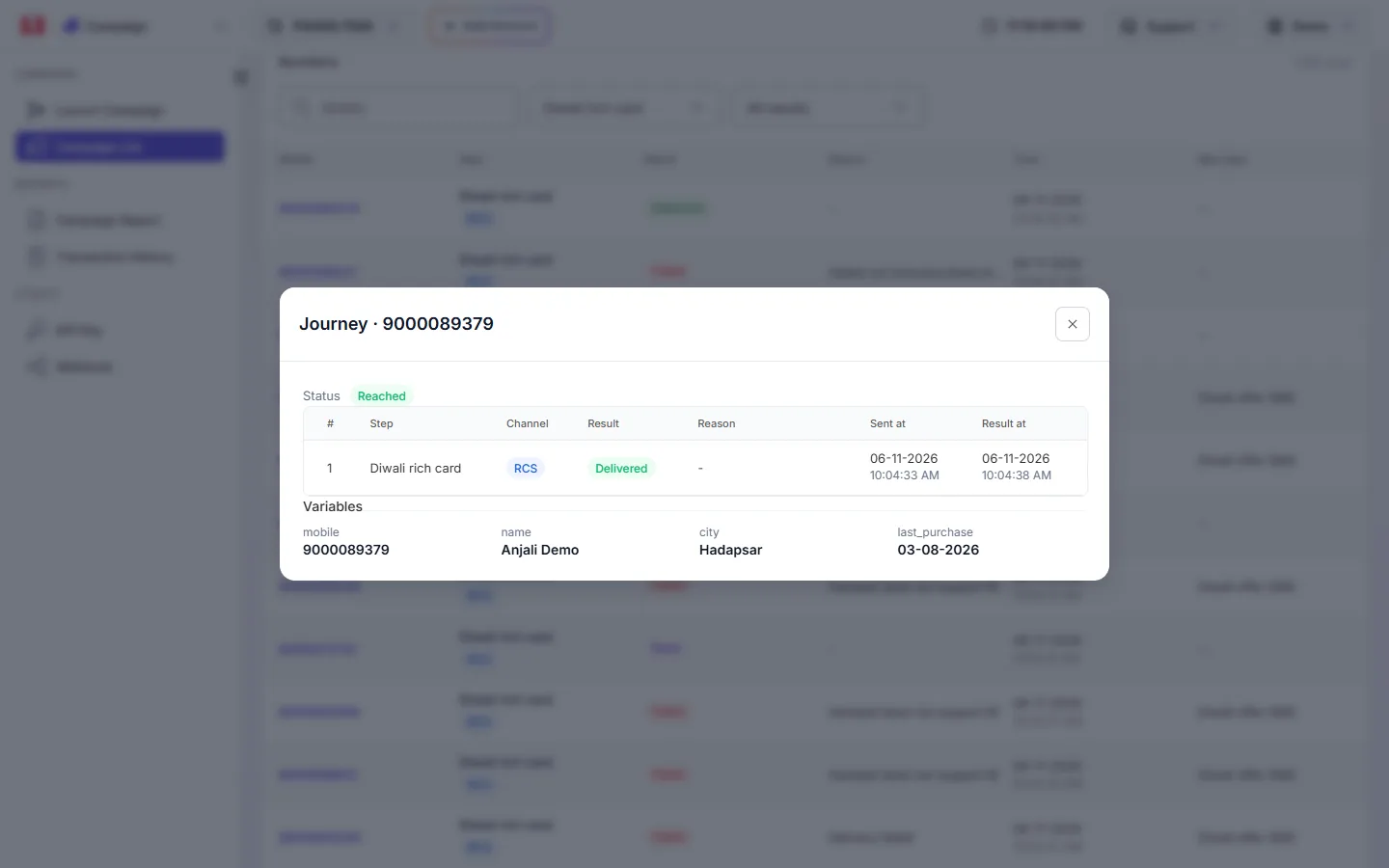
- Campaign Report, per step: entered, sent, delivered, read, failed and not delivered, with average time, cost and top failure reasons such as 131049.
- Per number: one customer's whole path, for example "WhatsApp failed (131049) → RCS failed → SMS delivered".
- Run totals: reached, unreached, opted out, cost, refund and net cost.
- Webhooks: each step result goes to your server with the step name, channel, status, reason, cost and next step (Webhook → Campaign).
- OTPs: the OTP report shows each attempt, WhatsApp and SMS, on its own line.
If one reason dominates, fix the cause as well as catching it. Many 131049 failures mean too many marketing messages; many "not on WhatsApp" failures mean SMS or RCS should go first for that list.
Mistakes to avoid
- Wiring only "failed". Offline phones end as "not delivered". Connect both outputs.
- A result wait that is too short for offers. Late WhatsApp receipts turn into double messages and double cost.
- A result wait that is too long for urgent updates. A delivery alert two hours late is useless.
- No DLT template for the backup. The SMS step cannot send free text. Register the short version before launch.
- Building OTPs in Campaign. Use Smart OTP; it has the same-code fallback and the verify endpoint.
- Resending WhatsApp at once after 131049. Send SMS now, or wait a day before WhatsApp again.
- Ignoring a paused template. Fallback hides the problem; fix the template so WhatsApp works again.
- Pushing blocked customers to SMS. A block is a no. Do not re-add those numbers on another channel.
- Calls at night. Put a Frequency step before any voice fallback.
- Not testing with a number without WhatsApp. You never see the backup path until a real customer needs it.
Why build WhatsApp fallback with Fast2SMS?
- Both kinds in one account: Smart OTP for codes and Campaign for journeys, sharing one wallet and one API key.
- Four channels to fall back to and from: WhatsApp, RCS, SMS and voice. See the omnichannel marketing platform guide.
- No fallback fee: pay only for backup messages that are sent; failed WhatsApp messages are refunded.
- Your timing: a result wait on every step, from 1 minute to 24 hours.
- Clear reasons for every failed number, in reports and webhooks.
Open the WhatsApp fallback journey builder, start from a ready journey, and test it on one phone with WhatsApp and one without.
Frequently asked questions
What is WhatsApp fallback?
WhatsApp fallback is a backup rule: when a WhatsApp message fails or is not delivered, the information goes out another way, usually by SMS, RCS or a voice call. On Fast2SMS it works for OTPs through Smart OTP and for campaigns and notifications through Campaign.
What does WhatsApp failover mean?
It means the same as WhatsApp fallback: switching to another channel when WhatsApp cannot deliver, so the customer still gets the message.
What is WhatsApp fallback to SMS?
If a WhatsApp message fails or is not delivered within the time you set, the customer gets an SMS from your DLT-approved template instead. The SMS fallback guide covers the SMS side in depth.
What are the two kinds of WhatsApp fallback on Fast2SMS?
OTP fallback with Smart OTP, where the same code is resent by SMS if WhatsApp fails, and campaign fallback with Campaign, where a WhatsApp step's failed or not delivered output leads to an SMS, RCS or voice step.
Which one should I use?
Use Smart OTP for one-time codes. Use Campaign for reminders, order updates, offers, notices and follow-ups.
Does every customer get the backup message?
No. Only the customers WhatsApp could not reach get it. If WhatsApp delivers to most of your list, only the rest get an SMS, RCS message or call.
Do I need to check which numbers have WhatsApp first?
No. Send on WhatsApp and let the failed output catch the numbers that are not on WhatsApp.
Why are my WhatsApp messages not delivered?
The usual reasons are: the number is not on WhatsApp, Meta's per-person marketing limit (error 131049), a paused or disabled template, or a phone that is off or offline. A customer who blocked your number also cannot be reached on WhatsApp.
What is WhatsApp error 131049?
It means Meta did not deliver a marketing message because the person has recently received many marketing messages from businesses. It depends on the customer, not your number, and the failed message is refunded under the WhatsApp policy.
What should I do after error 131049?
Send the offer by SMS now, or wait a day and try WhatsApp again with a second WhatsApp step, then SMS. An RCS card is another option for Android users. Resending at once does not help.
Does error 131049 affect utility or OTP messages?
The limit is aimed at marketing messages. Order updates, reminders and OTPs sent as utility or authentication templates are not its target.
What is WhatsApp error 131026?
It is an error shown when WhatsApp cannot deliver to that number, for example when the number does not use WhatsApp. A fallback to SMS or RCS reaches these customers.
What happens when my WhatsApp template is paused?
Meta can pause and later disable a template after quality problems, such as many customers blocking or reporting it. Messages using it cannot be sent, so a fallback keeps the journey working while you fix or replace the template.
What if the customer's phone is switched off?
WhatsApp holds the message until the phone is back online. In Campaign the step ends as "not delivered" after the result wait you set, and the backup sends.
What does one grey tick mean on a business WhatsApp message?
One grey tick means sent but not yet delivered, usually because the phone is offline. Two grey ticks mean delivered and two blue ticks mean read.
Why does a message show sent but not delivered?
The phone has not come online, or WhatsApp has not been opened for a while. It may still arrive later. Decide how long the message stays useful and set the result wait to match.
WhatsApp message not delivered: what should I do next?
Check whether it failed or is only waiting, read the failure reason, check the template status and the number. Then send a backup by SMS, RCS or a call, and set up fallback so it happens on its own next time.
What if the customer blocked my WhatsApp number?
In Campaign, numbers blocked on WhatsApp leave the journey and are not pushed to another channel. Treat a block as a no.
Is a failed WhatsApp message charged?
Failed WhatsApp messages are refunded under the WhatsApp refund policy. A message that ends as "not delivered" was sent, so it is charged.
What is WhatsApp OTP fallback?
With Smart OTP, your app sends one request, the code goes out on WhatsApp, and if WhatsApp reports a failure the same code is sent by SMS automatically. Full details are in the WhatsApp OTP API guide.
Does my app need a second API call for the SMS OTP?
No. The fallback is built into Smart OTP. Your app makes one send request and one verify request, whichever channel delivered the code.
Is the same OTP sent on SMS?
Yes. The fallback carries the same code, so the customer verifies one OTP.
How fast is the WhatsApp OTP fallback?
The WhatsApp OTP API guide says the fallback goes out within about a minute, and only for attempts less than two minutes old.
Can OTP fallback go from SMS to WhatsApp?
Yes. Smart OTP works both ways. SMS first with WhatsApp fallback suits login, payment and banking flows; WhatsApp first with SMS fallback suits signups and delivery codes.
Does WhatsApp OTP fall back when the phone has no internet?
The OTP fallback fires when an attempt is reported as failed. A phone with no data may hold the WhatsApp message, so for audiences with weak data an SMS-first order is safer.
How do I set up WhatsApp OTP with SMS fallback?
In Smart OTP, add an OTP template with WhatsApp and your approved authentication template, open Configure Channel Fallback and attach a DLT SMS template, then use the OTP ID in your send request.
What does a WhatsApp OTP cost?
At the time of writing, ₹0.25 per delivered authentication message, with failed attempts refunded. The SMS fallback is charged at your SMS rate. See WhatsApp pricing.
Can I use Campaign for OTPs?
It is not the right tool. Smart OTP is built for one-time codes, with the same-code fallback and a verify endpoint.
How does WhatsApp fallback work in Campaign?
Each WhatsApp step gives sent, delivered, read, failed and not delivered outputs. You connect failed and not delivered to an SMS, RCS or voice step, and that step sends only for the customers who reached it.
What is the difference between failed and not delivered?
Failed means WhatsApp said it cannot deliver, so the backup sends at once. Not delivered means no final result arrived within the result wait; the message may still arrive later.
How long does Campaign wait before falling back?
The default result wait for WhatsApp is 30 minutes, and you can set it from 1 minute to 24 hours. A failed result skips the wait.
What result wait should I use?
Short for urgent messages (10 to 15 minutes for a delivery arriving soon), 30 minutes for a payment due today, 1 to 2 hours for an appointment tomorrow, and a few hours for an offer that runs all week.
Can a customer get both the WhatsApp and the SMS?
Yes, if the WhatsApp message arrives after the result wait has ended and the SMS has gone. A longer wait reduces this; for urgent messages it is usually acceptable.
Which ready journeys have WhatsApp fallback?
Examples are "WhatsApp offer then SMS if not delivered", "WhatsApp update, SMS in 5 min if it fails", "WhatsApp invite, SMS if not delivered, call on the day" and "Rich RCS card, then WhatsApp, then SMS". Pick them under Start from a ready journey.
Can my website start a journey with WhatsApp fallback?
Yes. Your website, app, CRM or store backend calls POST https://www.fast2sms.com/dev/campaign/start with the campaign ID and the numbers, and the journey starts at once. See event-triggered messaging.
Can I fall back when a WhatsApp message is delivered but not read?
Yes. Add a Wait step and a Condition step that checks the WhatsApp step result, and send an SMS to those who have not read it. Some customers switch off read receipts, so "not read" does not always mean "not seen".
Can I follow up when the customer does not reply on WhatsApp?
Yes. A Condition step can check "Reply received (WhatsApp / RCS)". The ready journey "WhatsApp, no reply: call, then SMS" does this for leads.
Can I send a free-text WhatsApp message in a journey?
Campaign uses approved Meta templates. "Direct Send (Utility)" free text is available only on numbers with the 100K or unlimited tier.
What is WhatsApp to RCS fallback?
When WhatsApp fails or is not delivered, an RCS message with images and buttons is sent from your approved RCS bot. If RCS also fails or the phone does not support RCS, the next step, usually SMS, sends.
Why fall back to RCS instead of SMS?
RCS can carry rich cards, media, carousels and suggestion buttons, so the image and buttons reach Android customers WhatsApp missed. SMS stays as the last step for everyone else.
Do I need to know which phones support RCS?
No. If the phone does not support RCS, the RCS step ends as failed and the next step sends.
What does an RCS fallback message cost?
From ₹0.35 per message at the time of writing, the same for text, media and rich cards. See RCS pricing.
When can promotional RCS messages be sent?
Promotional RCS bots send between 7 AM and 10 PM. Other channels have their own rules, so a Frequency step keeps the whole journey in daytime.
Can a voice call be the WhatsApp fallback?
Yes. Connect the failed and not delivered outputs to a voice step, usually after an SMS step, with a Frequency step before it. Calls cost ₹0.25 per 15-second pulse for answered calls only, at the time of writing. See the voice campaign guide.
Can the fallback call say the customer's name?
No. Voice uses recorded audio that is the same for everyone. Put names and amounts in the SMS.
Does the SMS fallback need DLT?
Yes. The backup SMS must use a DLT-approved template linked to your sender, and each variable value must be 30 characters or less.
Can I send the WhatsApp text as it is by SMS?
Only if it matches a DLT-approved template. Keep a short SMS version of each WhatsApp message registered on DLT before launch.
Will a promotional SMS fallback send at night?
No. A promotional SMS is held outside the promotional window when that rule applies. Service SMS can go at any time.
Does WhatsApp fallback cost extra?
There is no fallback fee, campaign fee or monthly fee. You pay the normal rate of each backup message that is sent.
What does WhatsApp fallback to SMS cost for 10,000 messages?
As an example, if 700 of 10,000 utility WhatsApp messages fail, the 700 backup SMS cost ₹175 at ₹0.25 each, at the time of writing. The failed WhatsApp messages are refunded.
What are the WhatsApp prices on Fast2SMS?
At the time of writing: ₹0.95 per marketing message, ₹0.25 per utility message, ₹0.25 per authentication message and ₹0.13 per service reply. See WhatsApp pricing.
What does the SMS fallback cost?
₹0.25 per SMS from a ₹100 recharge, down to ₹0.11 on bigger slabs, at the time of writing. See SMS pricing.
How do I check that the fallback worked?
In the Campaign Report, compare the WhatsApp step's failed and not delivered counts with the number of customers who entered the backup step. Each number also shows its full path, such as "WhatsApp failed (131049) → SMS delivered".
Can I get fallback results on my server?
Yes. Campaign webhooks post every step result with the step name, channel, status, reason, cost and next step. Smart OTP attempts also reach your webhook.
How do I test WhatsApp fallback?
Use Send test for up to 10 numbers and include one number without WhatsApp, so you see the backup path fire. Test sends are charged like normal sends.
Does WhatsApp fallback work for international numbers?
No. Campaign accepts Indian mobile numbers only, 10 digits starting with 6 to 9.
Is there an automatic STOP opt-out in the fallback?
No. There is no automatic STOP keyword handling. Numbers blocked on WhatsApp, unsubscribed on RCS or on the voice opt-out list leave the journey; remove other stop requests from your list yourself.
Why build WhatsApp fallback with Fast2SMS?
You get Smart OTP for codes and Campaign for journeys in one account, four channels (WhatsApp, RCS, SMS, voice), no fallback fee and a reason for every failed number. Read the omnichannel marketing platform guide or open Campaign.