Use push notifications for people who have your app and allowed notifications, email for long content and documents people keep, and RCS when you want a branded, rich message in the phone’s messaging app of customers who only gave you their mobile number. Most businesses use two or three of them together, with SMS as the backup that reaches every phone.
This page compares RCS, push notifications and email on reach, content, cost, tracking and rules, and shows which to pick for common messages.
RCS vs push notifications vs email at a glance
| Point | RCS | Push notification | |
|---|---|---|---|
| What you need from the customer | Mobile number and opt-in | Your app installed and notifications allowed | Email address and consent |
| Who it reaches | Phones with RCS on and internet | Only your app’s users | Anyone with that email address |
| Where it appears | The phone’s messaging app, under your verified brand name and logo | Notification shade, among other apps’ alerts | Inbox, or a promotions or spam folder |
| Content | Text, images, video, PDF, cards, carousels, buttons | Short title and text, sometimes an image | Long text, any layout, attachments |
| Replies | Yes, as a chat | No, it opens your app | Yes, by email |
| Delivery and read status | Delivered and Read per number | Depends on your app’s tracking | Opens are hard to measure exactly |
| Setup | RCS brand registration | Building and keeping an app | Email sending tool and domain setup |
| Cost per message | Paid per message | No per-message fee from the phone platforms, but the app has its own cost | Low per email, usually through a monthly plan |
When RCS is the better choice
- You have numbers, not app users. Most shops, clinics and service businesses have their customers’ mobile numbers but no app. RCS reaches them in the messaging app they already open every day.
- You need trust. The chat shows your brand name, logo and a verified tick, which an email “from” name or a notification cannot match.
- The message is visual and short. A product photo with a Shop now button, or a carousel of 4 products.
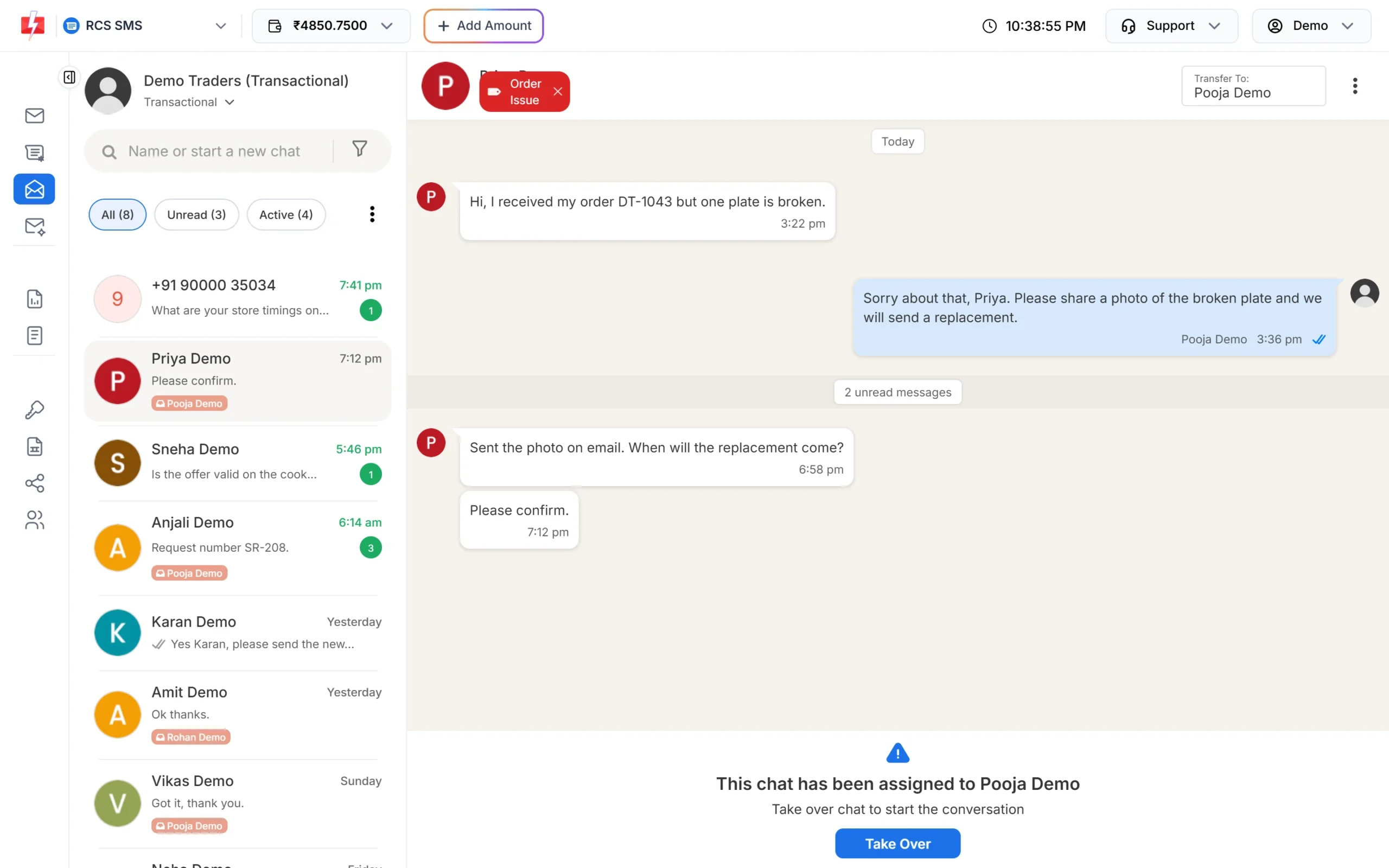
- You want replies. Customers type back, and your team answers from Live Chat (Inbox) in Fast2SMS.
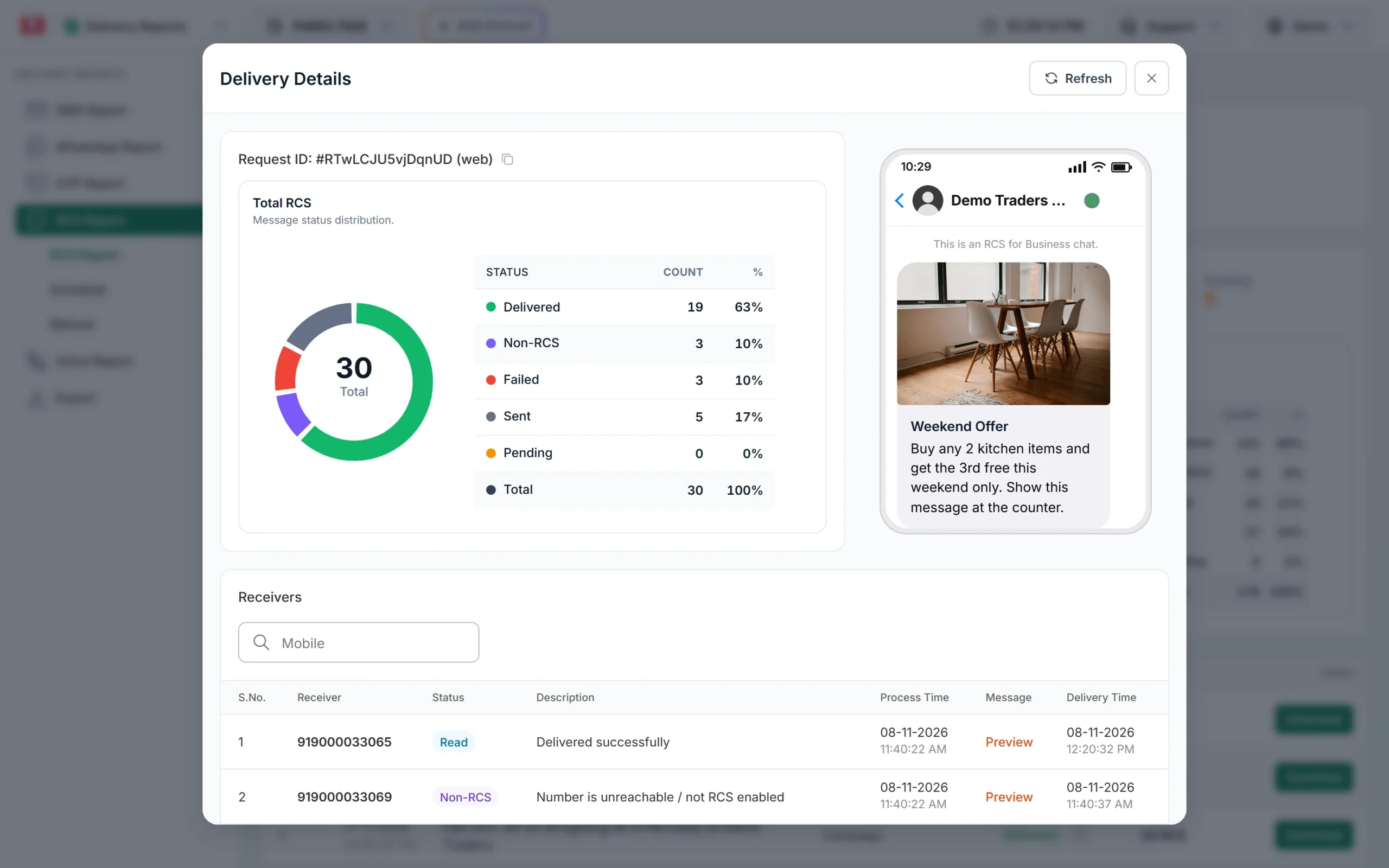
- You want proof it was seen. The RCS report shows Read for each number that opened the message.
When push notifications are the better choice
- The customer is using your app. In-app events like “your cab has arrived” or “price dropped on your wishlist item” fit push best.
- Very frequent, small alerts. Live score, live order tracking, chat alerts inside your app.
- No per-message cost matters. Once the app exists, sending push has no per-message fee from the phone platforms.
The catch: push only reaches people who installed your app, kept it, and allowed notifications. Newer Android versions and iPhones ask the user before an app can show notifications, and people who uninstall the app get nothing.
When email is the better choice
- Long or detailed content. Newsletters, policy updates, account statements, course material.
- Documents people file away. GST invoices, contracts and reports that customers forward to their accountant.
- Business customers. B2B buyers often work from email during office hours.
The catch: promotional email often lands in a promotions or spam folder, and people check email less often than their messaging app.
Which channel for which message
| Message | First choice | Backup |
|---|---|---|
| Login OTP | Smart OTP (SMS and WhatsApp with fallback) | Email OTP for web logins |
| Order confirmation with invoice | RCS from a transactional bot with the PDF, or email | SMS with a link |
| Delivery update | Push if they have your app, else RCS transactional | SMS |
| Festival or weekend offer | RCS rich card or carousel from a promotional bot | Promotional SMS, email |
| Abandoned cart reminder | Push for app users, RCS promotional for others | |
| Monthly newsletter | None needed | |
| Win back customers who deleted your app | RCS or SMS | |
| Payment due reminder | RCS transactional or SMS | Voice call for overdue cases |
Google lists abandoned cart reminders as promotional RCS, so send them from your promotional bot.
RCS rules and cost to keep in mind
- Promotional RCS from Fast2SMS can go only from 7:00 AM to 10:00 PM, and each number can get up to 4 promotional RCS a month. Transactional bots have neither limit, but are only for informative messages.
- Not every phone has RCS. Non-RCS numbers get nothing, and Fast2SMS does not switch them to SMS automatically today. Plan an SMS for messages everyone must get.
- At the time of writing, Fast2SMS charges ₹0.35 per RCS message for every type. Failed and Non-RCS numbers are refunded within 48 hours. See the RCS pricing page.
Sending in bulk? For high RCS volumes our team offers discounted rates. Talk to our team or see RCS pricing.
Using them together
A simple setup for a small online shop: email for invoices and the monthly newsletter, push for app users, RCS for offers and order updates to customers who only gave a number, and SMS for anyone RCS cannot reach. Keep the opt-in for each channel separate, and honour STOP or unsubscribe on each one.
Frequently asked questions
Is RCS better than push notifications?
For customers without your app, yes, because push cannot reach them at all. For active app users, push is cheaper and fits in-app events better.
Is RCS better than email marketing?
For short, visual offers and quick replies, RCS usually gets seen faster in the messaging app. For long content and documents customers keep, email is better.
Do customers need an app to get RCS?
No extra app. RCS arrives in the phone’s messaging app, such as Google Messages on Android, when RCS is turned on.
Can I see if an RCS message was read?
Yes. The Fast2SMS RCS report marks numbers that opened the message as Read.
Does Fast2SMS send push notifications or email?
No. Fast2SMS sends SMS, WhatsApp, RCS, OTP and voice calls. Push comes from your app, and email from your email tool.
Can RCS replace SMS?
Not fully. RCS reaches only phones with RCS on and internet. Keep SMS for messages that must reach everyone.