On WhatsApp Business API, messages your customers send you are free. You pay for the messages you send: templates by category (Marketing, Utility, Authentication) and replies inside the 24-hour window as service (session) messages. This guide explains Meta’s per-message pricing in simple words, the changes Meta made in 2025 and October 2026, and exactly which WhatsApp messages are free and which are charged on Fast2SMS.
Per-message pricing in one minute
Since 1 July 2025, Meta charges for each delivered WhatsApp message instead of for 24-hour “conversations”. The price depends on two things:
- The category of the message: Marketing, Utility, Authentication or Service.
- The country of the customer’s number.
Meta also says businesses are charged only when a message is delivered, and that it does not charge for messages from customers to businesses.
Which WhatsApp messages are free and which are charged
| Message | Meta’s rule (at the time of writing) | On Fast2SMS (at the time of writing) |
|---|---|---|
| Customer messages you | Free | Free (Incoming ₹0) |
| Marketing template (offers, promotions) | Charged per delivered message | ₹0.95 per message |
| Utility template (order, payment, delivery updates) | Charged. It was free inside an open 24-hour window from July 2025, but Meta charges it again from 1 October 2026. | ₹0.25 per message |
| Authentication template (OTP) | Charged. Some international markets have a higher authentication-international rate. | ₹0.25 per message |
| Service (free-form reply within 24 hours) | From 1 October 2026, each number gets 1,000 free delivered service messages a month, then they are charged | ₹0.13 per reply (session message) |
| Message that fails or is not delivered | Not charged | Refunded to your wallet automatically |
Sending in bulk? For high WhatsApp volumes our team offers discounted rates. Talk to our team or see WhatsApp pricing.
Rates can change, and your account may have its own rates. Always check the WhatsApp pricing page and the rates shown in your panel.
Where you see your rates in the Fast2SMS panel
-
On the WhatsApp connect page
Before you connect a number, the Official WhatsApp Business API Registration Process page shows “No Monthly or Setup Cost – Pay Per Message (on delivery)” and your rates for Auth/Utility, Marketing and Session.
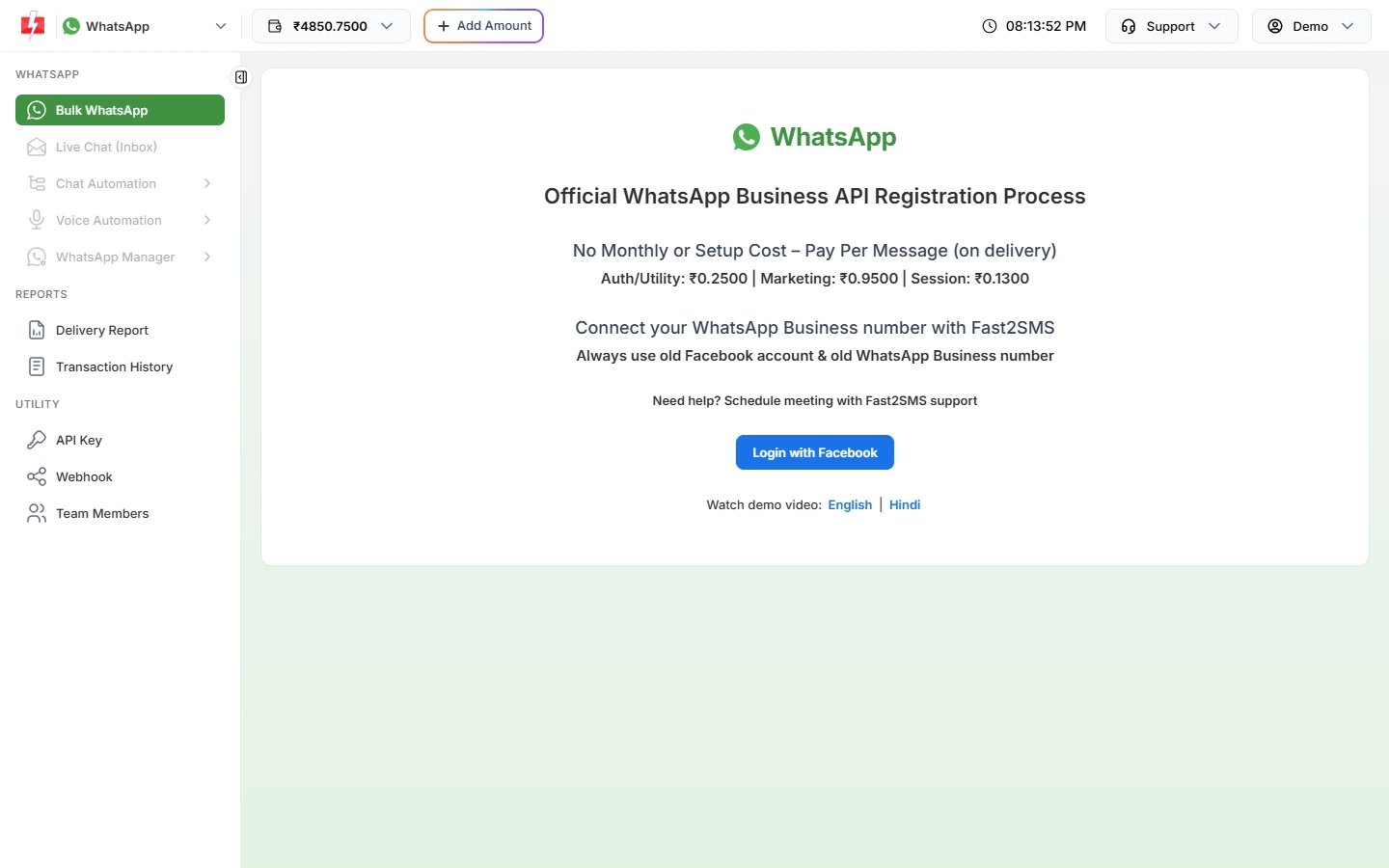
Your per-message rates on the connect page. -
In Live Chat
The Live Chat empty screen shows “Incoming: Free | Outgoing: ₹0.13 (13 paise) per session message”. Each reply you send costs one session message: one text, one batch of files or one voice note. Automatic replies (welcome message, auto reply, out-of-office, delayed response) are also charged at the session rate.
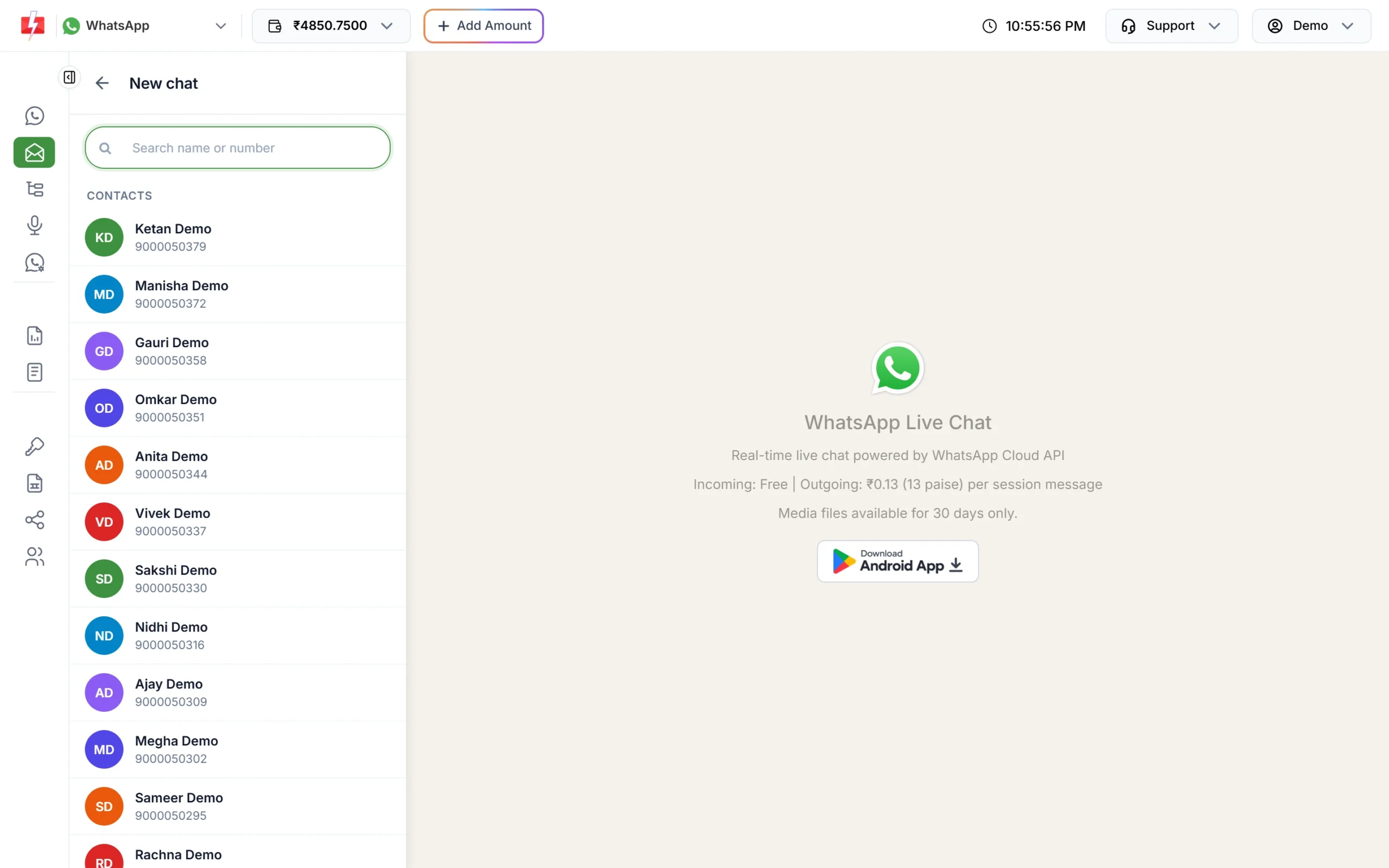
Incoming messages are free; replies are charged per session message. -
Before every campaign
When you click Send on Bulk WhatsApp, the Message Preview & Confirmation window shows Cost per SMS for the template’s category and the total for the valid numbers.
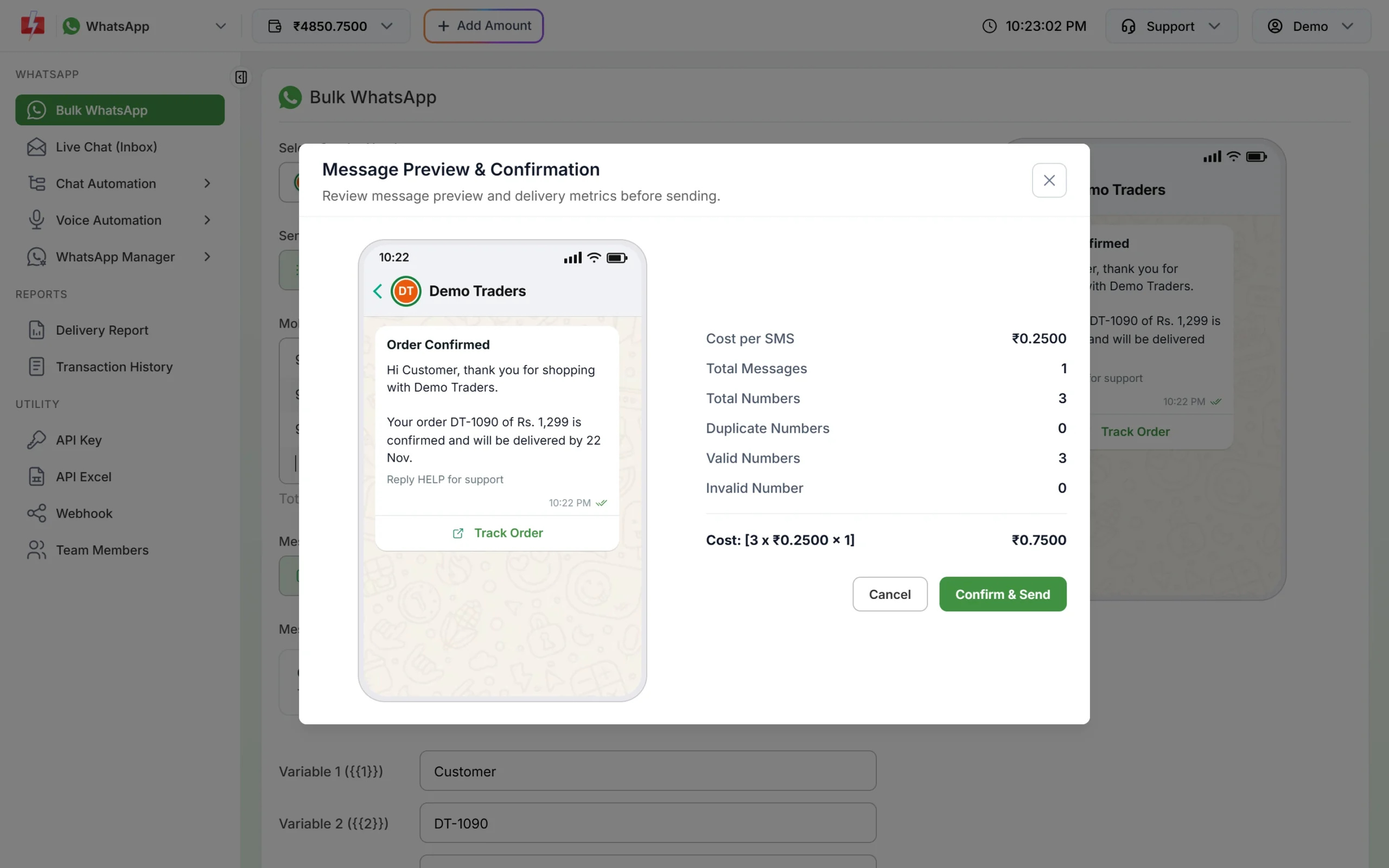
The template’s category sets the cost per message.
Are replies to customers free?
Receiving messages is free. Replying is a paid service message on Fast2SMS, at ₹0.13 per reply at the time of writing. Meta itself started charging for service messages above 1,000 per number per month from 1 October 2026. If your team mostly replies to customers, your cost per chat stays low, because one reply can answer several questions.
Are utility templates free inside the 24-hour window?
This is where many older blog posts are now wrong. Meta made utility templates sent inside an open customer service window free from 1 July 2025, then started charging them again from 1 October 2026. On Fast2SMS, every template is charged at its category rate, so a utility template costs ₹0.25 at the time of writing whether or not the customer wrote to you recently.
Are Click-to-WhatsApp ad chats free?
Meta has a “free entry point” rule. When a customer messages you from a Click-to-WhatsApp ad on the WhatsApp Android or iOS app, and you reply within the 24-hour window, Meta does not charge that reply and opens a free window that can last up to 7 days. Desktop and web do not qualify. If you plan to run these ads, talk to Fast2SMS support about how they are billed on your account before you start.
What Fast2SMS does not charge for
- No setup fee, no monthly or panel fee, no per-number fee, no fee per agent or inbox.
- Duplicate numbers in a campaign are sent once and charged once.
- Invalid numbers are dropped before sending and not charged.
- Failed messages are refunded to your wallet automatically, whatever the reason.
GST at 18% applies to wallet recharges, with a GST invoice for every payment.
Frequently asked questions
Is WhatsApp Business API free?
No. Receiving messages is free, but every message you send is charged by category. On Fast2SMS there is no setup or monthly fee, only per-message charges.
What is the cheapest WhatsApp message type?
Service (session) replies, at ₹0.13 on Fast2SMS at the time of writing. Utility and Authentication templates are ₹0.25 and Marketing is ₹0.95.
Am I charged when a customer messages me?
No. Incoming messages are free on Fast2SMS and Meta does not charge for them either.
What changed on 1 October 2026?
Meta started charging service messages beyond 1,000 free per number per month, and stopped making utility templates free inside the 24-hour window.
Do I pay for messages that fail?
No. Fast2SMS refunds failed and undelivered WhatsApp messages to your wallet automatically.
Why is marketing more expensive than utility?
Meta sets a higher base price for marketing messages. Do not label offers as utility to save money. Meta checks the category when it reviews a template, and a template in the wrong category can be rejected.