
Trusts, societies, NGOs, schools and government bodies register on DLT the same way a company does: as a Principal Entity, on any one DLT portal, in the organisation’s own name. What changes is the paperwork. You prove the organisation exists with its own registration document, and a government body adds a letter from the government. This guide covers the documents, the steps and the few rules that are different for these organisations.
Who can register on DLT
DLT portals accept many kinds of senders. Vi’s DLT FAQ, for example, lists these Principal Entity types at the time of writing: individual, sole proprietor, partnership firm, private, public or government company, LLP, the TASC group (trust, association, society and club) and government entity. So a charitable trust, a registered society, a residents’ association, a club or a government department can each register in its own name.
| Your organisation | Register as | Register in the name of |
|---|---|---|
| Charitable or religious trust | Trust (TASC) | The trust, as on its PAN |
| Registered society, association or club | Society, association or club (TASC) | The society or club, as on its PAN |
| NGO set up as a Section 8 company | Company | The company, as on its Certificate of Incorporation |
| Private school or college | The type of the body that runs it | The trust, society or company that owns the school |
| Government department, municipal body | Government entity | The department or body |
| PSU, government-owned bank | Government company | The company |
Documents for trusts, societies and NGOs
Portals ask for the same set of documents from every sender. For a trust, society or NGO they look like this:
- PAN in the organisation’s name. Not the PAN of a trustee or the secretary.
- Proof that the organisation is registered. For example the trust deed or the society’s registration certificate, or the Certificate of Incorporation for a Section 8 company. If you have GST, TAN or another registration, the portal may accept that as well. Check the list your portal shows for your entity type.
- Address proof, only if the portal asks for it separately.
- ID proof of the authorised person who will manage the DLT account, with a working email and mobile number.
- Letter of Authorisation (LOA) on your letterhead, signed and stamped, in the portal’s format.
The name must be the same on every document and on the form. A school called “Sunrise Public School” run by “Sunrise Education Trust” registers as the trust. Use the school name in your headers and templates, and keep proof that the trust runs the school, such as the school’s letterhead or website.
Extra rules for government bodies
- Government letter. Vi’s DLT FAQ says a government entity needs a Letter of Intent or Agreement issued by the Government of India or the State Government, plus the ID proof of the authorised person and a Letter of Authorisation.
- Consent. The same FAQ says government entities do not need to collect subscriber consent. Government companies, such as PSUs and banks, still do.
- -G suffix. Messages sent on the direction of the central or state government show a -G after the sender ID, so citizens can tell them apart.
How to register step by step
-
Choose one DLT portal and sign up as a Principal Entity
Pick any one portal: Jio, Airtel, Vi, BSNL, Tata or Smartping. One registration works for all operators. Sign up as a Principal Entity (not as a telemarketer) and choose the entity type that fits your organisation.
-
Upload documents and pay the fee
Upload the PAN, the registration proof, the LOA and the authorised person’s ID. The registration fee is ₹5,900 per year including GST (at the time of writing), the same on every portal. Trusts, societies and NGOs pay the same fee as businesses.
Sending in bulk? For high SMS volumes our team offers discounted rates. Talk to our team or see SMS pricing.
-
Register headers and templates
After approval, register short headers that people will recognise, such as a short form of your school or society name, and register your message templates. Notices to your own members, parents or citizens, such as fee reminders or meeting notices, are usually service messages.
-
Add your details in Fast2SMS and bind PE-TM
In Fast2SMS, add your Entity ID, Sender IDs and templates under DLT Manager. Then open PE-TM Binding, send the chain request to our TM ID from your DLT portal and upload the screenshot. In Select Document Type, a trust or society can pick PAN or Other and upload its own document.
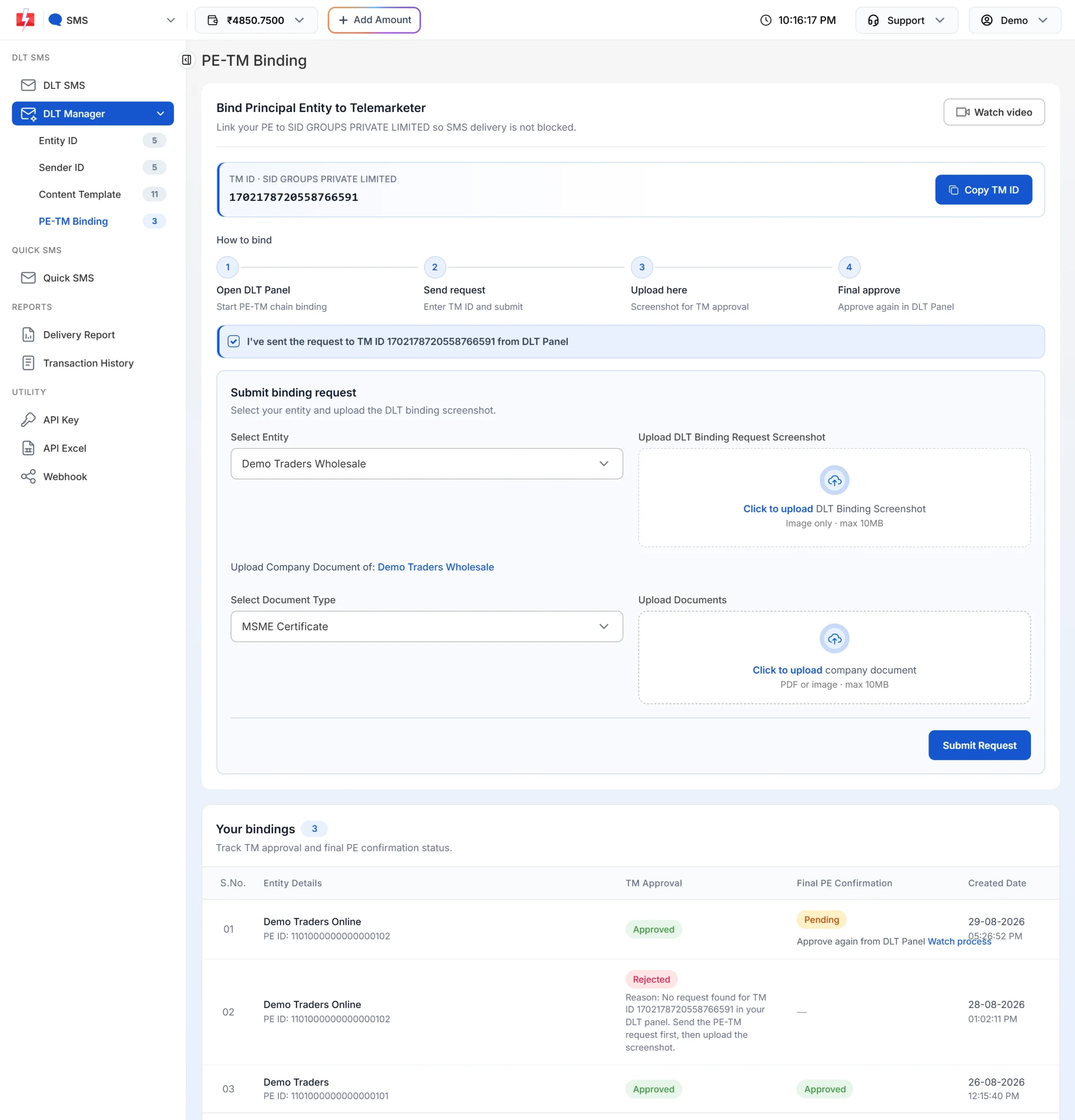
Pick the document type you have and upload it.
Common problems and fixes
| Problem | Fix |
|---|---|
| Registered with a trustee’s personal PAN | Register in the organisation’s name with its own PAN. A personal PAN makes the trustee the sender. |
| Header rejected because it does not match the trust’s name | Upload proof that the school or brand belongs to the trust, or choose a header closer to the registered name. |
| Portal asks for GST and you have none | Upload another registration document the portal accepts, or pick a portal that accepts it. |
| Department registered without the government letter | Get the Letter of Intent or Agreement from the competent government office and submit it. |
Frequently asked questions
Can a trust register on DLT?
Yes. Trusts are one of the entity types DLT portals accept. Register with the trust’s own PAN and registration document.
Does an NGO need DLT registration to send SMS?
Yes, if it sends SMS from its own sender ID. Every organisation that sends business SMS in India registers on DLT.
Should a school register in the school’s name or the trust’s name?
In the name of the legal body that runs it, usually the trust or society. You can still use the school’s name in headers and messages.
Is the DLT fee lower for trusts or government bodies?
The fee is ₹5,900 per year including GST on every portal at the time of writing. Check the payment screen of your portal for any change.
Do government departments need customer consent for SMS?
Vi’s DLT FAQ says government entities do not need subscriber consent. Government companies such as PSUs and banks do.
Can one trust that runs three schools use one registration?
Yes, if all three schools belong to the same trust. Register a separate header for each school under the one entity.