
Recorded and automated business calls are legal in India, but TRAI’s rules for robocalls set clear conditions. Since TRAI’s February 2025 amendment to the TCCCPR, every business that uses auto-dialers or robocalls must tell its telecom operator about it in writing, in advance, along with the purpose of the calls. The calls must also come from the number series meant for commercial calls, reach only people who have not blocked them or who gave consent, and must never try to deceive.
This guide explains the 2025 amendment in plain words: the written declaration, consent, deceptive calls, complaints and penalties, and what it means for bulk voice calls you send from Fast2SMS. It is general information, not legal advice.
What is a robocall or an auto-dialer call?
A robocall (robo call) is a call that plays a recorded or computer-generated message instead of a live person. An auto-dialer is software or equipment that dials numbers from a list by itself. Most bulk voice call services, including Fast2SMS Bulk Voice Call, do both: the system dials your list and plays your recorded voice file to everyone who answers.
TRAI does not ban these calls. They are commercial communication like any other, so the normal rules on registration, number series, consent and complaints apply. The 2025 amendment adds a duty to declare them and makes the action against spam faster and stricter.
The 2025 amendment at a glance
TRAI notified the Telecom Commercial Communications Customer Preference (Second Amendment) Regulations, 2025 on 12 February 2025 and explained it in Press Release No. 11/2025. Most of it came into force 30 days after publication in the Gazette, and a few parts after 60 days.
| Rule | What it says |
|---|---|
| Declare robocalls | Every sender must notify its originating access provider (the telecom operator it sends through) in advance and in writing that it uses auto-dialers or robocalls, and what the calls are for. |
| Designated number series | Commercial calls must come from registered headers or special number series. Normal 10-digit numbers cannot be used for telemarketing. The 140 series is for promotional calls and the 1600 series for service and transactional calls. |
| Consent and preferences | Promotional calls may reach only people who have not blocked that category, or who gave explicit digital consent. |
| Deceptive calls | Any call made to deceive, or to try to deceive, the person called is treated as unsolicited commercial communication (UCC). |
| Complaints | Customers can complain within 7 days of the call, up from 3 days. |
| Penalties | First violation: outgoing services on all of the sender’s telecom resources barred for 15 days. Repeat violation: all resources disconnected for one year and the sender blacklisted. |
Rule 1: tell your operator before you use robocalls
Regulation 4 of the TCCCPR now says every sender shall notify the originating access provider, in advance and in writing, about the use of auto-dialers or robocalls and the intended objective of such calls.
TRAI’s explanatory note gives the reason. Once the operator knows which calls are automated and why, those calls can be checked against each customer’s preferences and blocked for people who have blocked them. TRAI also wrote that promotional robocalls should go through the 140 series, and service or transactional robocalls through the 1600 series or another series allotted for that purpose, so it saw no need for a separate set of robocall rules.
Rule 2: consent and customer preferences
The amendment rewrote the definitions of each type of commercial voice call:
- Promotional voice call: any call with promotional material or an advertisement for a product or service. If a call mixes promotion with any other content, the whole call counts as promotional. It may reach only customers who have not blocked that category in the preference register, or who have given consent. Explicit digital consent from the customer overrides their block for that sender.
- Transactional voice call: a call to your customer in response to a transaction they started, made within 30 minutes of it, such as a transaction confirmation. No explicit consent is needed.
- Service voice call: information about a product or service the customer bought or uses, such as warranty, product recall or delivery updates. The customer’s implied consent lasts only as long as your contract with them. A call to help complete an ongoing purchase needs explicit consent, which is valid for 7 days.
Two more consent rules matter for calling lists. If a customer opts out, you cannot ask them for consent again for 90 days, though they can opt in any time themselves. And a business that is not registered with any operator for commercial communication may not make such calls at all; anything it sends is treated as UCC.
Rule 3: calls meant to deceive count as spam
The definition of UCC now includes any call or message made to deceive, or to try to deceive, the person who receives it. This lets operators act quickly against the telecom resources used for fraud calls, including disconnection and blacklisting. TRAI noted that investigating the fraud itself stays with law enforcement.
For a business this means a recording that pretends to be a bank, a government office or the police, offers a fake prize, or asks for an OTP is not just bad practice. It can cost the sender its telecom connections.
What happens when customers complain
- A customer can complain within 7 days of getting the call. A complaint is valid if it has the customer’s number, the caller’s number, the date and a short note about the call.
- Operators must show the complaint option in an easy-to-find place in their app and website. The app can read call logs, with the customer’s permission, and accept screenshots.
- For unregistered senders, action now starts when five or more different people complain within ten days (earlier it was ten complaints in seven days). The operator suspends the sender’s outgoing services and investigates.
- The same check applies when promotional calls are made from numbers meant for service and transactional calls.
- Operators must also watch for spam patterns, such as very high call volumes, short call durations and few incoming calls compared to outgoing calls, and must use methods to detect misuse of robotic calls, auto-dialer calls, pre-recorded announcements and SIM box type setups.
Penalties for senders
| Violation | Action |
|---|---|
| First instance | Outgoing services of all telecom resources of the sender, including PRI and SIP trunks and SIMs, are barred by all operators for 15 days. |
| Second and later instances | All telecom resources of the sender are disconnected by all operators for one year. The sender is blacklisted, gets no new connections in that period, and the devices used for the calls are blocked for one year. |
The sender can make a representation to the operator against the action, and may keep one number with outgoing calls barred during the period. Operators can also ask senders for a security deposit that can be forfeited for violations, and must sign a binding agreement with every registered sender.
What this means for voice calls sent with Fast2SMS
-
Calls go through the operator
Fast2SMS Bulk Voice Call places your campaign through the telecom operator. You do not dial from your own SIM or personal number, and there is no caller ID setting in the form; the number customers see comes from the operator’s side.
-
DND numbers are not dialled
The operator does not call numbers on the DND registry. In Delivery Report > Voice Report they show with the status DND and the description “DND number: not called by operator”, and they are not charged.
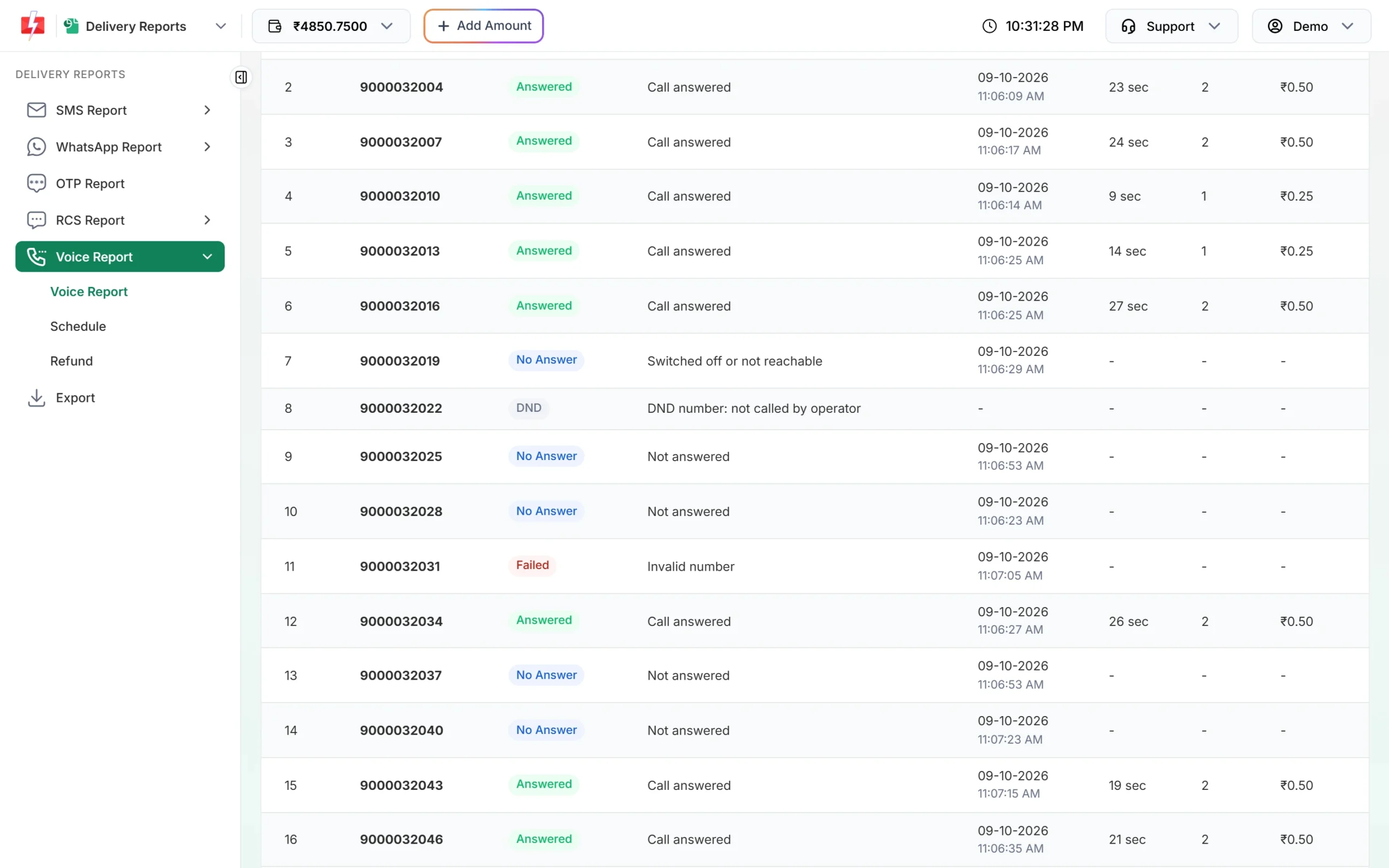
DND numbers are skipped by the operator. -
Calls only between 10 AM and 9 PM
Bulk voice calls are dialled only between 10:00 AM and 9:00 PM IST. A campaign sent outside these hours is scheduled for 10 AM, and one still running at 9 PM is paused.
-
Every recording is checked
Each voice file is approved by the operator before you can use it. The Voice File Rules popup shows the one Must rule, “Say your company or brand name clearly in every voice file”, and a Not Allowed list that includes prize or cashback claims, asking for OTP, PIN, password, Aadhaar, PAN or bank details, and pretending to be a government body, bank, RBI, police, court or telecom company.
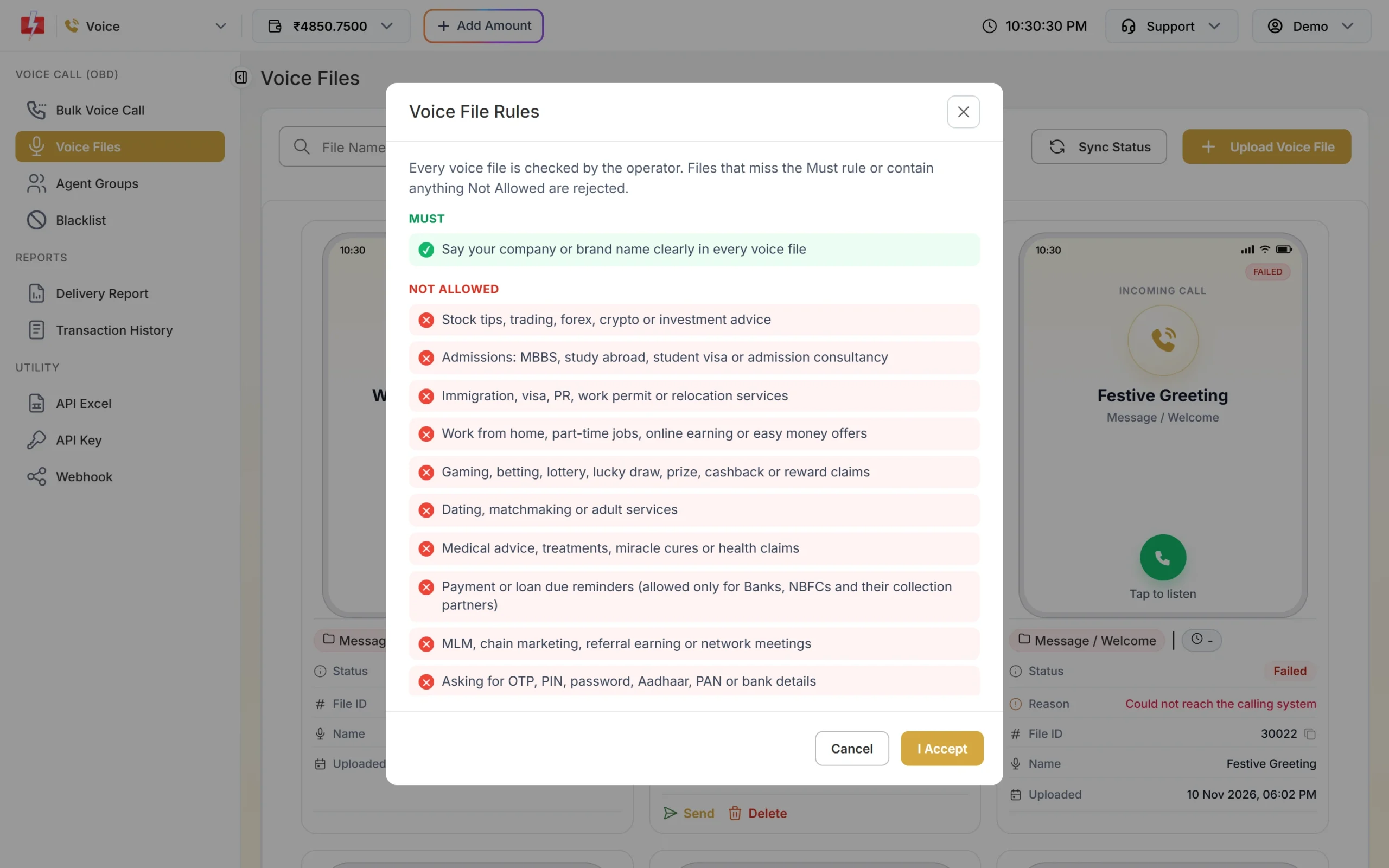
Files that break these rules are rejected. -
Opt-outs stay out
Add anyone who asks you to stop calling to the voice blacklist. Blacklisted numbers are never called in any campaign.
If you are not sure whether your business needs to give the written declaration about automated calls, or which call type your campaign falls under, contact our support team before your first campaign.
Frequently asked questions
Are robocalls legal in India?
Yes, when a registered sender makes them through the right number series, to people who have not blocked them or who gave consent, and has told its operator in advance in writing that it uses robocalls and why.
Are auto-dialers illegal in India?
No. TRAI’s 2025 amendment does not ban auto-dialers. It requires every sender to notify its originating operator in writing, in advance, about their use and purpose.
What is a robo call?
A robo call is an automated call that plays a recorded or computer-generated message instead of a live person. Bulk voice calls with a recorded message are robocalls.
Can I make automated business calls from my normal mobile number?
No. The amended rules do not allow normal 10-digit numbers for telemarketing. Commercial calls must come from the 140 or 1600 series or other designated resources, and violations can bar all your connections.
Do I need consent for promotional robocalls?
Promotional calls may reach only people who have not blocked that category, or who gave explicit digital consent. If someone opts out, you cannot ask them for consent again for 90 days.
How many days does a customer have to complain about a spam call?
Seven days from the day the call was received, up from three days before the 2025 amendment.
What is the penalty for spam calls in India?
For a first violation, outgoing services on all the sender’s telecom resources are barred for 15 days. Repeat violations lead to disconnection of all resources for one year and blacklisting of the sender.
Does Fast2SMS call DND numbers?
No. The operator does not dial DND numbers. They show as DND in the Voice Report and are not charged.
Related guides
- TRAI rules for bulk voice calls: 140 and 1600 series, DND and calling hours
- Why are my bulk voice calls marked as spam, and how do I stop it?
- Voice call blacklist: how to stop calling numbers that opted out
- Is DLT needed for WhatsApp, RCS or voice calls in India?
- What are DND and non-DND numbers?
- Bulk voice call