
People in India get many fraud calls that use recordings and “press 1” menus, so a genuine business call has to prove itself in the first few seconds. Business voice calls customers trust say who is calling and why, never ask for anything secret, never threaten, and give the listener an easy way to check. This page shows what scam IVR calls usually do, eight habits that make your calls sound genuine, and a script comparison you can use.
If your number is already being marked as spam, read why voice calls get marked as spam first. This page is about the words and habits that build trust.
What scam IVR calls usually do
Customers learn to hang up on calls that sound like these:
- Pretend to be a bank, RBI, the police, a court, a government office or a telecom company.
- Threaten: “your number will be blocked today”, “a case has been filed against you”.
- Promise a prize, lottery win, cashback or reward.
- Ask the listener to “press 1 to talk to an officer”, who then asks for an OTP, PIN, card number, Aadhaar or PAN.
- Push for action right now, with no way to check later.
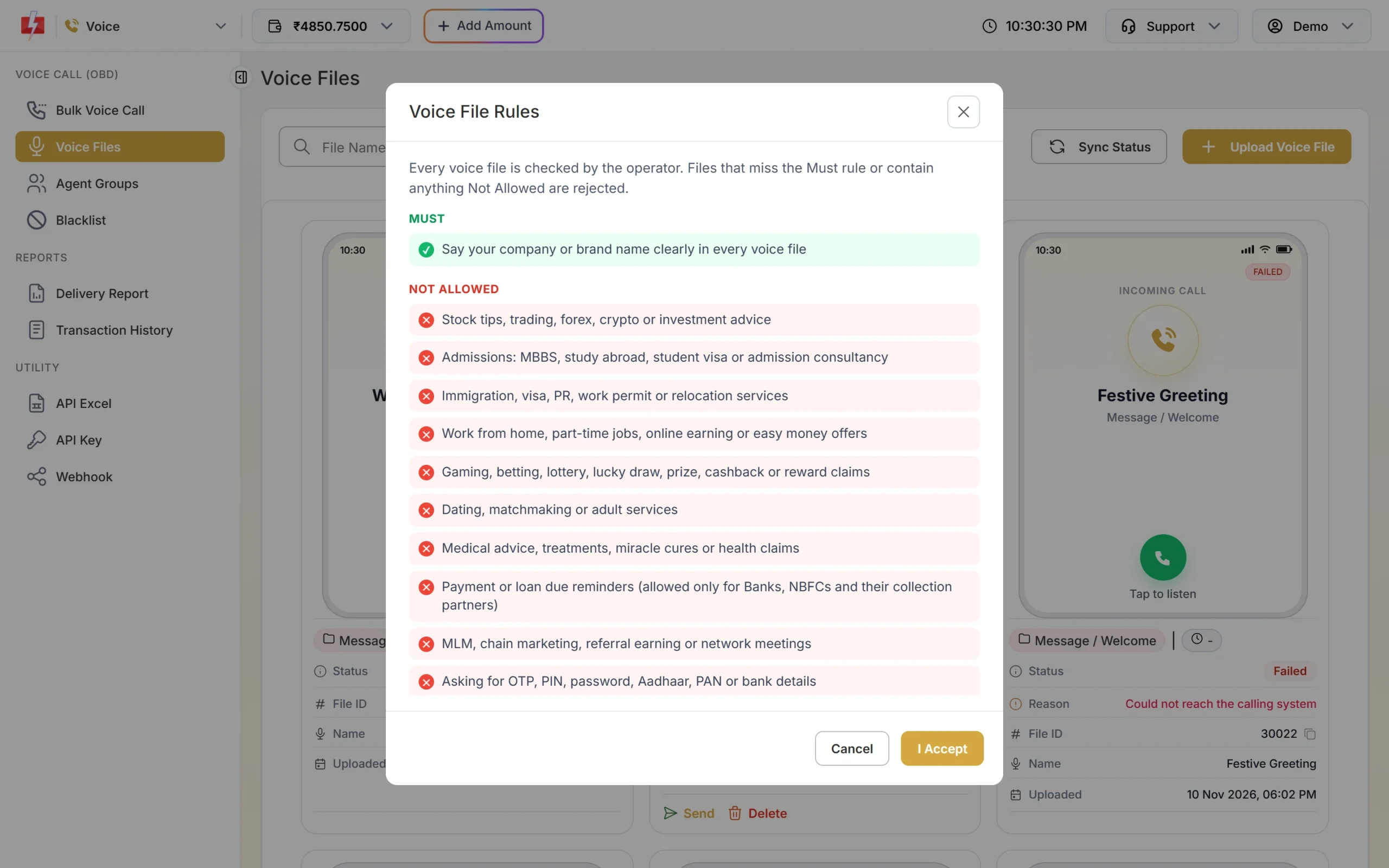
TRAI’s 2025 amendment to its commercial communication rules treats any call made to deceive, or to try to deceive, as unsolicited commercial communication, so operators can act fast against the numbers used. In Fast2SMS, the same patterns are on the Not Allowed list of the Voice File Rules, and the operator rejects files that contain them.
8 habits of a voice call people trust
-
Say your brand name first
Start with your business name and place: “Namaste, this is Demo Clinic, Andheri.” It is also the one Must rule for voice file approval. A call that takes 15 seconds to say who it is from sounds like a trick.
-
Say why you are calling in one sentence
Link the call to something the customer did: their order, their appointment, their admission enquiry. Every number hears the same recording, so name the type of relationship (“your recent order with us”), not personal details.
-
Never ask for secrets, and say so
Do not ask for an OTP, PIN, password, card, Aadhaar, PAN or bank details, by voice or keypad. Better still, add one line: “Demo Traders will never ask for your OTP or bank details.” It costs a few seconds and sets you apart from fraud calls.
-
No threats, no rush
Give the facts and the next step calmly. “Your appointment is tomorrow at 11 AM” builds trust; “Act now or your booking will be cancelled” sounds like the calls customers are warned about.
-
Give a way to check
Point people to a channel they already know: “You can also see this in the Demo Store app” or “call us on the number printed on your bill”. A genuine business is happy to be checked; a scam is not.
-
Back the call with a message from a name they know
Send an SMS from your registered sender ID or a WhatsApp message from your business number before or after the call, saying the same thing. A matching message from a known name makes the call easy to believe. See what the prefix in an SMS sender ID means.
-
Let them reach a real person
If the call asks people to act, give them a person to talk to. A Call Patch campaign connects callers who press a key to your own agents, on your agents’ phones, without showing the agent’s number to the customer.
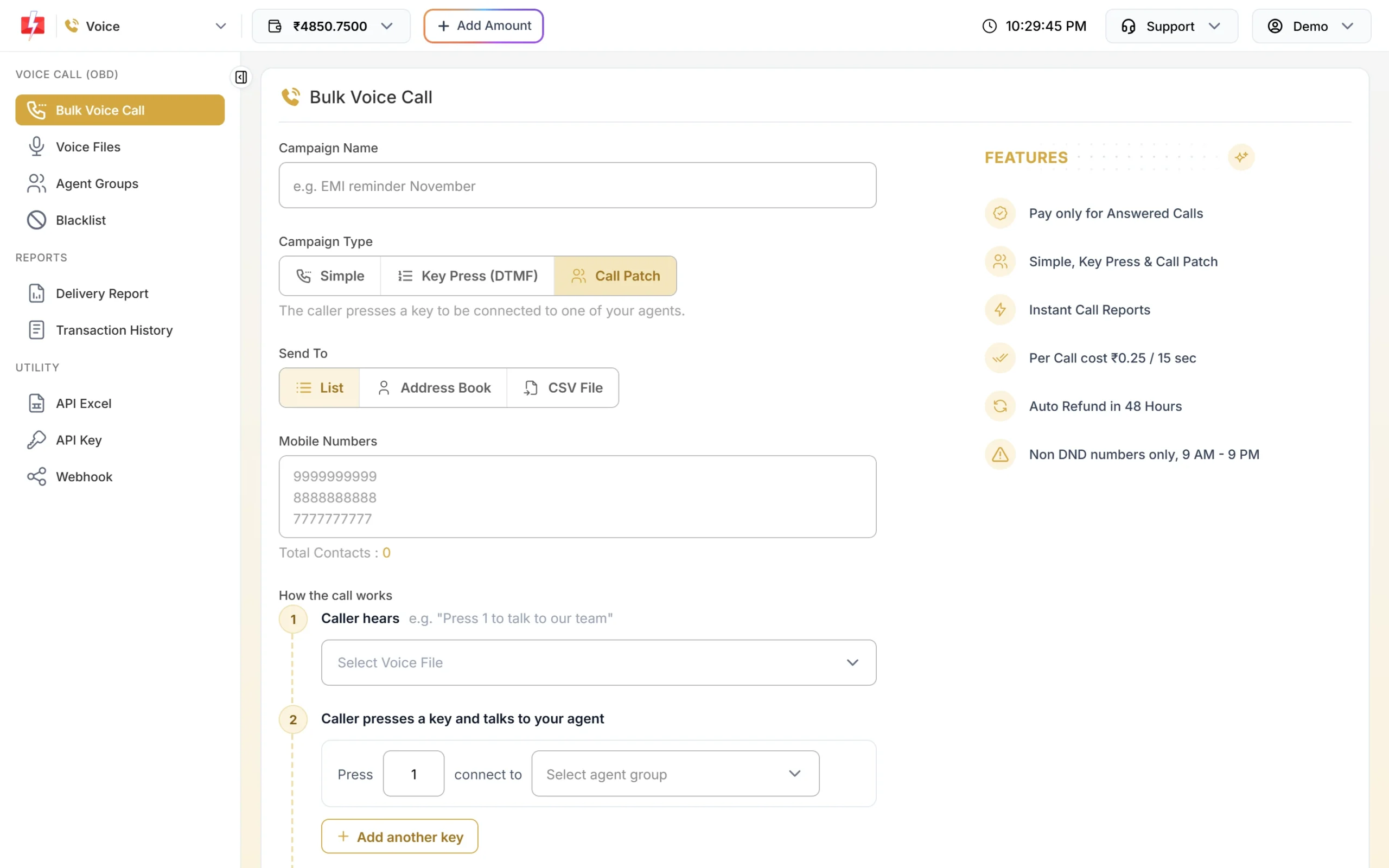
Call Patch puts interested callers through to your team. -
Make stopping easy
Offer a key to stop calls, such as “press 9 if you do not want these calls”, using a Key Press campaign, and add those numbers to your voice blacklist. Respecting a “no” is the clearest sign you are not a scammer.
A genuine script vs a scam-sounding one
| Sounds genuine | Sounds like a scam |
|---|---|
| “Namaste, this is Demo Clinic, Andheri.” | “This is an important call regarding your account.” |
| “Your appointment is tomorrow at 11 AM. Press 1 to confirm, press 2 to cancel.” | “Your service will be stopped today. Press 1 to talk to an officer.” |
| “We will never ask for your OTP or bank details.” | “Please keep your card and OTP ready.” |
| “You can also check this in our app or call the number on your bill.” | “Do not disconnect. This offer is only for the next ten minutes.” |
| “Press 9 if you do not want these calls.” | No way to stop the calls. |
Tell customers in advance
Trust starts before the phone rings. On your website, bills, booking confirmations or welcome message, say what you call about and what you never ask for, for example: “Demo Traders sends automated calls only for order confirmation and delivery updates. We never ask for OTP, PIN or bank details on a call.” Customers who have read this pick up with confidence and hang up on fakes that use your name.
What Fast2SMS does on its side
- Every voice file is approved by the operator before use, against the Voice File Rules.
- The operator does not dial DND numbers.
- Calls go out only between 10 AM and 9 PM IST.
- Numbers in your voice blacklist are never called.
The Bulk Voice Call form has no caller ID setting; the number customers see comes from the operator’s side. That is why your words, and the messages you send around the call, do most of the work of earning trust.
Frequently asked questions
What is an IVR scam?
A fraud call that uses a recorded voice menu, often pretending to be a bank or government office, to get people to press a key and then share an OTP, PIN or account details.
How can customers tell a genuine business call from a scam?
A genuine call names the business first, gives a clear reason, never asks for OTP or bank details, does not threaten, and offers a way to check through the business’s own app, website or number.
Is “press 1” itself a sign of a scam?
No. Businesses use key press calls for confirmations and surveys. What matters is what happens after the key: a genuine call records your choice or connects you to its own team, and never asks for secrets.
Can I show my business name or number as the caller ID?
Not in Bulk Voice Call. The form has no caller ID setting, and the number comes from the operator’s side. Say your brand name in the first seconds instead.
Can I ask customers to confirm their identity on the call?
Do not ask for OTP, PIN, password, Aadhaar, PAN or bank details on a voice call. These requests are on the Not Allowed list and the file will be rejected.
Can I send loan or EMI reminder calls?
Payment or loan due reminders are allowed only for banks, NBFCs and their collection partners. Other businesses’ files with this content are rejected.
What if customers still report my number as spam?
Call only people who know you, space out your calls and honour every opt-out. See our guide on voice calls marked as spam.
Related guides
- Why are my bulk voice calls marked as spam, and how do I stop it?
- How to record a good voice message for bulk calls (with script templates)
- Voice files for bulk calls: format, upload, approval and rejection reasons
- Voice call blacklist: how to stop calling numbers that opted out
- Ethical considerations in bulk voice calling
- Bulk voice call