
The letter after the hyphen at the end of an SMS sender ID tells you the message type: -P means Promotional, -S means Service, -T means Transactional and -G means Government. The two letters before the first hyphen (like VM- or JX-) show the operator and the telecom circle that sent the SMS. Your mobile operator adds both. This page explains how to read a sender ID such as VM-DMTRDS-S and what it means for businesses that send SMS.
How to read a sender ID like VM-DMTRDS-S
| Part | Example | What it means | Who sets it |
|---|---|---|---|
| Prefix (2 letters) | VM | First letter: the operator that sent the SMS. Second letter: the telecom circle (area). | The operator, automatically |
| Header | DMTRDS | The sender ID the business registered on DLT, up to 6 characters. | The business, on the DLT portal |
| Suffix (1 letter) | S | The message type: P, S, T or G. | The operator, based on the template type |
What do -P, -S, -T and -G mean?
| Suffix | Message type | Typical messages |
|---|---|---|
| -P | Promotional | Offers, sales, discounts, ads |
| -S | Service | Order and delivery updates, appointment reminders, account and warranty information |
| -T | Transactional | OTPs, payment confirmations and alerts right after a transaction you made |
| -G | Government | Messages sent on the directions of the central or state government, or TRAI |
The suffix was introduced by TRAI’s Telecom Commercial Communications Customer Preference (Second Amendment) Regulations, 2025, notified on 12 February 2025. The rule says the type of commercial message should be identifiable from the header structure by suffixing “-P”, “-S”, “-T” and “-G”. TRAI chose a suffix because the first two characters are already used by operators for billing and complaint routing, and a header has room for 11 characters, of which only 9 were in use.
Why does my SMS show a different sender name with extra letters?
That is normal. You register only the core header, such as DMTRDS. The operator adds the 2-letter prefix in front and the type letter at the end. The prefix can change from one customer to another because it depends on the operator and circle the message was sent through. A business has no control over the prefix or the suffix.
If the 6-character part itself is different from your header, something else is wrong: the message was sent from another header, or your template is linked to a different header. Check which Sender ID you picked when sending.
What does the prefix mean (AD-, JX-, VM-)?
The first letter is the operator and the second is the circle. Common operator letters include A for Airtel, J for Jio, V or I for Vodafone Idea, B for BSNL and M for MTNL. Common circle letters include D for Delhi, M for Mumbai, K for Kolkata, X for Karnataka, T for Tamil Nadu and Z for Maharashtra. So AD- is Airtel Delhi and VM- is Vodafone Idea Mumbai.
For the full list of letters, see the meaning of the prefix in a sender ID.
What the suffix means for businesses
- You do not register the suffix. Keep registering your header as before. The operator adds the letter.
- The template category decides the letter. A login OTP registered as Transactional shows -T. An order update registered as Service shows -S. An offer shows -P. If you register a template in the wrong category, customers see the wrong letter.
- Customers can tell an offer from an alert. Many people ignore -P messages but read -T and -S messages. Do not put offers inside service templates: a message mixing promotion with service is treated as promotional anyway.
- Tell customers what to expect. If your OTPs come from
DMTRDS, customers can learn to trustXX-DMTRDS-Tand be suspicious of look-alikes.
How sender IDs look in the Fast2SMS panel
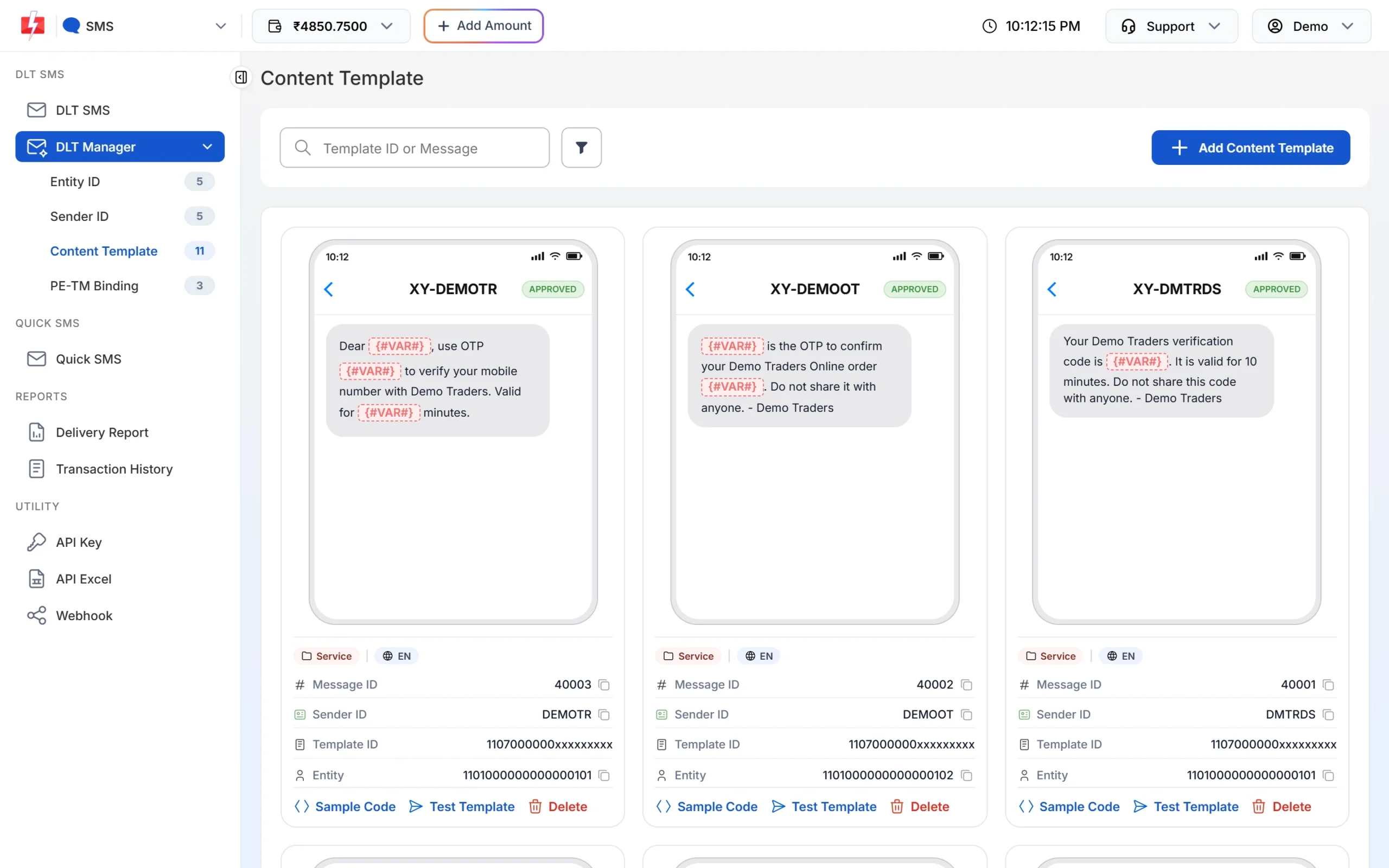
In Fast2SMS, the phone previews in DLT Manager > Content Template show your header as XY-DEMOTR. The XY is only a placeholder for the operator prefix, because the real prefix depends on each recipient’s network. Each card also shows whether the template is Service or Promo, which is what decides the suffix your customers see.
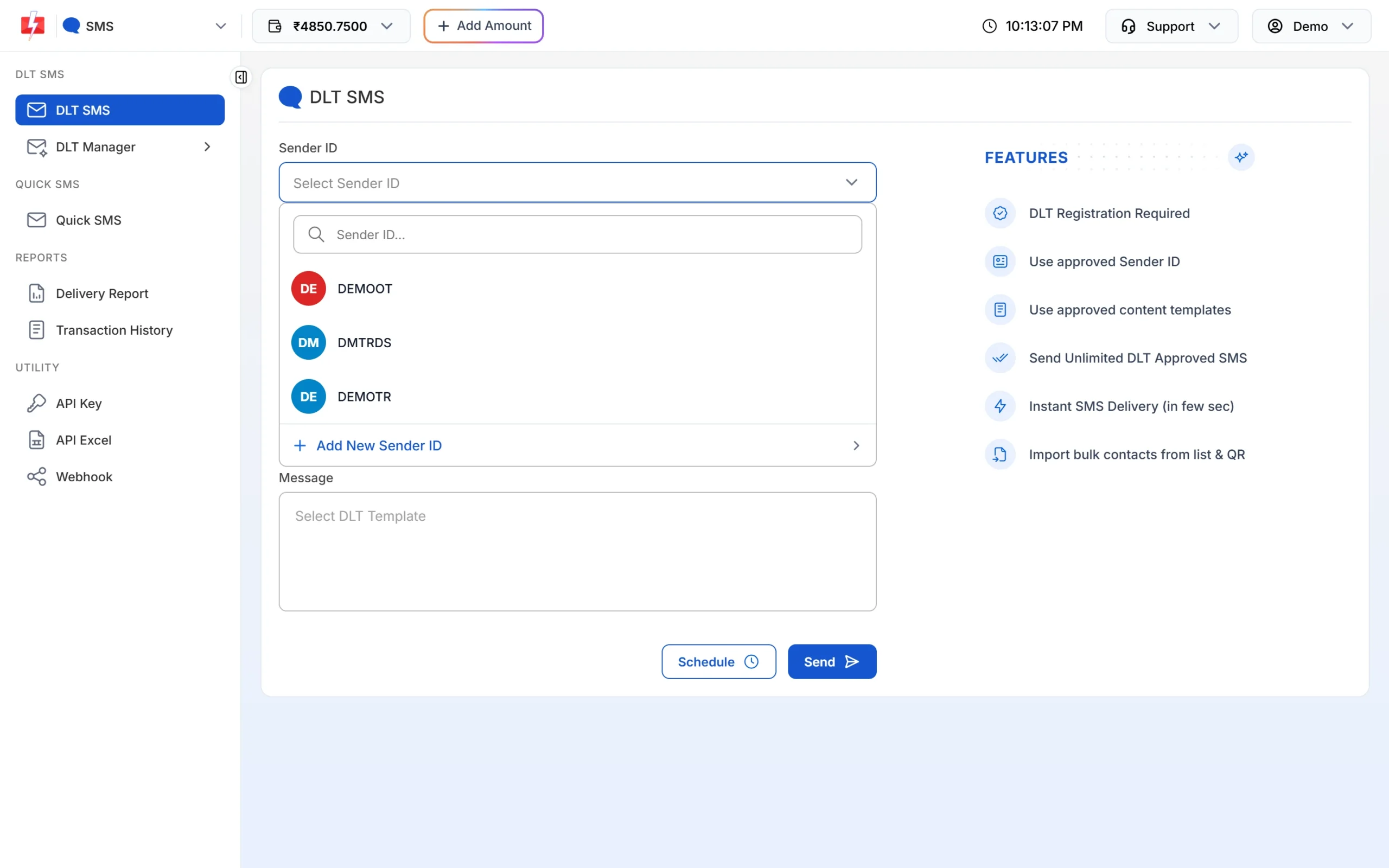
When you send a DLT SMS, you choose the header in the Sender ID list. Only your approved headers appear there.
Frequently asked questions
What does -T mean at the end of an SMS sender ID?
It means Transactional, such as an OTP or a payment alert sent right after a transaction.
What does -S mean in an SMS sender ID?
Service. It is used for updates such as order, delivery, appointment or account information.
What does -P mean in an SMS sender ID?
Promotional. The message is an offer or an ad.
What does -G mean in an SMS sender ID?
Government. The message was sent on the directions of the central or state government or TRAI.
Do I have to add the suffix to my header on DLT?
No. You register only your header. The operator adds the prefix and the type suffix.
Why does my header show a different prefix for different customers?
The prefix depends on the operator and circle the message went through, so it can differ between recipients.
Is a message with -G or -T always genuine?
The letters come from the operator based on registered templates, but stay careful. Never share an OTP or password with anyone who asks for it.