
Bulk SMS in India: 100+ Questions Businesses Ask
This guide is for Indian business owners, marketers and developers who want to send bulk SMS without getting stuck on DLT approvals, rejected templates or messages that never arrive. Shops, D2C brands, clinics, schools, CA firms and app teams ask our support team the same questions every week, so we have put them in one place with straight answers.
You will learn how the SMS types work, what DLT needs from you, how to pick a sender ID, how to write messages that pass template checks, when you can send promotional SMS, how pricing works, how to read delivery reports and what the PE-TM chain rules from 30th September mean for your traffic. Every answer starts with the short version, then adds the detail you actually need.
Signup NowSchedule Free Meeting
Quick answers
- Every business SMS in India needs DLT registration: your entity, sender IDs (headers), message templates and a PE-TM chain.
- Transactional and service headers are 6 letters. Promotional headers are 6 digits.
- Promotional SMS can go only between 10 AM and 9 PM, and never to numbers on DND/NCPR.
- One SMS holds 160 English characters, or 70 characters in Unicode (Hindi and other regional scripts).
- Service Explicit has been merged into Promotional. OTPs now count as transactional, even for non-banks.
- From 30th September, SMS that does not match your approved PE-TM chain is blocked, OTPs included.
- Fast2SMS: free signup, ₹50 free test credit, no setup fee, no monthly fee, pay per message from a prepaid wallet.
In this guide:
- Bulk SMS basics
- SMS types and routes
- DLT requirements, sender IDs and headers
- Writing messages: characters, languages, links and variables
- Promotional SMS rules: timing, DND and opt-out
- Sending methods: panel, Excel, scheduling, API and plugins
- Bulk SMS pricing and billing
- Delivery, reports and failures
- PE-TM chain and compliance from 30th September
- Use cases by industry and choosing a provider
- Wrap-up
Bulk SMS basics
Bulk SMS means sending the same message, or a personalized version of it, to many mobile numbers at once through a provider that is connected to the telecom operators. In India it is still the one channel that reaches every mobile phone, including basic feature phones with no internet. The rules here are stricter than in many countries, so it helps to understand the basics before your first campaign.
What is bulk SMS?
Bulk SMS is sending one message, or a personalized version of it, to hundreds or lakhs of mobile numbers at once through an SMS provider’s panel or API, instead of typing it from your personal phone. Businesses use it for OTPs, order updates, reminders, alerts and offers. The message arrives under your business sender ID, not a random phone number.
How does bulk SMS work in India?
You write a message that matches a DLT-approved template, pick a registered sender ID, and submit it to your provider, which passes it to the telecom operators for delivery to each phone. Before delivering, the operator checks your DLT records: the entity, the header, the template and the PE-TM chain. If any of these do not match, the message is dropped instead of delivered.
Is bulk SMS legal in India?
Yes, bulk SMS is fully legal in India as long as you follow TRAI rules: register on DLT, use approved headers and templates, send promotional messages only in allowed hours, and respect customers’ DND preferences. What is not allowed is unregistered traffic, messages that do not match their template, and promotional content sent to people who have opted out.
Who needs a bulk SMS service?
Any business that needs to reach customers on their phones at scale needs a bulk SMS service, from a kirana store sending festival offers to a fintech app sending login OTPs. Common users include e-commerce and D2C brands, clinics and diagnostic labs, schools and coaching institutes, CA firms, real estate developers, logistics companies and software teams.
Is SMS still useful when everyone uses WhatsApp?
Yes, because SMS works on every mobile phone without internet, an app or a data pack, which makes it the safest channel for OTPs, alerts and anything time-sensitive. Many businesses keep SMS as the base layer and add WhatsApp or RCS for richer conversations. The channel comparison table in the last section shows where each one fits.
Can I send bulk SMS from my own mobile number?
No, you should not send bulk SMS from a personal SIM, because business messages must go through a DLT-registered header via a provider. Operators limit bulk sending from personal numbers and can block the SIM for spam, and your customers will see an unknown 10-digit number instead of your brand.
What is an SMS gateway?
An SMS gateway is the system that connects your panel, website or software to the telecom operator networks, so the messages you submit get delivered to phones. When you use a provider’s dashboard or API, you are using its gateway and its operator connections. The quality of those connections decides how reliably and quickly your messages arrive.
What is the difference between bulk SMS and A2P SMS?
A2P (application-to-person) SMS is any message sent by a business system to a person, and bulk SMS is one common form of it. OTPs from an app, order alerts from an online store and promotional campaigns are all A2P traffic. All of it falls under the same DLT rules, whether you send one message or one lakh.
How fast are bulk SMS messages delivered?
Bulk SMS messages to phones that are switched on and in network coverage are usually delivered within seconds of submission, as long as your DLT setup is correct. Delays happen when the phone is off or out of coverage, when a very large campaign is still being processed, or when the operator is retrying delivery. OTPs and alerts should always go on a transactional or service header so they are not held by promotional timing rules.
How do I start sending bulk SMS?
To start, sign up with an SMS provider, complete DLT registration for your business, get your sender ID and templates approved, add your provider to your PE-TM chain, and then send from the panel or API. On Fast2SMS, signup is free and you get ₹50 test credit to try the panel and API before adding money.
SMS types and routes
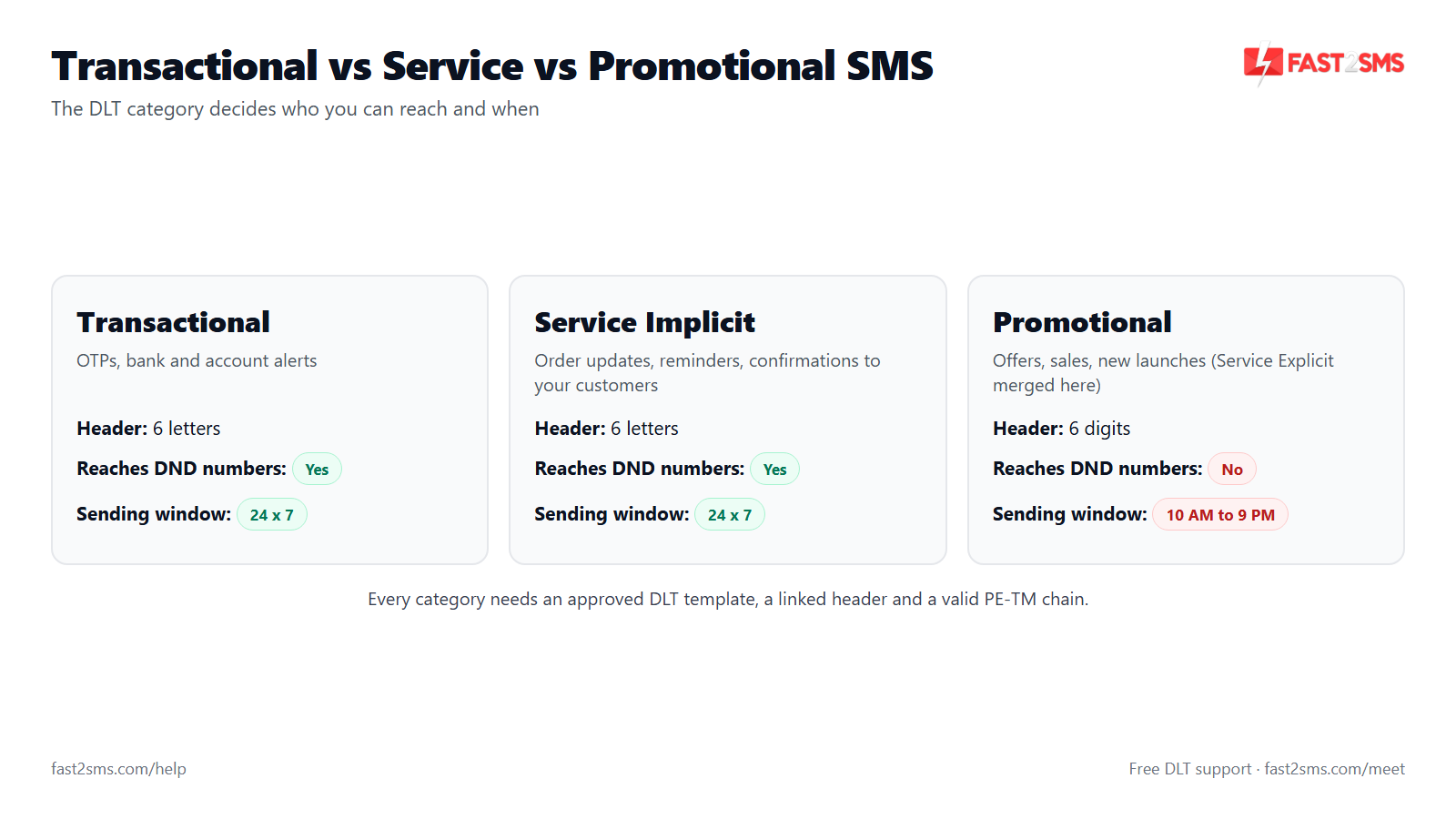
Every business SMS in India belongs to a category, and the category decides which header you use, when you can send and whether the message reaches DND numbers. Under the current DLT rules there are three types to know: transactional, service implicit and promotional. Service Explicit no longer exists as a separate category. The table below puts them side by side.
| SMS type | Used for | Header format | When you can send | DND/NCPR numbers | Example |
|---|---|---|---|---|---|
| Transactional | OTPs (for any business) and critical bank transaction alerts | 6 letters | Any time | Delivered | “482915 is your login OTP for ShopKart. Do not share it.” |
| Service implicit | Updates customers expect from an existing relationship | 6 letters | Any time | Delivered | Order shipped, appointment reminder, fee due reminder |
| Promotional (now includes former Service Explicit) | Offers, launches, sales, marketing | 6 digits | 10 AM to 9 PM only | Not delivered | “Festive sale: flat 20% off on all sarees this weekend.” |
What are the types of bulk SMS in India?
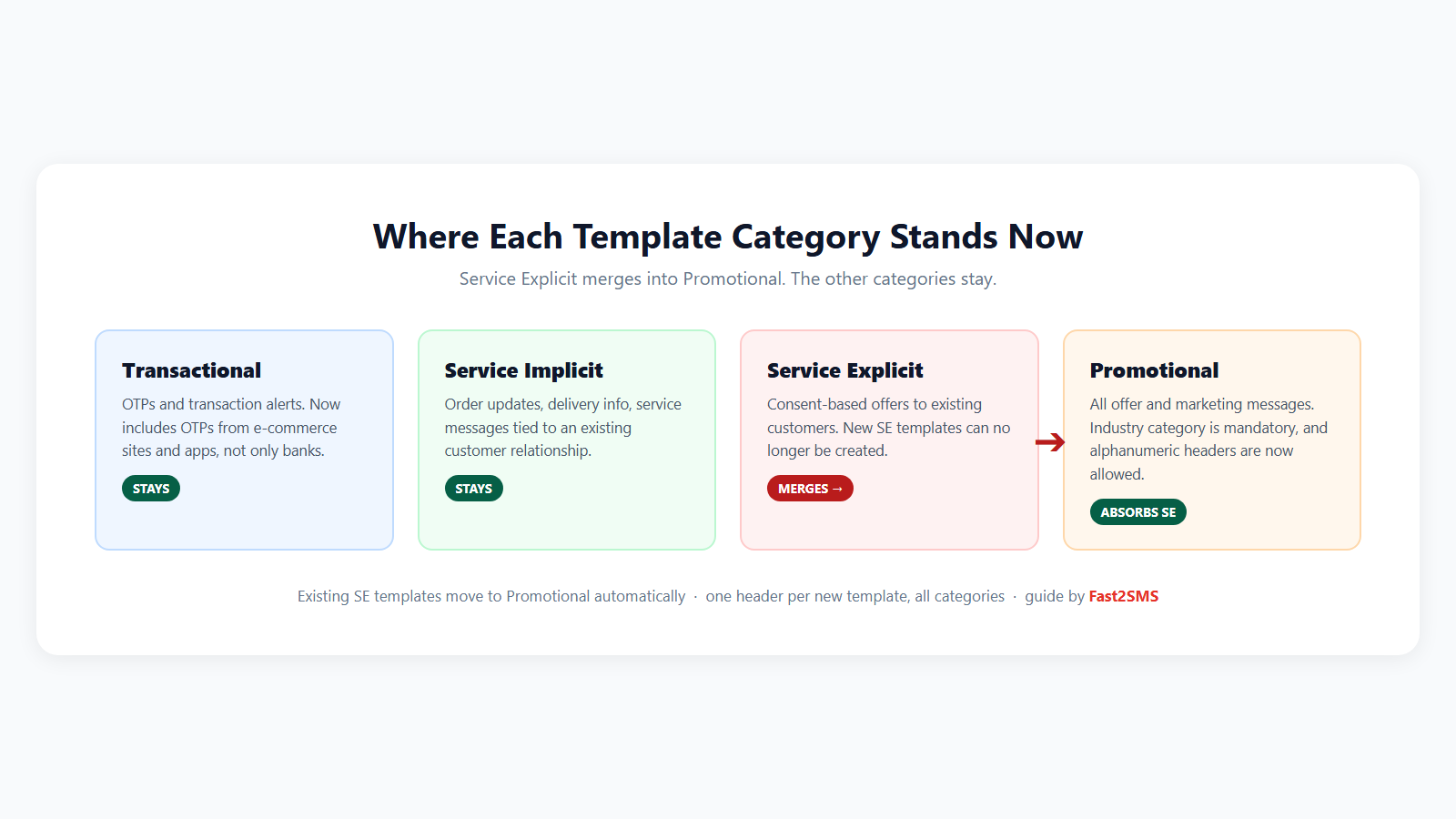
The three types of bulk SMS in India are transactional, service implicit and promotional, and each has its own header format, sending hours and DND rules. Transactional covers OTPs and critical alerts, service implicit covers updates to existing customers, and promotional covers offers and marketing. Service Explicit, which used to be a fourth type, has been merged into promotional.
What is transactional SMS?
Transactional SMS carries OTPs and critical alerts such as bank debit and credit messages, and under the current rules OTPs count as transactional even for non-bank businesses. These messages use a 6-letter header, can be sent at any hour and reach DND numbers too. They must never contain promotional content.
What is a service implicit SMS?
A service implicit SMS is a message the customer expects because of an existing relationship or an action they took, such as an order confirmation, delivery update, appointment reminder, bill or fee reminder. It uses a 6-letter header, can be sent at any time and reaches DND numbers. The content must stay informational, with no offers mixed in.
What is promotional SMS?
Promotional SMS is any message meant to sell or market something, like discounts, new arrivals, festival offers, admissions open notices or event invitations. It uses a 6-digit numeric header, can only be sent between 10 AM and 9 PM, and is not delivered to numbers registered on DND/NCPR. Rules for it are covered in the promotional rules section.
What happened to Service Explicit SMS?
Service Explicit has been merged into the Promotional category, so messages you used to send under SE with customer consent now follow promotional rules. If you still have old SE templates, review them and move them to the right category so your campaigns do not fail. Our guide on moving from Service Explicit to Promotional walks through it step by step.
Which SMS type should I use for OTP?
Use the transactional category for OTP SMS, because OTPs now count as transactional even for non-bank businesses, so an app, website or online store can send login and verification codes on a 6-letter header at any hour, including to DND numbers. Most providers offer a dedicated OTP API for this.
Can I add an offer inside a transactional or service message?
No, putting promotional content inside a transactional or service implicit template breaks the category rules, and the template can be rejected at approval or blocked later after complaints. Keep lines like “get 10% off your next order” in a separate promotional template that you send during allowed hours.
What is an SMS route?
An SMS route is the category and path your message travels on, and providers often use names like “transactional route”, “OTP route” or “promotional route” for it. Under DLT, the route is decided by your header type and template category, not by a setting you can freely switch. A promotional template cannot be sent as transactional just by choosing a different route.
Can I use the same sender ID for promotional and transactional SMS?
No, because transactional and service headers are 6 alphabetic characters while promotional headers are 6 digits, so one header cannot cover both. Most businesses keep one letter header for OTPs and service updates and a numeric header for marketing campaigns.
How do I know which category my template belongs to?
Ask what the message does for the customer: an OTP is transactional, an update they expect from an existing relationship is service implicit, and anything that tries to sell is promotional. If a message does both, split it into two templates. Our sample DLT SMS templates show ready examples for each category.
DLT requirements, sender IDs and headers
DLT (Distributed Ledger Technology) is the TRAI-mandated registration system every business must complete before sending SMS in India. You register your business as a Principal Entity, then your headers (sender IDs) and message templates, and finally link your provider through a PE-TM chain. You do this once on one operator portal, and most of the work after that is adding new templates as your needs grow.
What is DLT registration?
DLT registration is the mandatory process where your business registers itself, its sender IDs and its SMS templates on a telecom operator’s DLT portal, so operators can verify every message you send. Without it, business SMS is not delivered in India. Our beginner’s guide to DLT explains each step in plain language.
Is DLT registration mandatory for bulk SMS?
Yes, every business sending SMS to Indian mobile numbers must be DLT-registered, whether you send ten messages a day or ten lakh. Operators check each A2P message against DLT records and drop anything that does not match, so there is no way to skip it.
Which DLT portal should I register on?
You can register on any one operator portal: Jio TrueConnect, Airtel DLT, Vi Vilpower, BSNL, Tata or Smartping (Videocon/Pingconnect), and your registration on one portal is shared across operators, so you do not need to register on each one. Pick the portal whose interface and support you find easiest.
What documents do I need for DLT registration?
Usually you need your business PAN, a business proof such as a GST certificate or registration certificate, and a letter of authorization for the person managing the account. The exact list differs slightly between portals, so keep clear scanned copies ready before you start.
How long does DLT approval take?
DLT approval time depends on the operator portal and on how complete your documents are: some entities are approved quickly, others take a few working days. Headers and templates are reviewed separately after the entity is approved. Uploading correct, readable documents on the first attempt saves the most time.
Is there a fee for DLT registration?
Some operator portals charge a one-time entity registration fee, and the amount differs by portal and can change, so check the current fee on the portal itself before paying. Help from your SMS provider is a separate matter: Fast2SMS gives free DLT support to its customers.
Can my SMS provider complete DLT registration for me?
Your entity registration has to be in your own business name with your documents, but a good provider can guide you through it and handle the approvals that follow. Fast2SMS has a fully automated DLT system with auto approval handling for sender IDs and templates, plus free DLT support if you get stuck.
What is a Principal Entity (PE)?
The Principal Entity is your business as registered on DLT: the company, firm or proprietorship that owns the headers and templates and is responsible for every message sent in its name. Each PE gets an Entity ID, which you share with your SMS provider so your messages can be matched to your records.
What is a DLT template?
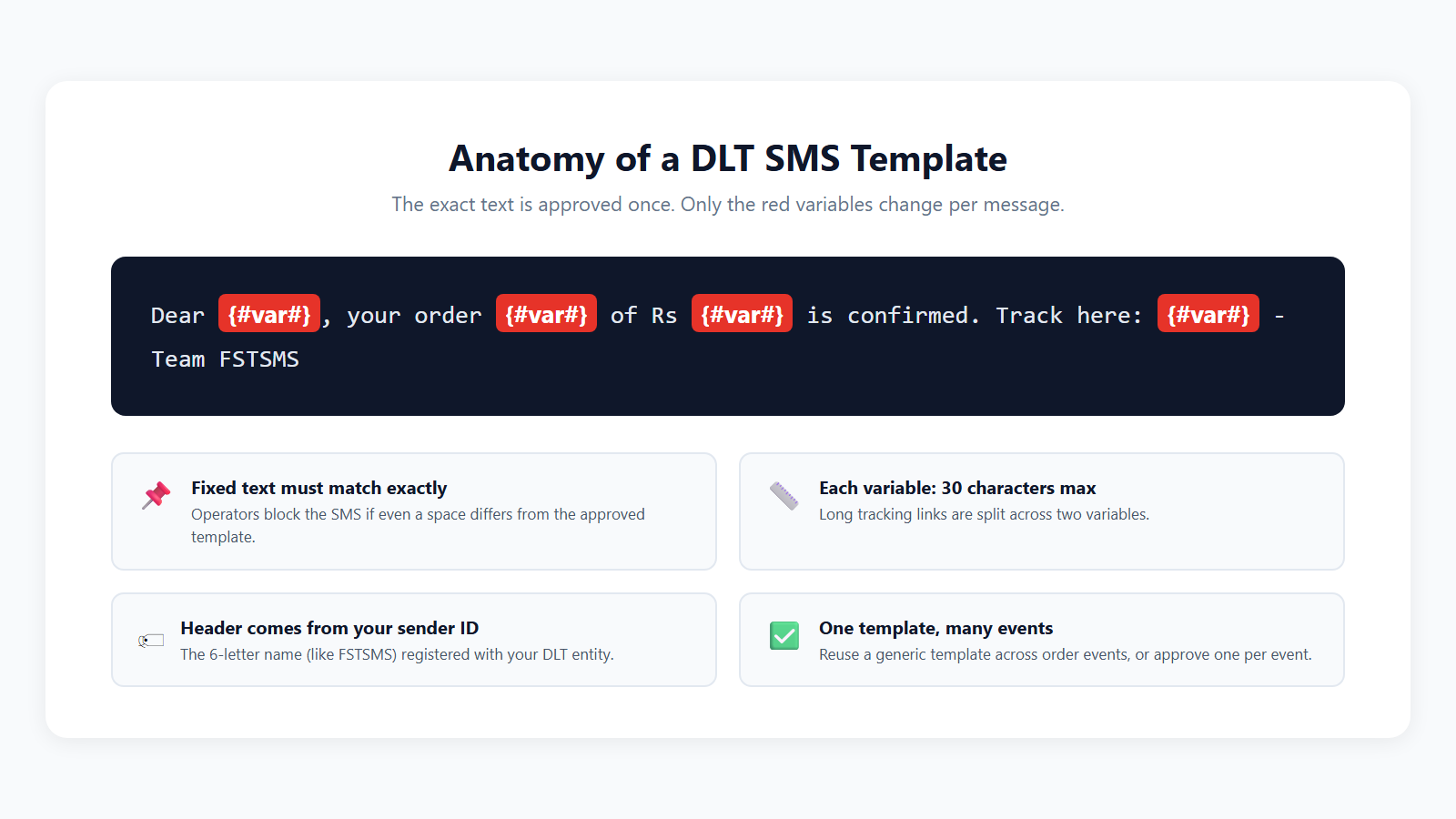
A DLT template is the approved text pattern of a message, with fixed words plus marked variable parts, linked to one header and one category. Every SMS you send must match an approved template exactly except for the variable parts. Think of it as a form letter the operator already knows.
Why was my DLT template rejected?
DLT templates are usually rejected because the category does not match the content, variables are tagged wrongly, the sample message is missing or does not match, or a service template contains promotional lines. Read the rejection remark on the portal, fix that exact point and resubmit. Our DLT SMS FAQ covers the most common rejection reasons.
Do I need a sample message when submitting a template?
Yes, a sample message is mandatory when you submit a DLT template, and it should be your template with realistic values filled into each variable, for example a real-looking name, order number and date, so the reviewer can see exactly what customers will receive.
What is a DLT template ID and where do I find it?
The template ID is the unique number the DLT portal assigns to each approved template, and you will find it in the template section of your portal after approval. Your provider needs this ID to match each message to the right template. Copy it exactly, since one wrong digit causes failures.
What is a sender ID or header?
A sender ID, called a header in DLT, is the name or number that shows as the sender of your SMS, such as a 6-letter short form of your brand. Customers see it instead of a phone number, so it tells them straight away that the message is from you. Every template you create is linked to a header.
How many characters can a sender ID have?
A transactional or service sender ID has 6 alphabetic characters, and a promotional sender ID has 6 digits, so the header type follows the category of messages you send. So a letter header like SHRMDC works for OTPs and updates, while your marketing messages come from a numeric header.
Can I choose any sender ID I want?
No, your header should clearly relate to your business or brand name, and operators can reject generic words, other companies’ brand names, or names you cannot support with documents. For “Sharma Dental Clinic”, a header like SHRMDC has a far better chance of approval than a generic word like DENTAL.
Can one template be used with multiple sender IDs?
No, one DLT template is linked to exactly one header, so the same text cannot be shared across sender IDs. If you want to send the same message from two different headers, you register the template twice, once under each header. Decide your headers before you create a large set of templates, so you do not have to redo the work.
Writing messages: characters, languages, links and variables
A good bulk SMS is short, clear and matches its approved template exactly. The character count decides how many SMS parts one message uses, and that decides your cost. Variables let you personalize each message with a name, amount or link, but they must be tagged correctly in DLT or the message will not go through.
How many characters are allowed in one SMS?
One standard SMS holds 160 characters when it is written in plain English using the normal SMS character set, and longer text uses more than one SMS. If your message is longer, it is split into parts of 153 characters each and joined back together on the customer’s phone, with each part counted as a separate SMS.
Why does my 170-character message count as 2 SMS?
Because anything over 160 characters becomes a multi-part message, and each part then holds only 153 characters, since a few characters are used to join the parts. So a 170-character message needs 2 parts and is counted as 2 SMS. Cutting a few words to get under 160 halves the cost of that campaign.
Can I send bulk SMS in Hindi or other regional languages?
Yes, you can send bulk SMS in Hindi, Marathi, Tamil, Telugu, Bengali, Gujarati, Kannada and other Indian scripts using Unicode, as long as your DLT template is approved in that language. Regional-language SMS often gets better attention in smaller towns, but Unicode messages hold fewer characters, so keep them short.
How many characters fit in a Unicode SMS?
A single Unicode SMS holds 70 characters, and longer Unicode messages are split into parts of 67 characters each, which is why regional-language messages use more SMS. That means a Hindi message of 140 characters uses 3 SMS parts, while the same length in plain English would use only 1. Write regional messages with this in mind.
Why did my English SMS count as Unicode?
Your English SMS counted as Unicode because it contains at least one character outside the standard SMS set, such as curly quotes, long dashes, the ₹ symbol or an emoji copied from Word or WhatsApp. One such character switches the whole message to 70 characters per part. Use plain quotes, a normal hyphen and “Rs.” instead of ₹ to stay at 160.
How do I personalize bulk SMS with names or order numbers?
Add variables to your DLT template, such as {#alphanumeric#} for a customer name or {#numeric#} for an amount, and fill them from your contact file or API call when sending. Every customer gets the same approved text with their own details. Our guide to DLT variable tagging shows which tag to use where.
What are DLT variable tags?
DLT variable tags are placeholders that mark the parts of a template that change for each customer, such as a name, amount or link. {#numeric#} holds up to 40 digits, {#alphanumeric#} up to 40 characters, {#url#} and {#urlott#} hold links up to 120 characters, {#cbn#} holds a callback number of 3 to 14 digits, and {#email#} holds an email address up to 40 characters. The right tag for each value avoids rejections and mismatches.
Can I put a link in a bulk SMS?
Yes, but the link must sit in a {#url#} or {#urlott#} variable, and a {#url#} link must be CTA-validated and whitelisted on DLT. You cannot slip a link into an {#alphanumeric#} variable, because that tag must not start with www or http. Links that are not whitelisted are one of the most common reasons messages get blocked.
Can I use a URL shortener in bulk SMS?
You can use a short link only if its domain is whitelisted for your template under the {#url#} tag, because operators check links against the approved entries. Public shorteners that are not whitelisted for you can get the message rejected. Many businesses use a short link on their own domain, so the customer can also see where it leads.
Does my SMS need to match the DLT template exactly?
Yes, the message you send must match the approved DLT template word for word, with only the variable parts changing. An extra word, a changed phrase, a missing line or a variable value longer than its limit can make the operator reject the message as a template mismatch, so copy the approved text rather than retyping it.
What makes a good bulk SMS message?
A good bulk SMS names your business in the first few words, says one clear thing, includes the code, amount or date the customer needs, and gives one action such as a link or phone number. For example: “Hi Priya, your order 45821 from Kavya Sarees has shipped. Track it here: {link}”. Short, specific messages get read and cost less.
Promotional SMS rules: timing, DND and opt-out
Promotional SMS has the most rules, because it goes to people who did not ask for that particular message. Timing, DND preferences and consent all matter. Following them keeps your headers and templates safe from complaints and blocks, and it also gets better results from the people who do want to hear from you.
What time can I send promotional SMS in India?
Promotional SMS can only be delivered between 10 AM and 9 PM, every day, and this window applies to all promotional headers and templates. Messages submitted outside this window are not delivered in that window; depending on the provider, they are either rejected or held until the window opens. Plan campaigns for late morning or early evening, and schedule them so a delay does not push them past 9 PM.
Can I send transactional or service SMS at night?
Yes, transactional and service implicit messages, like OTPs, order updates and appointment reminders, can be sent at any time because customers expect them. The time restriction applies only to promotional content, which is one more reason never to mix offers into your service templates.
What is DND and NCPR?
DND (Do Not Disturb) is the preference Indian mobile users set to stop promotional messages, and it is recorded in the National Customer Preference Register (NCPR). Users can block all promotional categories or only some of them, and operators filter promotional SMS against this register before delivering it.
Can I send promotional SMS to DND numbers?
No, promotional SMS is not delivered to numbers registered on DND/NCPR, and those numbers are filtered out of your campaign. If you need to reach DND customers with genuine order or account updates, use a service implicit template on a letter header, as long as the content has nothing promotional in it.
How do customers turn DND on or off?
Customers can register or change their DND preference by calling or sending an SMS to 1909 from their mobile number, or through their operator’s app or website. A business cannot change a customer’s DND status for them. If a regular customer wants your offers, the practical route is to reach them on a channel they opted into.
Do I need consent to send promotional SMS?
Yes, you should send promotional SMS only to people who gave you their number and agreed to hear from you, such as customers who opted in at checkout, on a form or at your shop counter. Messaging bought or scraped lists brings complaints, and complaints can get your headers and templates blocked. Keep a record of where each number came from.
Should promotional SMS include an opt-out option?
Yes, give customers a simple way to stop marketing messages, such as a missed-call number in a {#cbn#} variable or a link to unsubscribe, and remove them from your list quickly when they ask. It reduces complaints, keeps your list clean and protects your sender reputation.
What happens if customers complain about my SMS?
Customer complaints about unwanted messages are recorded by operators, and repeated complaints can lead to action against your templates, headers or entity. The best protection is simple: message only opted-in customers, use the correct category, send promotions in allowed hours and honour opt-out requests.
Is there a limit on how many promotional SMS I can send?
The main limits on promotional SMS are the 10 AM to 9 PM window, DND filtering and approved templates, rather than a fixed number you must stay under. The practical limit is your list: sending too often to the same people increases opt-outs and complaints. Most businesses do better with fewer, well-timed campaigns.
Sending methods: panel, Excel, scheduling, API and plugins
You can send bulk SMS without writing any code, straight from a web panel, or connect your own software through an API or a ready plugin. Most businesses end up using both: the panel for campaigns and the API for automatic messages like OTPs and order alerts. Here is how each method works.
How do I send bulk SMS online?
To send bulk SMS online, log in to your provider’s panel, choose your sender ID and approved template, add numbers by pasting them or uploading a file, fill in any variables, and send now or schedule for later. The panel shows the SMS count before sending and delivery status afterwards.
Can I upload an Excel file to send bulk SMS?
Yes, bulk SMS panels let you upload an Excel or CSV file of mobile numbers, with extra columns for names, amounts or other variables that fill your template for each contact. That way every customer gets a personalized message in one campaign. Keep one number per row and remove duplicates before uploading.
How should I format mobile numbers in my contact file?
Use 10-digit Indian mobile numbers in a single column, without spaces, dashes, brackets or a leading zero, and add the 91 country code only if your panel asks for it. Format the column as text in Excel, so numbers do not turn into scientific notation like 9.87E+09 and get corrupted.
Can I schedule bulk SMS for later?
Yes, you can schedule a campaign for a future date and time from the panel, which is useful for festival offers, payment reminders or appointment reminders the evening before. For promotional SMS, pick a time inside the 10 AM to 9 PM window with some margin, so a large list finishes before the window closes.
Should I test a campaign before sending it to everyone?
Yes, always send the message to your own number and a few team members on different operators first, before releasing it to your full customer list. Check that it arrives, that the variables fill correctly, that the link opens and that the SMS count is what you expected. A two-minute test can save a full campaign from a template mismatch.
What is a bulk SMS API?
A bulk SMS API lets your website, app or software send SMS automatically by making an HTTP request to the provider with the mobile number, sender ID, template and variable values. It is how OTPs, order confirmations and alerts go out the moment something happens. Our bulk SMS API guide for India explains the flow.
How do I integrate an SMS API in my website or app?
Get an API key from your provider’s dashboard, read the documentation, and call the send endpoint from your backend with the required parameters. Fast2SMS has REST API documentation with examples at docs.fast2sms.com. Keep your API key on the server only, never inside app code or browser JavaScript where anyone can read it.
How do I get SMS delivery reports through the API?
You can fetch delivery status from a report endpoint using the request ID, or better, set up a webhook so the provider pushes each status update to your server automatically. Webhooks save you from polling and keep your records current. Fast2SMS supports webhooks for SMS, OTP, WhatsApp and RCS; see how webhooks work.
Can I send SMS from WordPress or WooCommerce?
Yes, with an SMS plugin you can send order confirmations, shipping updates and OTP logins from WordPress or WooCommerce without writing code. Fast2SMS has a free plugin; see the bulk SMS WordPress plugin guide.
Can I send SMS from my Shopify store?
Yes, Shopify stores can send order updates and OTP messages through an SMS app, so customers hear from you at each step without manual work. Fast2SMS has a free Shopify app, and this guide shows how to integrate OTP with Shopify.
Can I send SMS from Tally?
Yes, Fast2SMS has a free TallyPrime integration, so your billing team can message customers directly from Tally instead of copying numbers into a separate tool. It suits distributors, wholesalers and CA firms that already manage their accounts in Tally.
How many numbers can I send bulk SMS to at once?
Bulk SMS panels and APIs are built for large lists, so you can send to a few hundred or several lakh numbers in one campaign. For very large lists, send a small first batch, check its delivery report, and then release the rest. That catches template, link or number-format problems before they affect everyone.
Not sure which setup fits your business?
Talk to our team about DLT registration, sender IDs, templates, API integration or moving your traffic from another provider. Schedule a free meeting, call +91-6262778811 or email [email protected].
Bulk SMS pricing and billing
Bulk SMS in India is charged per SMS, usually from a prepaid balance. The price per message depends mainly on your volume, and the length of each message decides how many SMS units it uses. Rates change with volume and over time, so instead of quoting numbers, the answers below explain the principles that help you compare providers and control cost.
How much does bulk SMS cost in India?
Bulk SMS in India is charged per SMS sent, and the price per message starts low and drops as your volume grows. Your actual spend depends on how many messages you send, how long they are and whether they are in English or Unicode. For a rate based on your monthly volume, ask the provider’s sales team for a quote.
What decides the bulk SMS price?
Volume is the biggest factor in bulk SMS price: the more messages you send, the lower your per-SMS rate usually becomes. Message length also matters because each extra part is billed as another SMS, and Unicode messages use more parts for the same text. Hidden costs like setup or monthly fees change the real price too, so compare the total.
Are there setup fees or monthly fees for bulk SMS?
Some bulk SMS providers charge setup, monthly rental or per-number fees on top of the message price, so always ask before you sign up. Fast2SMS charges no setup fee, no monthly fee and no per-number fee on any channel: you add money to a prepaid wallet and pay only for the messages you send.
Can I try bulk SMS for free before paying?
Yes, Fast2SMS gives ₹50 free test credit after free signup, so you can try the panel and API and check delivery before adding money. Keep in mind that business SMS still needs DLT registration to be delivered, so start your DLT work early.
How is a long SMS billed?
A long SMS is billed by the number of parts it uses: up to 160 English characters is 1 SMS, and beyond that every 153 characters adds one more. For Unicode, up to 70 characters is 1 SMS and each 67 characters after that adds a part. Check the SMS count in your panel before sending a large campaign.
Do I pay for SMS that fail to deliver?
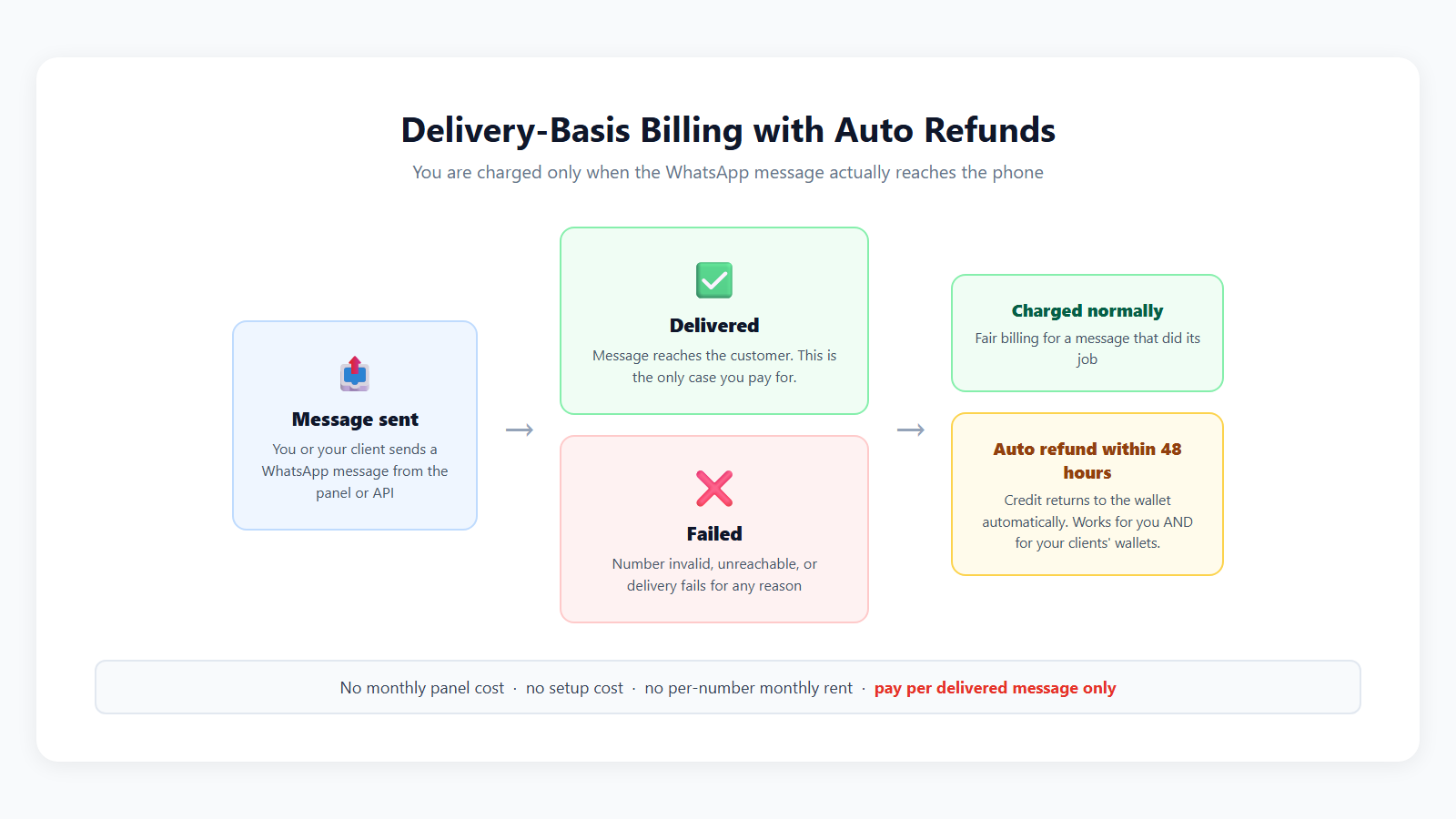
It depends on the provider’s billing policy and on why the message failed, so check this before a big campaign, because some providers bill on submission and others on delivery. On Fast2SMS, WhatsApp and RCS are billed on delivery, and failed messages are refunded automatically.
How do I recharge or pay for bulk SMS?
Most bulk SMS providers work on a prepaid balance: you add money to your wallet online and the cost of each message is deducted as it is sent. Fast2SMS works this way, so you pay only for what you send. If you send very high volumes, the sales team can discuss rates on +91-6262778811.
Is WhatsApp or RCS cheaper than SMS?
Per-message cost depends on the channel and the message type, so compare what each message needs to do, not just the rate. On Fast2SMS, WhatsApp session messages cost ₹0.13, utility and authentication templates ₹0.25, marketing templates ₹0.95, and RCS ₹0.35 per message, while SMS starts low and drops with volume. See WhatsApp session message pricing for details.
Delivery, reports and failures
Once you press send, the operator tries to deliver each message and reports back a status. Reading these reports properly tells you whether a problem is on the customer’s phone, in your number list or in your DLT setup. Most delivery problems fall into a small number of patterns, and each one has a clear fix.
What is an SMS delivery report?
An SMS delivery report (DLR) shows the final status of each message you sent, such as delivered, failed or pending, along with the time it was updated. It is the operator’s confirmation, passed back to you through your provider, and you can view it in the panel or receive it on your server by webhook.
What do SMS delivery statuses mean?
Delivered means the operator confirmed the message reached the handset, failed means it could not be delivered, and pending means delivery is still being attempted. A failure can happen for reasons such as an invalid number, DND filtering of promotional traffic or a DLT mismatch. Pending or submitted means the operator accepted it and is still trying, which usually happens when the phone is off or out of coverage.
Why does my SMS show delivered but the customer did not get it?
If the report says delivered, the operator confirmed it reached the handset, so the message is usually sitting in a spam, promotions or blocked folder of the customer’s messaging app. Ask the customer to check those tabs and their blocked senders list. Some phones sort business SMS into separate folders automatically.
Why are my bulk SMS not delivered?
Bulk SMS usually fails because of a template mismatch, a header not linked to the template, a PE-TM chain mismatch, promotional SMS sent to DND numbers or after hours, invalid numbers, or phones that stay switched off. Start with the failure reason shown in your report, because it points to the fix.
Why are my OTP SMS delayed?
OTP SMS delays usually come from weak network on the customer’s phone, messages failing a DLT check, or traffic that is not on a proper transactional header. Use a transactional template that matches exactly and keep your PE-TM chain correct. For extra reliability, Smart OTP sends the code on WhatsApp with SMS as fallback.
Why do some numbers always fail?
Numbers that fail every time are usually invalid, disconnected or not mobile numbers at all, such as landlines typed into a form. For promotional campaigns, DND numbers will also always be filtered out. Remove repeat failures from your list after checking the reason, so your reports stay clean and you stop wasting sends.
How long does an SMS delivery report take?
For phones that are on and in network, the delivery report usually comes back within seconds to a few minutes of sending. For phones that are switched off or out of coverage, the status can stay pending while the operator keeps retrying, and the final status arrives later.
What is a template mismatch error?
A template mismatch means the text you sent did not match any approved template linked to that header, so the operator rejected it. Common causes are edited wording, a variable value longer than its limit, a link placed outside {#url#}, or the wrong template ID. Compare your message line by line with the approved version on your DLT portal.
How can I improve my bulk SMS delivery rate?
To improve delivery, send to clean opt-in lists, use the correct category and header, keep templates matching exactly, maintain a valid PE-TM chain, and use a provider with direct operator connectivity. For promotional SMS, send inside the allowed window and expect DND numbers to be filtered, so measure delivery against non-DND numbers only.
Can I get SMS delivery updates in my CRM or software?
Yes, a webhook can push each delivery status straight into your CRM, order system or app, so your team sees whether a customer received the message without opening the SMS panel. Fast2SMS supports webhooks for SMS, OTP, WhatsApp and RCS, and marketing tools like CleverTap can be connected the same way.
PE-TM chain and compliance from 30th September
The PE-TM chain is the DLT record of which telemarketers are allowed to carry your messages, from your provider to the delivery telemarketer (TMD) that connects to the operator. From 30th September operators validate every A2P SMS against the approved PE-TM chain, the authorized TMD and the hash code, and block anything that does not match. This affects every business, including those sending only OTPs.
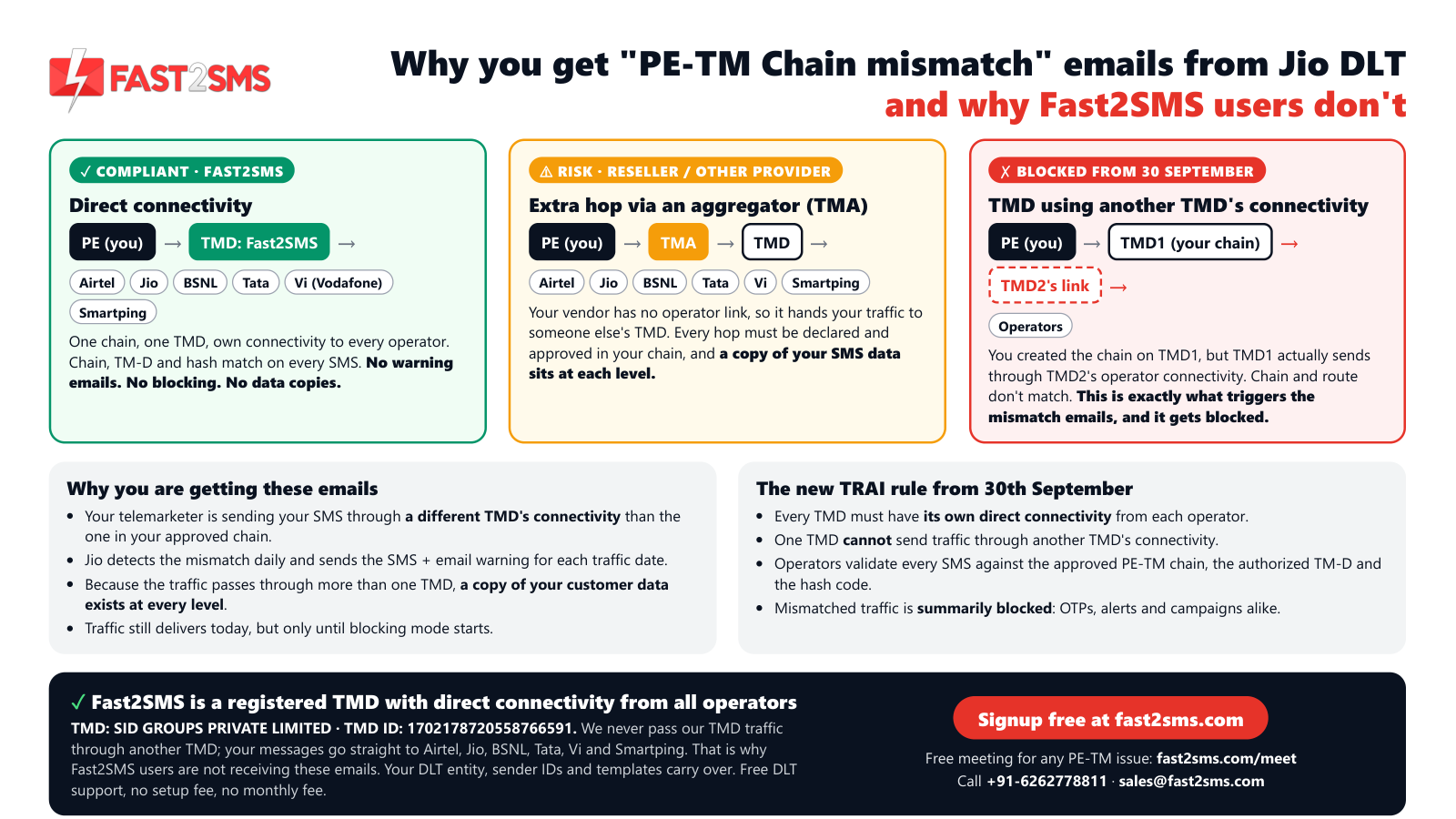
Fast2SMS registered TMD: SID GROUPS PRIVATE LIMITED · TMD ID 1702178720558766591
Fast2SMS has direct connectivity with Airtel, Jio, BSNL, Tata, Vi and Smartping, and never routes its TMD traffic through another TMD. Add this TMD to your PE-TM chain on your DLT portal and your chain stays short and correct.
What is a PE-TM chain?
A PE-TM chain is the approved path on DLT that links your business, the Principal Entity, to every telemarketer that handles your SMS, ending with the delivery telemarketer (TMD) connected to the operator. Operators use it to confirm your traffic comes only through companies you authorized. Read more about the TRAI PE-TM binding framework.
What changes from 30th September for bulk SMS?
From 30th September, operators check every A2P SMS against your approved PE-TM chain, the authorized TMD and the hash code, and block messages that do not match. This applies to all traffic, OTPs included, so a broken chain can stop customer logins and payment confirmations, not just marketing campaigns.
What is a TMD in SMS?
A TMD, or delivery telemarketer, is the registered telemarketer with direct connectivity to operators that finally hands your messages to the network. Your PE-TM chain must list the TMD that actually delivers your traffic. Our guide on choosing a registered TMD SMS provider explains why this matters.
What is a PE-TM chain mismatch?
A PE-TM chain mismatch means your messages arrived through a telemarketer or TMD that is not in your approved chain, or with a hash code that does not match it. The most common cause is a provider delivering through another TMD’s connectivity without that TMD being declared. See the full list of PE-TM mismatch causes and fixes.
How do I know if my PE-TM chain has a problem?
Operators warn you: Jio sends SMS alerts from the header JIODLT-S and emails from [email protected] when it detects a mismatch. If you received one, read our explainer on the PE-TM mismatch SMS and check your chain status on your DLT portal.
How do I fix a PE-TM chain mismatch?
To fix a PE-TM chain mismatch, ask your provider exactly which telemarketer and TMD deliver your traffic, add them to your chain on your DLT portal, and confirm the chain shows as active. If your provider cannot name its TMD clearly, treat that as a warning sign.
How do I add a telemarketer on my DLT portal?
Log in to the DLT portal where your entity is registered, open the PE-TM binding or telemarketer section, search for the telemarketer by name or ID, and add it to your chain. The screens differ by portal, so follow the guide for yours: Jio, Airtel, Vi, BSNL, Tata or Smartping.
What is the DLT hash code?
The DLT hash code is a unique value generated for your approved PE-TM chain that is carried with your messages, so operators can verify the chain in real time. If the hash sent with a message does not match your chain, the message is blocked. Our guide explains the DLT hash code and PE-TM chain together.
Does it matter if my SMS provider is a reseller?
Yes, because if you buy from a reseller, your messages pass through more than one telemarketer, and each one must appear in your chain all the way to the TMD that connects to the operator. One missing link means blocked traffic. Ask your provider to confirm the full path in writing.
Which TMD ID should I add for Fast2SMS?
If you send through Fast2SMS, add SID GROUPS PRIVATE LIMITED, TMD ID 1702178720558766591, to your PE-TM chain on the DLT portal where your entity is registered. Fast2SMS is a registered TMD with direct connectivity to Airtel, Jio, BSNL, Tata, Vi and Smartping, and it never routes its TMD traffic through another TMD, so this one entry covers the delivery end of your chain.
Use cases by industry and choosing a provider
Almost every kind of Indian business can use bulk SMS, but the right mix of transactional, service and promotional messages differs by industry. SMS is also not the only option: WhatsApp and RCS do some jobs better. The table below compares the three channels, and the answers after it cover industry use cases and how to pick a provider you can rely on.
| Channel choice | SMS | RCS | |
|---|---|---|---|
| Reaches | Every mobile phone, no internet needed | Users who have WhatsApp and internet | Mainly Android phones with Google Messages; other phones depend on device and operator |
| Setup needed | DLT entity, header, templates and PE-TM chain | WhatsApp Business API number, Meta-approved templates, customer opt-in | Verified brand sender set up through your provider |
| Content | Text only; 160 English or 70 Unicode characters per SMS | Text, images, documents, buttons and two-way chat | Rich cards, carousels, buttons, verified brand sender |
| Fast2SMS pricing | Starts low and drops with volume | Session ₹0.13, utility and authentication ₹0.25, marketing ₹0.95 | ₹0.35 per message |
| Billing on Fast2SMS | Per SMS from a prepaid wallet | On delivery; failed messages refunded within 48 hours | On delivery; failed messages refunded |
| Best for | OTPs, critical alerts, reaching every customer | Conversations, support, rich order updates, chatbots | Branded, visual promotions inside the default messaging app |
How do e-commerce and D2C brands use bulk SMS?
E-commerce and D2C brands use bulk SMS for OTP login, order confirmation, shipping and delivery updates, cash-on-delivery confirmation and promotional sale alerts. The first four go on transactional or service implicit templates, while sale announcements go on a promotional header in the allowed hours. Store plugins can automate most of it.
How do clinics and hospitals use bulk SMS?
Clinics, hospitals and diagnostic labs use bulk SMS for appointment confirmations and reminders, report-ready alerts, follow-up visit reminders and doctor availability updates. These are service implicit messages, so they reach patients on DND too. A health check-up camp or discount offer is promotional and follows the 10 AM to 9 PM rule.
How do schools and coaching institutes use bulk SMS?
Schools and coaching institutes use bulk SMS for fee reminders, absence alerts to parents, exam schedules, result notices and holiday announcements. Messages to existing students’ parents are service implicit, while “admissions open” campaigns to new families are promotional. Hindi or regional-language templates often work well with parents.
How can CA firms and accountants use bulk SMS?
CA firms and accountants use bulk SMS to remind clients about GST and income tax filing deadlines, request pending documents, confirm that a return was filed and follow up on professional fees. These are service messages to existing clients. Firms already working in Tally can send them straight from their accounting software.
How do apps and fintech companies use bulk SMS?
Apps and fintech companies use bulk SMS mainly for OTPs at signup and login, transaction alerts, security notices like a new-device login, and account updates. OTPs go on transactional templates through an API, so reliability and a correct PE-TM chain matter more than anything else for this group.
How can a local shop or real estate business use bulk SMS?
A local shop or real estate business can use bulk SMS to announce festival offers, new stock, site visit days, project launches and payment reminders to existing buyers. Offers and launches go on a promotional header to opted-in customers, while reminders to people who already bought from you can go as service messages.
Should I use SMS, WhatsApp or RCS for my business?
Use SMS when a message must reach every customer on any phone, like OTPs and critical alerts; use WhatsApp for conversations, support and rich updates to opted-in customers; and use RCS for branded, visual promotions on supported Android phones. Many businesses combine them. A common setup is WhatsApp first with SMS as the fallback.
How do I choose a bulk SMS provider in India?
Choose a bulk SMS provider that is a registered TMD with direct operator connectivity, gives real DLT help, shows clear delivery reports, has good API documentation and charges no hidden setup or monthly fees. Also check support response and how long the company has been running. Fast2SMS has served Indian businesses for 15+ years with 99.9% uptime.
Why does direct operator connectivity matter for bulk SMS?
Direct operator connectivity matters because your messages go from the provider straight to the operator, with no other telemarketer in between. That keeps your PE-TM chain short, removes extra points of failure and makes it easier to find the cause when something goes wrong. With the chain checks from 30th September, fewer hops also means fewer chances of a mismatch.
How do I check if a provider is a registered TMD?
Ask the provider for its registered company name and TMD ID, then search for that entity when adding a telemarketer on your DLT portal. A genuine TMD can give you both straight away and confirm which operators it connects to directly. Vague answers about “partner routes” usually mean your traffic passes through someone else.
Can I start my own bulk SMS reseller business?
Yes, you can resell bulk SMS to your own clients under your brand, as long as every client’s DLT setup and PE-TM chain are handled correctly. Resellers earn the margin between their buying and selling rate. Read how to become a bulk SMS reseller before you start.
More 100-question guides
- DLT registration A to Z
- SMS not delivered: every DLT and delivery error
- OTP via SMS and WhatsApp
- WhatsApp Business API in India
- WhatsApp template rejected? Approval FAQ
- WhatsApp marketing without getting banned
- RCS business messaging in India
Wrap-up
Bulk SMS in India works well once the foundations are right: a registered entity, the correct header and category for each message, templates that match exactly, promotions only in the 10 AM to 9 PM window, and a PE-TM chain that lists the real TMD carrying your traffic. Get those in place, test before every big campaign, read your delivery reports, and SMS will stay your most dependable way to reach every customer. If you want help with any step, from DLT to API integration, the Fast2SMS team is happy to walk you through it.
Signup NowSchedule Free Meeting
Sales: +91-6262778811 · [email protected] | Support: [email protected]