
TCCCPR 2018 is the TRAI regulation that controls commercial SMS and calls in India. It created the DLT system, where every business must register itself, its sender IDs and its message templates before sending, and it gives customers the right to block promotions and complain about spam. The 2025 amendments made the rules stricter: longer time for customers to complain, faster action against senders, a mandatory opt-out in promotional messages and category suffixes on headers.
This page explains TCCCPR in plain language and lists the main DLT rule changes from 2018 to 2026, so you know what applies to your business SMS today.
What is TCCCPR 2018?
TCCCPR stands for Telecom Commercial Communications Customer Preference Regulations, 2018. TRAI issued it to cut unsolicited commercial communication (UCC), meaning spam calls and SMS. Its main ideas are simple:
- Everyone must register. Businesses (Principal Entities) and telemarketers register on the DLT platform of an operator. Registration on one operator’s DLT is shared with all operators.
- Every message is pre-approved. Headers (sender IDs) and content templates are registered in advance. Operators check each SMS against them before delivery. This check is called scrubbing.
- Customers choose what they get. Customers can block all promotional messages or only some categories (DND), and can give or take back consent for specific brands.
- Customers can complain. Complaints go to the operator through 1909, the operator’s app or the TRAI DND app, and operators must act on them.
The four message types under DLT
| Type | What it is for | Reaches DND numbers? |
|---|---|---|
| Transactional | OTPs and alerts linked to a transaction, historically for banks and similar entities | Yes |
| Service Implicit | Messages a customer expects because of their relationship with you: order, delivery, payment, appointment | Yes |
| Service Explicit | Service-related messages that need the customer’s recorded consent | Only with consent |
| Promotional | Offers and marketing | No |
In practice, operators have been moving Service Explicit into Promotional. In the Fast2SMS panel you choose between Service Implicit and Service Explicit or Promotional when you add a template.
What changed in the 2025 TCCCPR amendment?
TRAI notified the second amendment to TCCCPR in February 2025. As reported at the time of writing, the main changes are:
- Longer complaint window. Customers can complain up to 7 days after the message, not 3.
- Faster action. Operators must investigate quickly, and action against a sender can start after fewer complaints (reported as 5 complaints in 10 days).
- Strict penalties for unregistered senders. First violation: outgoing services barred for 15 days. Repeat: disconnection for one year and blacklisting with all operators.
- Opt-out in every promotional message. After a customer opts out, the sender cannot ask them for consent again for 90 days.
- Number series for calls. Promotional calls use the 140 series, service and transactional calls the 1600 series. Normal 10-digit numbers must not be used for telemarketing.
- Header suffixes. Operators add a suffix after the header to show the category: -P (promotional), -S (service), -T (transactional), -G (government). Industry sources date this to May 2025.
- Penalties on operators. Operators face financial disincentives if they do not control UCC on their networks.
DLT rule changes timeline: 2018 to 2026
| When | What changed | What it means for you |
|---|---|---|
| 2018 | TCCCPR 2018 issued. DLT system created. | Businesses must register entity, headers and templates. |
| 8 March 2021 | Content template scrubbing switched on. After OTP disruption it was paused for 7 days, then brought back, with businesses asked to finish registration by 31 March 2021. | Every SMS must match a registered template. |
| June 2023 | TRAI directs operators to build Digital Consent Acquisition (DCA), with consent requests from a 127xxx short code. | Consent is collected and stored digitally on DLT. |
| 1 October 2024 | Whitelisting of URLs, APK and OTT links becomes mandatory. | SMS with links that are not whitelisted are blocked. |
| 1 December 2024 | PE-TM chain traceability enforced. Messages with an undefined or mismatched telemarketer chain are rejected. | You must bind your entity to your SMS provider’s telemarketer ID. |
| 2024 | Wrongly categorised templates can be blacklisted; misuse of headers or templates leads to suspension of the sender’s traffic. | Keep offers out of transactional and service templates. |
| February 2025 | Second amendment to TCCCPR (see above). | Opt-out, shorter action timelines, stricter penalties. |
| 2025 | Header suffixes -P, -S, -T, -G shown to customers. | Customers see what kind of message you are sending. |
| 2026 | TRAI continues consultations on further changes. | Check for updates before big campaigns. |
What do these rules mean for your Fast2SMS account?
Most of the work is a one-time setup, and Fast2SMS has a screen for each part:
-
Register on DLT and add your details
Register your entity, headers and templates on your DLT portal. Then add them in DLT Manager > Entity ID, Sender ID and Content Template. Pick the correct template category for each message.
-
Complete the PE-TM chain
Send the chain request on your DLT portal to the Fast2SMS telemarketer ID and submit it on the PE-TM Binding page. Both TM Approval and Final PE Confirmation must show Approved.
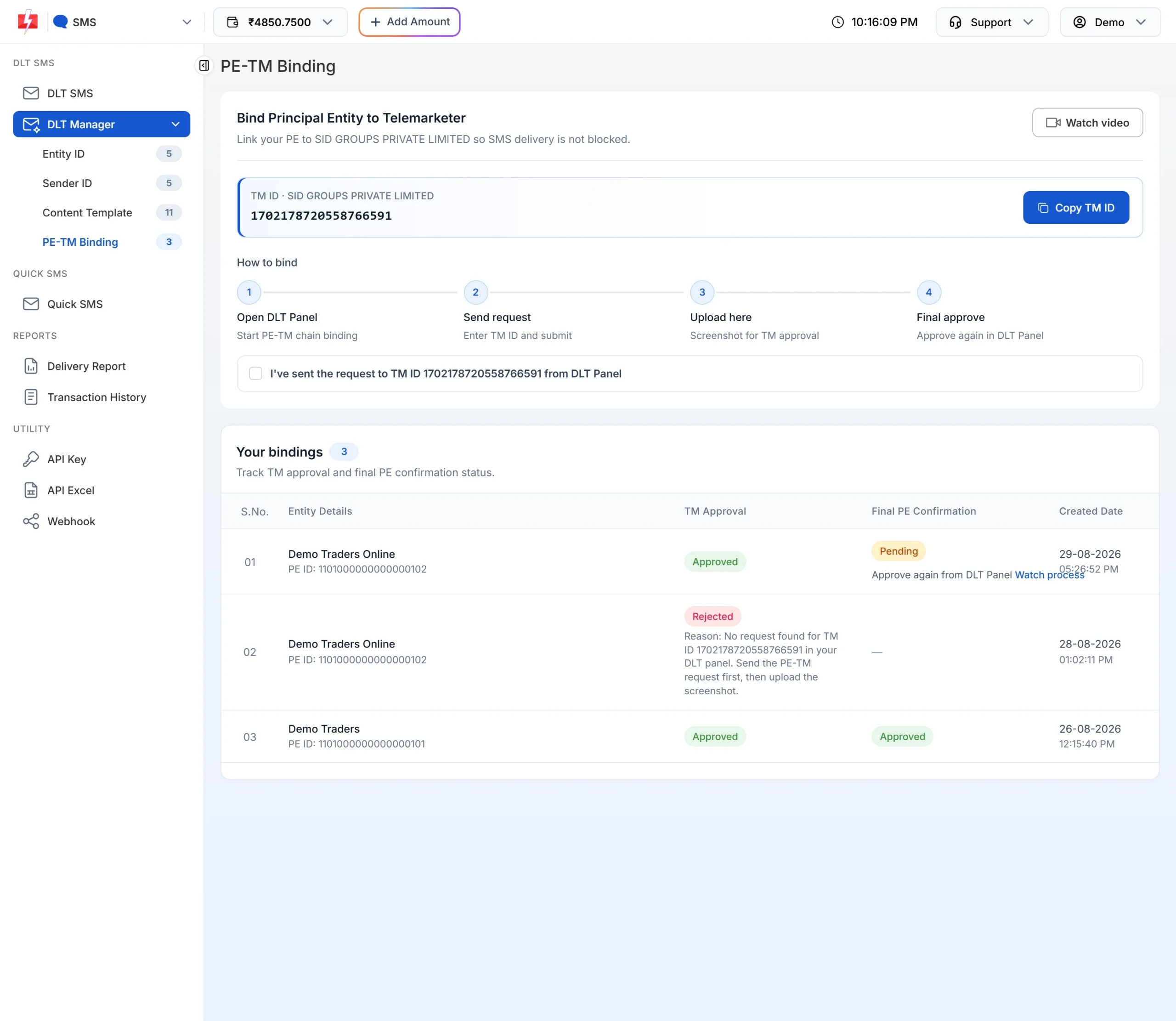
The PE-TM Binding page shows the status of each chain. -
Whitelist your links and call-back numbers
Whitelist every domain and call-back number you use in SMS on your DLT portal, under CTA whitelisting.
-
Send at the right time to the right people
Send promotional SMS only between 10 AM and 9 PM (Fast2SMS holds them otherwise), add an opt-out line, and honour every opt-out. Keep OTPs and alerts on Service Implicit templates.
Frequently asked questions
What is the full form of TCCCPR?
Telecom Commercial Communications Customer Preference Regulations, 2018, issued by TRAI.
Does TCCCPR apply to small businesses?
Yes. Any business that sends commercial SMS in India must register on DLT and follow the same rules, whatever its size.
Does TCCCPR apply to WhatsApp?
No. TCCCPR covers SMS and voice calls on telecom networks. WhatsApp Business messages follow Meta’s rules.
What is the penalty for sending spam SMS in India?
Operators can suspend headers and templates, suspend a sender’s services, and for unregistered senders bar outgoing services for 15 days and then disconnect and blacklist them for repeat violations.
What does -P or -T after a sender ID mean?
It shows the message category: -P promotional, -S service, -T transactional and -G government. Operators add it based on your registered template type.
Is opt-out mandatory in promotional SMS?
Yes, under the 2025 amendment. Promotional messages must give the customer a way to opt out.