
The RBI’s Authentication Mechanisms for Digital Payment Transactions Directions, 2025 do not ban SMS OTP. They require every domestic digital payment to be checked with two different factors, and for most online payments at least one factor must be created for that specific transaction (an OTP is the RBI’s own example) or be provable, like a biometric. SMS OTP still counts. What changed is that banks and payment companies may now use other factors as well, and must add risk-based checks. This page explains the rules in plain words and what they mean if you send OTPs.
This is a plain-language summary for businesses, not legal advice. Banks and payment companies should read the RBI directions in full with their compliance team.
The RBI rules at a glance
| Point | What the directions say |
|---|---|
| Issued | 25 September 2025 |
| Who must follow them | Payment system providers and participants, banks and non-banks, for domestic digital payments |
| In force from | 1 April 2026 |
| Core rule | At least two different factors of authentication: something the user has, knows or is |
| Dynamic factor | For payments other than card-present ones, at least one factor must be generated for that transaction (such as an OTP) so it cannot be reused, or be provable, such as a biometric |
| Independence | The factors should be designed so that one being compromised does not weaken the other |
| Exemptions | Small-value contactless card payments, recurring payments under the e-mandate framework, and gift prepaid instruments |
| Risk-based checks | Issuers must add risk-based authentication, for example extra checks on unusual payments |
| Cross-border card payments | Card issuers must check non-recurring cross-border card-not-present payments when the overseas merchant asks, by 1 October 2026 |
Is SMS OTP still allowed?
Yes. An OTP sent to the registered mobile number is a “something the user has” factor, and it is generated for one transaction, which is what the dynamic factor rule asks for. The directions give payment companies room to use other factors too, such as device binding, biometrics or app-based codes. So the change is more choice, not the end of OTP.
Does this apply to my business?
| You are | What it means for you |
|---|---|
| A bank, card issuer, wallet or payment aggregator | The directions apply to you. Your OTP flow is part of your authentication design. |
| An online shop or app taking payments through a payment gateway | Your bank or payment gateway handles payment authentication. Your own login or COD OTPs are a separate thing. |
| A business using OTP only for sign-up, login or delivery checks | These are not payment authentication, so these directions do not set the rules for them. Good OTP practice still helps. |
If you send payment OTPs: a practical checklist
-
Tie each OTP to one transaction
Put the amount and the merchant in the message, for example “OTP {#var#} for Rs {#var#} at {#var#}. Do not share it. – YourBank”. Register this as a Service Implicit template on DLT. With Smart OTP, pass the other values in
variables_valuesand let Fast2SMS fill the OTP variable. -
Keep the code short-lived and the tries few
Set
otp_expiryin minutes on each send (Smart OTP defaults to 15). In OTP Settings, set Max Verify OTP Limit (Per SMS) and the resend wait.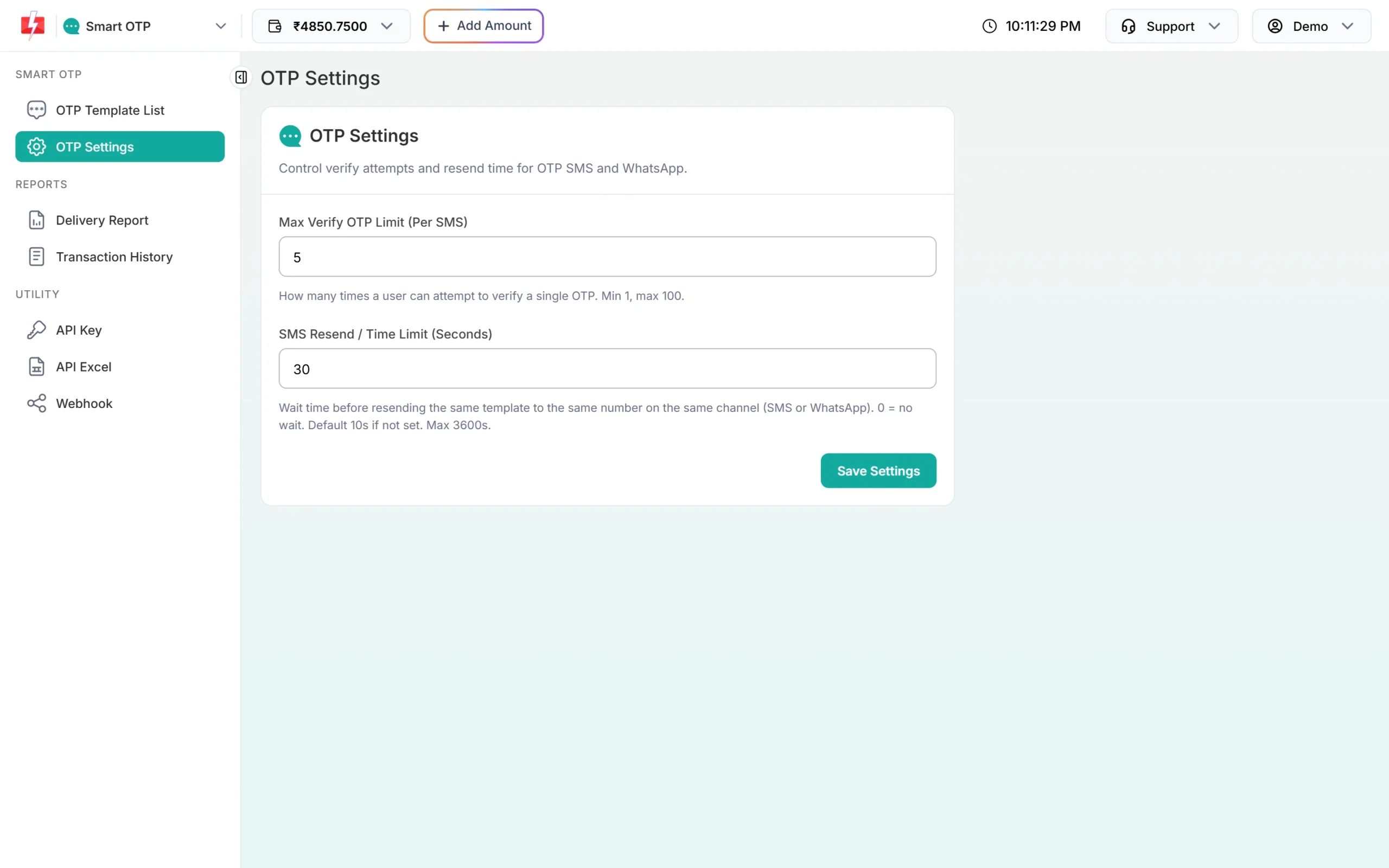
Limit wrong tries and how often a code can be resent. -
Make sure an old code cannot be reused
Smart OTP cancels older unverified codes when a new one is sent to the same number, and a code cannot be verified twice. Start a new send for each new transaction.
-
Keep the second factor separate
The OTP should not be the only thing standing between a stolen password and a payment, and the two factors should not depend on each other. Pair the OTP with a PIN, password or device check from your side.
-
Plan for delivery failures
A payment OTP that does not arrive is a lost payment. Use a priority route and keep your DLT template, header and PE-TM chain active. Smart OTP can also fall back to WhatsApp if your authentication design allows that channel.
-
Keep records
The OTP report export lists each OTP with its delivery status, verified status and time, which helps when you investigate a disputed payment.
Frequently asked questions
Has RBI banned SMS OTP?
No. SMS OTP remains a valid factor. The 2025 directions allow other factors too and require two factors for most digital payments.
When did the new RBI authentication rules start?
Payment providers had to comply by 1 April 2026. Cross-border card-not-present checks have a later date of 1 October 2026.
What is additional factor of authentication (AFA)?
A second, separate check besides the first one, such as an OTP or a biometric, used to confirm a payment.
Do these rules apply to login OTPs on my website?
They are about payment authentication by payment providers. A login OTP on your own website is not a payment check.
Which payments do not need two factors?
The directions exempt small-value contactless card payments, recurring payments under e-mandates and gift prepaid instruments.
Can I send payment OTPs on WhatsApp?
Smart OTP can send by WhatsApp with an authentication template. Whether that fits your payment flow is a decision for your compliance team.